
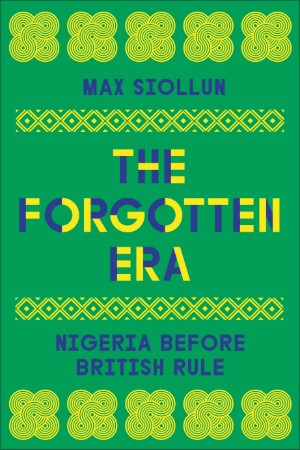
 Max Siollun, The Forgotten Era: Nigeria Before British Rule (Pluto 2025), xvi, 320pp.
This investigation of the history of pre-colonial Nigerian societies is a richly revealing account of pathways overwritten but not entirely obliterated by imperialism, finds Dominic Alexander
Although there are still far too many who seek to deny them, the crimes of British colonialism, and the horrors it perpetrated, are well known. There is a danger, however, that after these facts have been accepted, the pre-colonial societies are still left languishing in the shadow of the history written by the victors. While the impact of British colonialism, never mind the continuing imperialist regime of contemporary capitalism, should not ever be downplayed in considering the problems of contemporary post-colonial societies, equally, their own pasts deserve to be put in the picture as well.
The Forgotten Era follows Siollun’s earlier What Britain Did to Nigeria, and fills in with fascinating detail what was only glimpsed in his account of Britain’s imperial devastation of the various polities and cultures of the region. One problem with pre-colonial history in Africa is, of course, the paucity of written records. In Nigeria, Islamic culture left behind some actual histories, and Siollun also makes careful but revealing use of oral traditions, cross-checked with other available evidence to produce persuasive reconstructions of the histories of many of the states that existed in Nigeria before British colonisation.
Of course, the British were not the first Europeans to make contact with the region, the Portuguese having had sustained interactions with Benin over the course of the sixteenth century, on a basis of effective equality (p.159). This Benin was not the present-day country, but a kingdom somewhat to the west, near what is now the Nigerian coast, where the famed ‘Benin bronzes’ came from, having been looted by the British after their destruction of the city.
Sokoto and Hausaland
Far from Nigeria being a region of simple villagers practising subsistence agriculture, it was home to a complex mosaic of cities, confederations and kingdoms which have left their mark on the modern country, despite their systematic destruction in the nineteenth century.
In the north, the Sokoto Caliphate boasted highly developed Islamic scholarly traditions in an elite culture supported by sophisticated taxation systems. The British simply took these over intact after their conquest (p.36). It wasn’t just in India that imperialism depended upon pre-existing class relations to establish its exploitative rule.
The Sokoto Caliphate was a late arrival into the Nigerian scene, but had become Africa’s largest state by 1831 (p.34), not being destroyed by Britain until 1903. It replaced the many Hausa states in northern Nigeria which featured 247 walled towns by 1800 (p.5). These resembled city states dominating a surrounding countryside, but had at least loose ties with each other, based on specialisation. For example, Kano and Reno were centres for the textile industry, Gobir’s role was the defence of Hausaland against nomadic Tuareg raiding (p.5), and others focused on trade. The Hausa trading networks were deep and extensive, reaching across west Africa and the Sahara, such that goods from Turkey, Italy, even silk from France were traded for gold, ivory and other African goods.
The Hausa towns were also slave states, with Zazzau specialising in slave raiding. While it should be noted that West African slavery was some way apart from the chattel slavery practised by the European slave trade, it was still an oppressive system. It seems to have been one of the factors that drove the ‘jihad’ of a man called Usman Dan Fodio, from a Fulani family which is known to have migrated from what is now Senegal in the fifteenth century.
Dan Fodio was a Koranic scholar, as was his father, and was tutored also by an Islamic cleric who had studied in Mecca (p.16). Dan Fodio began preaching and writing around 1774 with a message of social and religious reform, and was clearly a charismatic and compelling figure. He was employed by the Sarkin (king) of Gobir as a teacher for the royal house, but his popularity was such that he was able successfully to make demands on the king for various reforms, including the abolition of non-Koranic taxation and the freeing of prisoners (p.17). Dan Fodio spent over thirty years preaching across the Hausa lands, and became seen by many as fulfilment of millenarian prophecies; social discontent clearly lay behind the scale and success of the rising or jihad which Dan Fodio called in 1804.
Siollun argues that while this jihad is usually presented by historians as primarily religious in character, social conflicts were a major part of it, particularly the conflict between Fulani and Tuareg herders and the Hausa authorities, who were, after all, also Muslim. Yet, there were also objections to the enslavement of Muslims, which meant that the Fulani/Tuareg core of the jihad gained the support of Hausa commoners, who also resented taxes and other royal impositions. While the war that created the Sokoto caliphate echoes with present-day conflicts, it was far from being simply an ethnic conflict (pp.25-6).
Sokoto was the most recent polity to emerge in pre-colonial Nigeria, but the oldest was the Kanem-Borno Empire around Lake Chad, which extended into the north-east quadrant of modern Nigeria, and first emerged around 700CE. In the late eleventh century, plausible traditions have a new dynasty hailing from Yemen taking power. The successor of the new ruler made the pilgrimage to Mecca, and Kanem established a madrassa and hostel for Kanem travellers in Cairo. Kanem also became a centre of Islamic scholarship in the seventeenth and eighteenth centuries (pp.39-40). The state eventually came into conflict with Dan Fodio’s jihad, muddying the religious dimension of that rising still further but leading to further conflicts which fatally weakened the state on the eve of British imperial expansion.
The Sokoto caliphate was also weakened in the course of the nineteenth century as its rulers after Dan Fodio tried to consolidate power, and began to create similar grievances against themselves which had motivated the jihad in the first place. There were further millenarian risings in the 1850s, which focused on the second coming of the prophet Isa (Jesus). This movement had no connection with Christianity, having emerged from a solely Islamic, if heterodox, context. Some of these ‘Isawa’ did later become early Christian converts (pp.75-6), showing again that British colonialism was not acting on any passive blank slate, but rather inserting itself into societies with their own involved dynamics. This only underlines the complexities of the damage done by colonial rule, and how it introduced new layers of strife, in this instance between Islam and Christianity.
Foundation myths
The influence of Islam went far deeper and wider than these events in the nineteenth century however, as many polities had some kind of origin legend connecting their ruling houses at one remove or another to founding princes of Middle Eastern origin. This was true of the seven Hausa states, which seem to have originated between the seventh and ninth centuries CE. The folklore looks similar to legends that may be found throughout Eurasia. The Hausa story is of a hero from Baghdad, Bayajidda, who killed a great snake. One of his sons in turn sired six sons who became the rulers of the six main Hausa states (pp.1-2). While this is folklore, an interesting aspect of it is the presence of pre-existing queens as rulers who the hero marries, which points to a wider pattern of female rulers in many polities of the region, and their replacement with patriarchal dynasties (p.3). Despite this, Siollun notes it is frequently overlooked how often women had military and political authority in pre-colonial West African societies (pp.170-1).
South-west Nigeria, and parts of neighbouring Togo and Benin also share an origin legend that connects their societies to the Middle East. These centre on the town of Ife, from where a number of kingdoms saw their origins. The story features one Oduduwa as an agent of the supreme god Olorun, but a different version of the legend makes Oduduwa a prince of Mecca instead (p.82). The two versions plausibly reflect two historical layers of tradition around the formation of Ife and its rulers, with one group displaced by the Meccan ‘Oduduwan’ royalty. Each of the kingdoms ‘descended’ from Ife had its own version of the legend, highlighting its own special status, but intriguingly, in one, Ketu, Oduduwa was a woman rather than a man.
Oduduwan states
The Oduduwan kings were hedged around with ritual requirements such as not being permitted to leave their own house. Thus ‘as late as 1903, when the Ooni of Ife travelled to Lagos to give testimony to a British colonial inquiry, the other Oduduwan kings also left their palaces as a mark of respect to, and solidarity with, the ooni, and vowed not to resume residence in their palaces until the ooni’s safe return’ (p.85). They were not, generally, autocratic rulers. Reports of the strange customs of the Oduduwan kings appear in European records as far back as the seventeenth century (p.86).
Particularly important, and militarily powerful, was the city of Oyo, or Katunga to outsiders, which amassed a sizeable territory known as the ‘Oyo Empire’, which Europeans did not reach until the nineteenth century. This emerged only after the sixteenth century when Oyo was overrun by invasion from the Nupe kingdom to the west (p.90). In fact, this region was dense with competing powers. This spurred military development, notably the trained archers and cavalry of Oyo. The competing claims for primacy over the region between Ife and Oyo led a British trader in the eighteenth century to awkwardly compare the rulers of the two states as ‘equivalent to those of our King and the Archbishop of Canterbury’ (p.92).
Of course, Oyo was a ‘middleman slave-trading state’ and this fuelled conflict with the kingdom of Dahomey in present-day Benin. Dahomey controlled the routes to the slave-trading ports on the coast, and when it expanded to take the coast itself, Oyo invaded in retaliation between 1724 and 1730, and the war resumed again in 1738 when Dahomey stopped paying the tribute agreed at the end of the first phase of the war. By 1747, Oyo had established a ‘predatory relationship’ with Dahomey (pp.96-7). Oddly, Siollun does not make much comment on how the slave trade affected the development and conflicts of these states, whereas surely their elites, and their strategies of surplus extraction, must have been strongly shaped by that context.
It is particularly interesting that Oyo had a political structure designed ‘to avoid tyranny by implementing an intricate separation of powers’, which is not quite what one might expect from a militarised society where the elite’s wealth is dependent upon the proceeds of the slave trade, and where slaves were also clearly kept in abundance in the royal household, at least. Perhaps the elite families of the Oyo perceived the dangers of such an economy early enough to take conscious steps to prevent tyranny from developing. This would parallel how ancient Greek cities developed intricate constitutions (often lauded as the inspiration for and even foundations of ‘Western’ political systems) for the same purposes.
Regardless, in Oyo, as so often in history, this didn’t work in the long term, and the kingdom became riven by internal conflicts as provincial officials jockeyed for power in the late eighteenth century. This also opened the way for a major slave rebellion, which itself generated a self-sustaining army called the Jamaa (‘association’), which from ‘1817 and continuing for the next decade … raided and devastated Oyo’s countryside’ pillaging ‘the homes of former masters’, and even selling captives into slavery themselves (p.113). The Oyo kingdom had all but imploded by the time Europeans first visited it in 1830.
Benin and Igboland
To the south and east of Oyo lay the famous kingdom of Benin, parts of whose city date back to the eleventh century (p.148). Benin had extensive contact with the Portuguese from the sixteenth century, but resisted their intensive efforts to convert it to Christianity. Siollun explores the intriguing origins of the Benin bronzes in the major events of Benin’s history (pp.156-8 and Chapter 9). However, Siollun sees Benin’s early contact with Europeans as something of a missed opportunity: ‘Since Benin had leverage [over Portuguese traders], its leaders could have made stronger demands for Portuguese engineers, navigators, ships, teachers and weapons … Benin’s military encounter with Britain in 1897 may have unfolded differently in an alternative chain of events’ where the latter might have faced a more militarily equal opponent’ (p.159).
In contrast to the stable kingdom of Benin, somewhat further to the east lay the Igbo societies, although they did not group themselves under that name until the nineteenth and twentieth centuries. Their history is less open to reconstruction than many of the other polities Siollun discusses, at least in part because, with some notable exceptions, ‘the Igbo knows no king’ as a saying has it; south-east Nigerian society was characterised by ‘decentralised social organisation’, which involved democratic village councils (p.164).
This does not mean Igbo societies were merely undeveloped villages. Igbo peoples seem to have specialised as itinerant artisans serving wide swathes of the region, into present-day Cameroon, as well as west to Benin, and elsewhere (p.175). In the town of Igbo-Ukwu, highly skilled bronze sculptures have been unearthed, of an entirely different kind from the Benin bronzes. This industry is dated to the ninth century, and, moreover, from various objects also found there, was connected to trading routes that reached to both India and Italy (p.178). Igbo societies did not form powerful monarchies or predatory class hierarchies, but they had their own complexities, and were by no means isolated from the rest of the world. It is also worth noting that the author of one of the most famous anti-slavery books of eighteenth-century England, Olaudah Equiano, was from here. It was also precisely because of Igbo societies’ relative lack of hierarchical social and political traditions that British methods of imposing colonial rule which worked in other parts of Nigeria were ‘an utter disaster in south-east Nigeria’ (p.193).
This is a book that is rich in fascinating detail all of which deserves more discussion than can be given here, and it is a work of impressive and even ingenious scholarship bringing together altogether disparate kinds of sources to reconstruct neglected and slighted histories that add not only to the understanding of Nigeria, but to the general understanding of the various pathways through which societies develop. All this also creates many possible reflections on Nigeria’s present problems, but Siollun emphasises that the region’s polities were always multi-ethnic and multi-lingual, and so a simple conclusion that ethnic and religious multiplicity is the root of present conflicts is not borne out (p.292). He suggests replacing the centralised nation state with a confederal structure as a step forward (pp.293-4).
Siollun’s aim in this book is not to provide a straightforward denunciation of the damage done by imperialism and the slave trade, which is essentially taken as given, but to treat pre-colonial history as still a living reality, overlain but not obliterated by the colonial period. Nonetheless, it is clear that the slave trade so severely destabilised Nigerian societies that they became easy prey for British imperialism when it moved in at the end of the nineteenth century, and that the trajectory of this history might have been very much different otherwise.
Before you go
The ongoing genocide in Gaza, Starmer’s austerity and the danger of a resurgent far right demonstrate the urgent need for socialist organisation and ideas. Counterfire has been central to the Palestine revolt and we are committed to building mass, united movements of resistance. Become a member today and join the fightback.

Dominic Alexander
Dominic Alexander is a member of Counterfire, for which he is the book review editor. He is a longstanding activist in north London. He is a historian whose work includes the book Saints and Animals in the Middle Ages (2008), a social history of medieval wonder tales, and articles on London’s first revolutionary, William Longbeard, and the revolt of 1196, in Viator 48:3 (2017), and Science and Society 84:3 (July 2020). He is also the author of the Counterfire books, The Limits of Keynesianism (2018) and Trotsky in the Bronze Age (2020).