
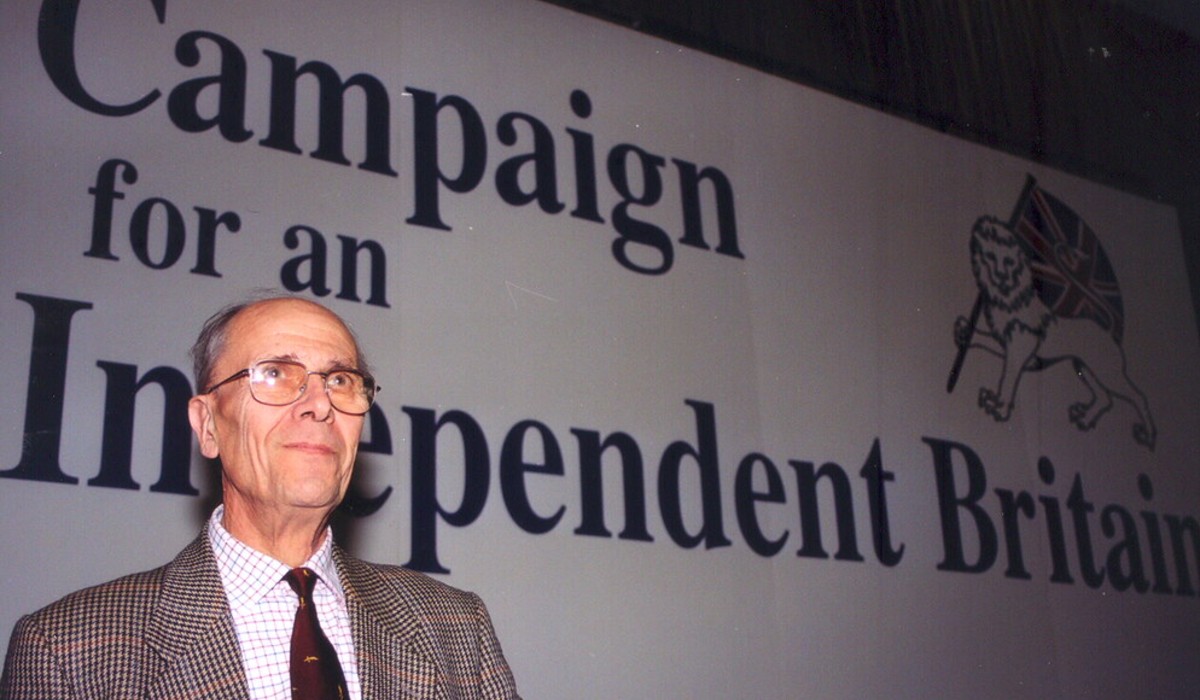
 Norman Tebbit & CIB backdrop / Flickr / Photo: Derek Bennett
The death of Norman Tebbit is an opportunity to remember the Thatcher governments in which he served, and the disastrous legacy they left, argues John Westmoreland
On the morning of 12 October 1984, an IRA bomb ripped through the Grand Hotel in Brighton where the Tory conference was being held. Norman Tebbit was filmed being stretchered out of the rubble in his pyjamas. The BBC’s solemn tones expressed the national mood, but, strange to say, not everyone was sad.
In South Elmsall, a Yorkshire mining village, when footage of the bombing was shown in the miners’ club, striking miners from Frickley pit punched the air to chants of ‘IRA! IRA!’ The discussion then turned to criticism of the bombers – the useless bastards missed Thatcher!
Thatcher’s enforcer
Thatcher was the beneficiary of the most right-wing Labour government since 1945. James Callaghan’s government had begun the erosion of the post-war consensus of so-called welfare-capitalism. He danced to the tune of the International Monetary Fund (IMF) which objected to lending money to a country with a ‘bloated public sector’. Thatcher picked up the IMF’s call by committing her government to the privatisation of nationalised industries and public services, alongside smashing the trade unions.
Tebbit was useful to Thatcher. He had working-class roots, had gone straight from grammar school to a job at the Financial Times and from there to national service in the RAF where he became a pilot.
At the FT, he had developed an anti-trade union bitterness because he didn’t like the constraints placed on his ambitions by the closed shop run by the trade union he was forced to join, Natsopa. In the RAF, he came into contact with the snobbish pride that the officers took in their elite service, and readily absorbed their politics.
Tebbit got nominated as a Tory candidate after some toadying to the Tory grandee, Cecil Parkinson. The vehemence of his right-wing views got him noticed, but after being elected, he had to remember his place.
Once Thatcher became the leader of the party, Tebbit’s working-class origins became an advantage. The grocer’s daughter welcomed a man from humble origins, whose devotion to her and her populist shtick would counterbalance the dominance of grandees over the party.
The grandees espoused paternalism rather than all-out class war. They were to be labelled ‘wets’ as Thatcherism gathered steam and their bleating needed to be shut down. Tebbit was ever ready to throw his weight behind her.
The neoliberal era that Thatcher personified proved to be a perfect stage for Tebbit to perform on. His waspish wit and willingness to cause offence, alongside his determination to destroy trade unionism and the Labour Party, took him into Thatcher’s inner circle.
Tebbit’s hatred of trade unionism found expression in Thatcher’s crusade to ‘end the tyranny of the closed shop’. The 1982 Employment Act was aimed at making the trade-union leaders police their members and stop strikes; Tebbit was Secretary of State for Employment at the time.
None of the fawning obituaries to Tebbit in the media seem to have drawn out what this meant for working people. Unemployment peaked at over three million, and there were reports that 6,000 people a day were losing their jobs.
Thatcher described the initial deindustrialisation of Britain as a kind of necessary, life-saving surgery. The demonstrations and riots that followed gave rise to Tebbit’s quip about his father facing unemployment in the 1930s: ‘He didn’t riot. He got on his bike and looked for work’.
This, as much as anything, is a measure of Tebbit’s indifference to the plight of the unemployed, as well as his crass stupidity in thinking that systemic unemployment could be overcome by cycling. This didn’t stop the Tory media heaping praise on him for being a straight-talking realist, whose pugnacious style was celebrated by his tabloid moniker ‘the Chingford skinhead’, or Maggie’s enforcer.
Racist bonehead
Boris Johnson is one of many Tories talking up Tebbit’s legacy. He called Tebbit ‘a hero of modern Conservatism’, and ‘today more than ever we need to restore the values of Norman Tebbit to our politics.’ Tebbit probably had more in common with Lee Anderson than he had with Johnson, but it would be a close call.
He admitted openly that he was a sexist. He was the original anti-woke bigot who once quipped, ‘Racist? I haven’t got a racist bone in my little finger.’
Tebbit’s ‘cricket test’ was a shamelessly overt encouragement to racism. He tried to provide the man in the street with a simple means to goad people from Asian and African heritage by asking who they would cheer for in a test match.
His insistence was that if they were loyal to their adopted country they would cheer for England rather than their country of origin, but this only applied to people with brown or black skins. Scots, Welsh, the Irish, Australians or any other white-skinned minority in England could cheer for whom they wanted.
This is the despicable racism that Johnson and the right-wing want to, not just excuse, but glamorise.
Good riddance
Father Time has taken care of what the IRA failed to do and brought an end to another Thatcher diehard who never had any regrets for the damage done.
The food banks, unemployment and inequality we see today have got Thatcher’s fingerprints all over it, and Tebbit was by her side to the end.
Those Frickley miners had a point.
Before you go
The ongoing genocide in Gaza, Starmer’s austerity and the danger of a resurgent far right demonstrate the urgent need for socialist organisation and ideas. Counterfire has been central to the Palestine revolt and we are committed to building mass, united movements of resistance. Become a member today and join the fightback.

John Westmoreland
John is a history teacher and UCU rep. He is an active member of the People's Assembly and writes regularly for Counterfire.