
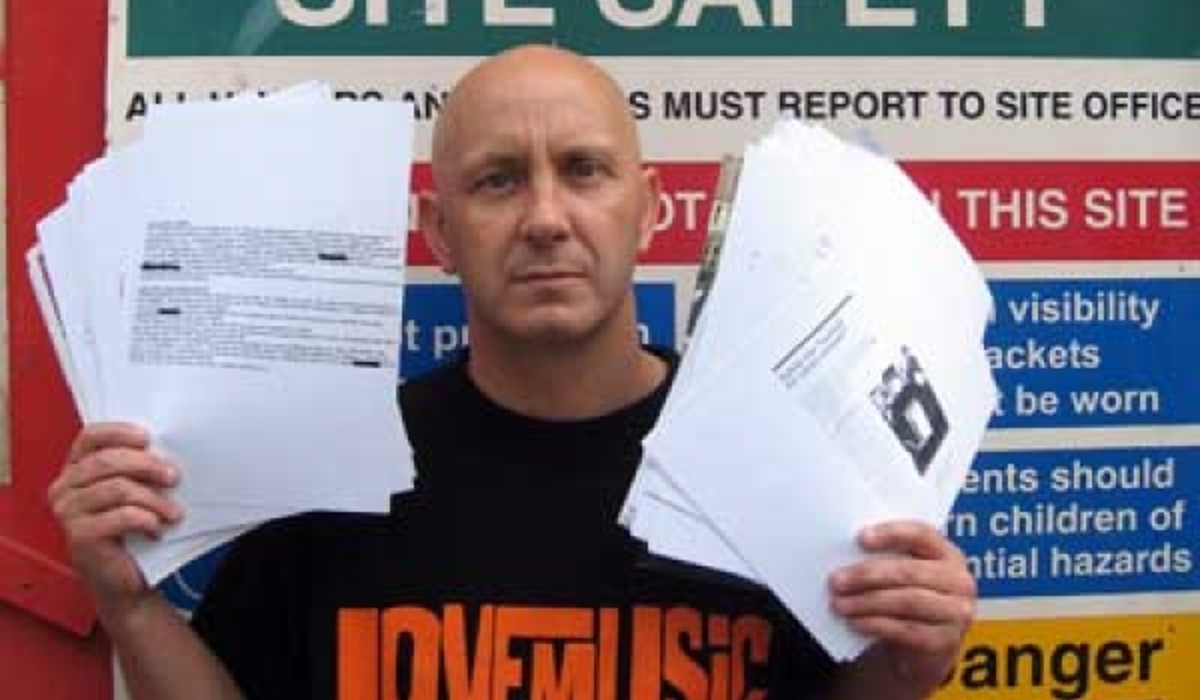
 Blacklisted trade unionist Dave Smith holding reports. Photo: Campaign Opposing Police Surveillance
James Simpson tells us a tale of two Daves who won’t be giving evidence at the Spycops Inquiry, for very different reasons
The Undercover Policing Inquiry resumes for its third tranche on Monday October 13th, 2025. True to form, the storied history of protecting the Metropolitan Police Service (MPS) and sidelining the victims of its subversive operations has re-emerged last week. Undercover officer, alias Dave Hagan, and blacklisted trade unionist, Dave Smith, will now not be called to give hearing evidence as expected.
The Undercover Policing Inquiry was called in 2015 by Teresa May to investigate the Spycops scandal. Officers from Special Branch, under the guise of public order policing, infiltrated organisations, almost entirely left-wing groups, from 1968 to at least the early 2010s, when the scandal erupted. Officers from the units under investigation at the Inquiry- the Special Demonstration Squad (SDS) and the National Public Order Intelligence Unit (NPOIU) – deceived activists into sexual relationships, reported to the security services and corporate blacklists, and subverted campaigns to end apartheid, fight fascism, prevent war and protect the planet from the corrosive practices of capital.
The Inquiry followed intense public pressure after the whistleblower and former SDS undercover officer, Peter Francis, claimed that he had been tasked with infiltrating the justice campaign of murdered teenager, Stephen Lawrence, with the intention of finding something that would smear the family.
Dodgy Dave
‘Dave Hagan’ was an undercover officer in the SDS between 1996 and 2001/2. His real name is being protected by a swathe of anonymity orders that protect the identities of officers that infiltrated campaign groups, ostensibly to protect them from the repercussions of their actions in the field. However no ill fate, other than social and professional embarrassment, has ever befallen any officer whose identity is known. (Known largely because of the hard work of activists whose lives they spied on). The MPS, as expected, has been non-cooperative and opaque with its secret units’ malfeasances throughout the process.
Hagan’s deployment, given the low bar of morality set by SDS officers, was unremarkable. He infiltrated the Stephen Lawrence campaign, other black justice groups, the Socialist Workers Party, Movement Against the Monarchy, and Class War over a five-year period, ending in the early years of the new Millenium. He has not been found to have deceived anyone into a sexual relationship. However, a secret August 1998 meeting at New Scotland Yard thrust Hagan’s deployment into the public gaze.
From Inquiry to Review to Inquiry to Sick Note for Dodgy Dave
The 2014 Stephen Lawrence Independent Review, known as the Ellison Review, disclosed that on the 14th August 1998, Hagan had met in secret with Bob Lambert, his handler and former SDS officer, and Detective Inspector Richard Walton. At that time, Walton was part of a team assisting the Metropolitan Police Commissioner, Paul Condon, with his submissions to the Macpherson Inquiry.
This was the first inquiry into the murder of Stephen Lawrence and would find the MPS to be institutionally racist and to have bungled the investigation. It stopped short of revealing the intense corruption prevalent throughout the investigation. Nor did the later and much lauded Macpherson Inquiry ever reveal that the family were being spied on by the MPS. Nor that one of those spies, Hagan, was meeting with somebody directly contributing to the evidential basis of its conclusions.
Baroness Doreen Lawrence, Stephen’s mum, has been given a date in November to give her own evidence. Core participants Neville Lawrence and Stephen’s best friend and eyewitness, Duwayne Brooks are sure to follow in 2026.
But chair of the Inquiry John Mitting, released a statement announcing Hagan would not have to appear. This is because he ‘suffers from complex post traumatic stress disorder, first diagnosed as post traumatic disorder in 2001’. (Incidentally 2001 coincides with the year that Hagan’s deployment in the field as an SDS officer was coming to an end.)
Family, friends and justice campaign activists, however, will give evidence. They are compelled by their desire for justice for Stephen and for the hope that these practices are ended. And in doing so they put their own mental health at risk, many for the umpteenth time. The state has sought fit to close ranks and use mental health as an excuse for a crucial police witness to be excused from shedding light on this episode. Light that could make clearer a core tenet of what the SDS became – a unit highly willing and capable of obfuscating the corruption, classism, incompetence and institutionalised racism that has characterized the MPS for decades.
Dave Number 2 the blacklisted union man
Dave Smith was a branch secretary for the Union of Construction, Allied Trades and Technicians (UCATT) in Dagenham. He regularly raised members concerns over health and safety on larger construction projects. For this he found himself on the blacklist of The Consulting Association (TCA).
TCA was founded in 1993 and ran a blacklist of people trained in the construction industry that meant active union members, particularly health and safety reps, and political activists, could not find work on large projects, such as Crossrail (now the Elizabeth line) and the Olympic Park.
Large firms like McAlpine, Balfour Beatty and Carillion paid subscriptions to the TCA and would use it to find out about prospective employees. Those on the list often found themselves sidelined from their profession for years on end, with sometimes disastrous consequences.
Dave Smith, who now has a PhD from University of West of England on the subject, and who co-authored the seminal book ‘Blacklisted: The Secret War Between Big Business and Union Activists’ with Phil Chamberlain, is not a peripheral figure in the Spycops scandal. Through his work we have found out about SDS officers, contributing to the blacklist files of TCA, such as Mark Cassidy, who is giving evidence in December, and Carlo Soracchi, who should appear in 2026. Both these men had deceived women into long term sexual relationships. Both regularly reported on and were present at trade union meetings and actions. Both befriended blacklisted workers.
Smith’s work on the Blacklists of the TCA, forming of the Blacklist Support Group and personal experience, is integral to an understanding of the mechanisms of this important part of the scandal. In Donna McLean’s book Small Town Girl, she recounts how Smith was part of the group that told her that Soracchi, then Carlo Neri, her long-term partner, had been an undercover police officer. She also says that Smith was an important part of the support network that helped her deal with the aftermath and comprehend the gravity and nuance of what had been done to her by the state.
The Blacklists are a vital part of the Spycops story not an irrelevance
The fact that police officers contributed to the Blacklists of the TCA and its predecessor, The Economic League, is a huge part of the problems that are revealed by the Spycops Scandal. By limiting activists and trade unionists from taking roles in society through their professions (the scope of The Economic League was wider and went far beyond one industry), directly limits the amount society can change, and creates a falsely inflated power dynamic between employee and employers, owners and workers.
In his interim report into the first tranche of evidence hearings, chair of the Inquiry, Mitting, omitted any reference to vetting or blacklisting. The second tranche failed to hear evidence from core participant, the National Union of Mineworkers (NUM). The Undercover Policing Inquiry seems allergic to gathering testimony from Blacklisted trade unionists.
Dave Smith has launched a legal challenge to Mitting’s ruling at the High Court. He describes the ruling as ‘unreasonable’ and ‘irrational’, and that it ‘makes the Inquiry look like an establishment cover-up’. It is nigh on impossible not to agree. Smith, like many of the core participants, is not a man that will take this ruling quietly without fighting back. In doing so, column articles and social media are once again lit up with discussion of the undercover police units’ roles in blacklisting and vetting practices of large corporations and institutions. The trade union movement was inevitably weakened by undercover policing, to the detriment of society at large. But also, it is crucial for the integrity of the Inquiry itself, that activist researchers and core participants, like Smith or those of The Undercover Research Group like Donal O’Driscoll, are called to give hearing evidence. Their testimony is vital to join the dots, and to provide context and a narrative to much of the tale that will otherwise come only from the SDS and NPOIU officers and managers accounts. Maybe that is the point.
Making the best of a bad hand
The tale of the two Daves underlines the flaws of the Undercover Policing Inquiry. It is overzealous in the extreme in protecting the officers and their secrets and controlling the narrative of what events the hearing looks at. The second tranche of the Inquiry, as well as not hearing evidence from the NUM, went through the whole nine months of gathering testimony with barely a mention of the role the SDS had in infiltrating the huge and significant anti-Poll Tax movement. Rumblings from the Inquiry seem to suggest that it will seek to do the same with anti-war movement against the invasion of Iraq in 2003. These things can be expected and are to be confronted by any available means.
However, the Undercover Policing Inquiry is still vital. In an era where much time is spent reacting to the arbitrary enforcement of rules and arrests, the inquiry does offer a rare moment where the forces of the activist left are able to push back and confront the contrived law and order narrative that justifies a rapidly increasing political police force. The Undercover Policing Inquiry is due, on the current timetable, to become the longest public inquiry in British history, overtaking the Bloody Sunday inquiry. Over the last few weeks Soldier F, has appeared in court charged with murder of two of these civilians and the attempted murder of five more. This is not real justice, but was not expected a few years ago.
The revelations that come out of the Undercover Policing Inquiry contribute to further understanding of the relationship the police has with the left, and are an opportunity, to push back against their narratives. This is an opportunity that still needs to be fought for as the state attempts to control using every legal trick and sleight of eye they think they can get away with.
Before you go
The ongoing genocide in Gaza, Starmer’s austerity and the danger of a resurgent far right demonstrate the urgent need for socialist organisation and ideas. Counterfire has been central to the Palestine revolt and we are committed to building mass, united movements of resistance. Become a member today and join the fightback.
