
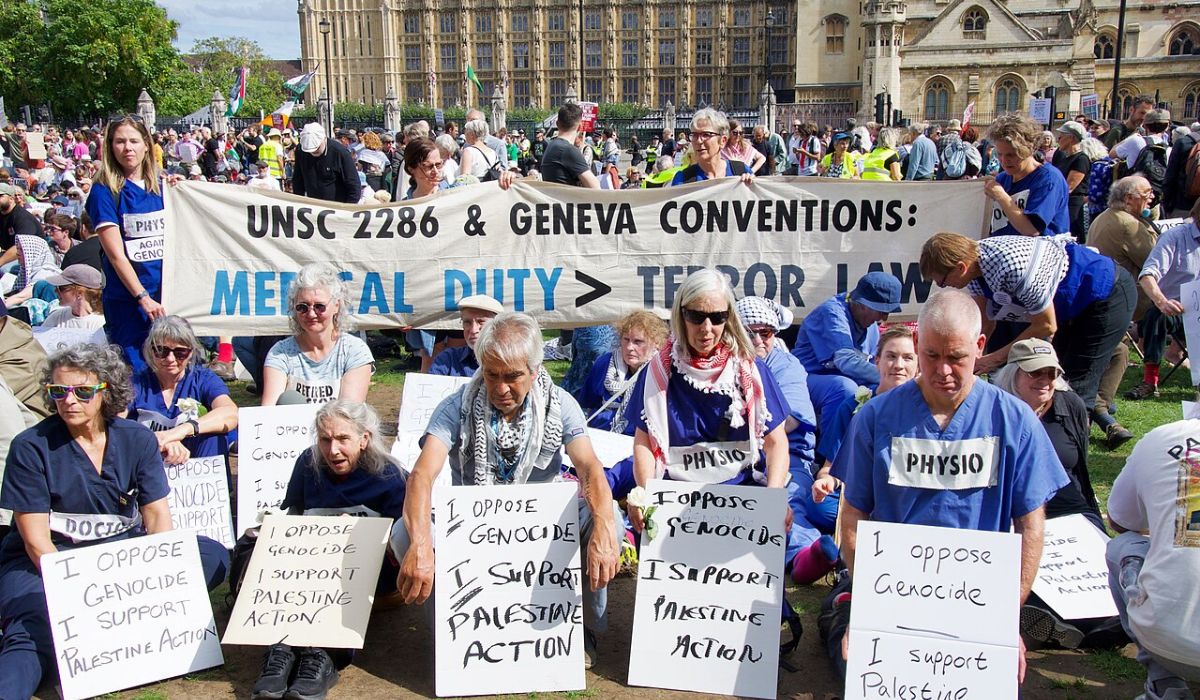
 Palestine Action Protest in London on the 6th of September. Source: indigonolan - Flickr - Wikicommon / cropped from original / CC BY 4.0
Democratic rights are under threat in the EU, the UK, the US and elsewhere, as the rule of law is eroded in many countries, but defending these rights is a priority, argues John Clarke
A report issued by the Civil Liberties Union for Europe (Liberties), has found that: ‘Concerted dismantling and cumulative decline sum up the state of the rule of law across large parts of the EU and increasingly within the European Institutions themselves’ (p.6). These findings clearly indicate a major threat to democratic rights, especially those of expression and assembly, that must be challenged. However, for working-class movements and socialists, the concept of the rule of law is highly contradictory and cannot be taken at face value.
The Guardian notes that governments in five EU member states are “consistently and intentionally” eroding the rule of law, Europe’s leading civil liberties group has warned, while democratic standards are deteriorating in six more, including historically strong democracies.’
The report views ‘the governments of Bulgaria, Croatia, Hungary, Italy and Slovakia as “dismantlers” that were actively weakening the rule of law.’ Moreover, ‘Liberties identified Belgium, Denmark, France, Germany and Sweden, all countries with strong democratic traditions, as “sliders”: places where the rule of law is declining in some areas.’ It points to ‘not only backsliding, but also ongoing and deliberate efforts to undermine the rule of law.’
This is the seventh year in a row that Liberties has produced a report of this kind. It looks at the track record of governments and institutions with regard to ‘justice, anti-corruption, media freedom and civil society checks and balances.’ This year, it finds that EU institutions themselves are culpable and ‘had not only “mirrored many of the issues seen in member states”, but had also failed to consistently apply and defend fundamental rights.’
The report points to disturbing efforts to stifle dissent and the right to protest. It finds that: ‘Regressive legislation and strong penalties for attending banned protests were increasing’ with Pride events banned in Hungary, while in Italy, ‘a highly restrictive security decree was adopted criminalising road blockades and other forms of dissent but strengthening guarantees for police.’ At the same time, in ‘several member states, climate and pro-Palestine protesters faced bans and criminalisation.’
Rising authoritarianism
The assault on democratic freedoms is by no means confined to the EU countries. Writing in Al Jazeera shortly before guilty verdicts were reached against Chris Nineham and Ben Jamal, Feyzi Ismail took stock of the dangerous nature of the charges they faced. Not only did the police curtail the right to protest by preventing a pro-Palestinian protest, held in January of 2025, from marching as intended but they did so because of pressure from supporters of Israel. In this situation, the two men were arrested on the basis of bogus claims that they had breached the Public Order Act when, in fact, they had sought to avoid a confrontation with the police.
Ismail makes clear that the prosecution of Nineham and Jamal ‘should be seen within the context of growing efforts by successive British governments to limit the rights to freedom of expression and assembly.’ These efforts she charts in chilling detail, making clear that the present Labour government is seeking to ‘restrict protests based on frequency, not behaviour, and make protests more conditional and subject to police discretion.’
Following last December’s murderous Bondi Beach attack, there has also been a state-orchestrated attack on the Palestine solidarity movement in Australia. In the state of Queensland, it is now illegal to chant ‘from the river to the sea, Palestine shall be free’ and ‘globalise the Intifada,’ with a penalty of up to two years imprisonment. As reported by Al Jazeera, there have been substantial restrictions on the right to protest and a dangerous escalation in police repression. This included brutal attacks on those protesting the visit of Israeli President Isaac Herzog.
The state of Victoria has bolstered ‘police powers targeting Muslim communities and pro-Palestinian protests’ so that police ‘in the state are now able to declare “designated areas” where they have increased powers of dealing with members of the public, including the power to stop and search at will.’
In the US, Trump has launched an all-out assault on the right to protest and the ability to express dissent. He demonises and criminalises protest activity as the work of a supposed ‘enemy within’ in ways that pose a threat to basic democratic freedoms. Human Rights Watch notes that: ‘Beyond using brute force to suppress protests directly, Trump has gone after the infrastructure of civil society that has been defending human rights. Groups working to protect immigrants’ rights, racial justice, reproductive rights, and civil liberties have been subjected to public vilification, threatened with the revocation of their tax status, and, in the case of Palestinian rights groups, hit with sanctions.’
So extreme and clear-cut has Trump’s attack on democratic rights been that it may be concluded that his approach constitutes a decisive strategic shift. We can see this if we consider the strange concept of ‘ordered liberty’ that the hard-right leader of the Canadian Conservatives, Pierre Poilievre, has advanced.
As the Tyee explained in 2024, the idea at work here is to create ‘a synthesis between liberal ideals of individual autonomy and freedom and traditional understandings of social norms and values.’ What these points point to is a very restricted form of democratic rights in which their enjoyment is tolerated only within very definite boundaries. Thus, condemnation of Israel or interference with the profit-making of fossil-fuel companies would go against ‘social norms and values’ and protests with such objectives would be restricted or curtailed.
Intensified threat
In the case of the Trump administration, however, it is highly questionable if the goal is any longer to merely restrict the liberties associated with bourgeois democracy. Trump has looked to free himself from legislative and judicial oversight to the greatest degree possible. His key assistant Stephen Miller has sounded forth on the ‘plenary authority’ the president supposedly enjoys. The Guardian has suggested that this term can be considered a ‘subtext for the broader ambitions of the Trump administration to assert legally unassailable power over the use of the military and other functions of government.’
Trump’s efforts to crush dissent, going over to his readiness to treat even mainstream liberal political opponents as a seditious threat, seem to be coming to a head with his efforts to undermine this year’s midterm elections.
As the cutting edge of an international political trend that has become increasingly impatient with the restrictions imposed by bourgeois democracy, Trump seems ready to embrace far more directly authoritarian solutions than had previously been the case. An article that appeared in Salon last October quoted a ‘White House insider’ as stating that: ‘One party rule, [Trump] and Stephen Miller believe they can make it happen.’
From the standpoint of working-class interests, as I have suggested, the rule of law is something of a double-edged sword. In the face of the arbitrary dictates of Donald Trump, legally codified democratic rights should certainly be defended. These rights, moreover, were won in struggle and can only be defended in the same way.
We must also understand, however, that the rule of law is fundamentally devoted to defending capitalist property and the exploitative social relations that distinguish this social and economic system. It is the rule of their law and not ours, and we defend the rights it grudgingly affords us so that we may all the more effectively challenge that system.
The findings of the Liberties report with regard to EU countries are in line with a broader assault on democratic freedoms. As Trump’s war of choice against Iran produces ever greater levels of political and economic instability, we may expect the threat to the rights of expression and assembly to face an intensified threat that we must resist and defeat.
Before you go
The ongoing genocide in Gaza, Starmer’s austerity and the danger of a resurgent far right demonstrate the urgent need for socialist organisation and ideas. Counterfire has been central to the Palestine revolt and we are committed to building mass, united movements of resistance. Become a member today and join the fightback.

John Clarke
John Clarke became an organiser with the Ontario Coalition Against Poverty when it was formed in 1990 and has been involved in mobilising poor communities under attack ever since.