
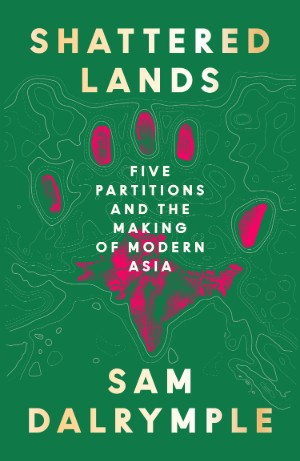
 Sam Dalrymple, Shattered Lands: Five Partitions and the Making of Modern Asia (William Collins 2025), 528pp.
This fascinating history of the end of the British Empire in the sub-continent reveals unfamiliar imperial horrors and alternative paths not taken, finds Kevin Crane
It is oftentimes easy to forget that most of the world’s countries are not actually terribly old. The existence of, say, the Republic of Slovakia is such a plain and unremarkable fact that it becomes slightly disorientating to consider that it is technically younger than the internet. States are monumental institutions in day-to-day life, and they have to make people feel that way in order to maintain their all-important legitimacy. States that fail are, outside of explicitly revolutionary circumstances, seldom a pretty sight.
To hold at bay various powerful political, economic and social forces that their prevailing elites fear, most states expend a non-trivial quantity of time and resources to back-project their existence into history, to make it feel as though they have always existed on some latent, deep, even spiritual level. This is so that, even if their foundation date is firmly in living memory, that fact can be handwaved as merely the realisation of a national project that possesses timeless legitimacy. This works most of the time, but when it fails, it will often do so spectacularly, and commonly with very heavy cost.
There are many reasons why people might wish to pick up Sam Dalrymple’s Shattered Lands, but I feel that one of the best ones is just what a powerful study of nations and nationalism it is. The book combines wide-view historical narratives with very real, sometimes horribly real, human stories involved the decolonisation of Britain’s Indian Empire, which represented some of the most disruptive unmaking and remaking of nation-states in recent history.
Dozens of lost civilisations
The first challenge the author sets for himself in this book is explaining to you just what the word ‘India’ meant a century ago, because it is most likely not what comes to your mind. The Indian subcontinent is pretty large and densely populated today, but Britain’s Indian ‘Raj’ was actually far larger and included territories no longer associated with the subcontinent in present-day thinking. To the north and east, beyond the area where India and Bangladesh’s borders now snarl together, Burma, Bhutan and Nepal were once components of the empire. Most surprisingly, though, is that the western reaches of the Raj were not even on the same coast of the Indian Ocean.
Some of the book’s most fascinating chapters are those that focus on Indian Arabia, which is a whole field of both history and geography that has been somehow expunged from memory. What we know today as the Gulf states, Oman and the majority of what is today Yemen were all politically and economically attached to the Raj, and profoundly so. Dalrymple’s writing really gets to shine as he takes us to this forgotten land and culture; whose politics, economy and society existed in a sort of liminal space. They were both caught between the Mediterranean and the subcontinent, and between ancient kingdoms and modern imperialism.
Britain had used military might to incorporate Southern Arabia into the Raj because the vital strategic position it has always had for Indian Ocean trade, but it would be completely wrong to imagine that ties between Arabia and India were a complete British imposition. Far from it: there were deep connections between the two regions, creating a fascinating web of split loyalties and shared customs and polities. Prominent rulers like the Nizam of Hyderabad had subjects in both landmasses. Arabian loyalty to the Nizam was so strong that there were still soldiers parading in Hyderabadi colours after his royal seat had been snatched away by Indian nationalism.
Although the Arabian parts of the Raj have forcibly jettisoned their centuries-old affiliation to India, there is an extent to which these aggressively ahistorical regimes do preserve an absolutely key feature of the Raj: countries like Kuwait, the UAE and Qatar are a remnant of what the British called the ‘princely states’, which are another feature of colonised India that the world has mostly forgotten.
The Indian Empire was never, from a legal standpoint, one country under British Rule. The British had, since the defeat of the rebels in the First War of Indian Independence (or ‘Indian Mutiny’ as the colonisers called it) of 1857, imposed direct rule on many parts of the huge territory. Where, however, there was a traditional feudal leader who was willing to join their counterrevolution, these aristocrats were incorporated into imperial rule. The result was that the Raj was harbouring a wild diversity of pre-modern states, under imperial yoke but legally autonomous and ruled over by dynasties that belonged to a past age.
No two of these strange entities were exactly alike: the rulers were referred to as ‘princes’ as a catch-all term, but there was no guarantee that the authority of a Nizam was the same as that of Raja, or Nawab the same as a Sheik. Many of the ‘princes’ additionally had feudal allegiances over one another, as well as to the British state, creating a web of overlapping legal and political systems of which no one really had a complete picture. Decolonising such a tangled structure was never going to be an easy task, but the ancient divisions emerging from feudal remnants would be as nothing next to the divisions emerging from thoroughly modern forces.
Nationalism finds innovative ways to fail, and imperialism helps it to
Britain’s control over India was politically and ideologically prestigious, but it was economically out of sorts with the way that capitalism was progressing in the twentieth century. A really strong sign of how much things had changed came in 1929, when the Wall Street Crash had reverberations that reached all the way across the world and had a major impact on India and British interests inside of it. The Empire was starting to look and feel it’s age, and resistance to imperialism was becoming more organised and more confident. Some of that resistance was socialist in nature – a large labour movement and a major Communist Party appeared in the Raj – but this book is not about the left in the subcontinent. Dalrymple is telling the tale of the long, complex and highly controversial history of bourgeois nationalism in India.
The Indian National Congress (usually just ‘Congress’ for short), began life as a thoroughly elite organisation. It was almost as much a social network for India’s growing modernised bourgeoisie, as it was an instrument to agitate for greater political rights from London. Mohandas Gandhi began the organisation’s historic shift. He was absolutely a man of the upper middle classes, but he converted Congress into a genuine mass political party that Indian workers and peasants could join through his innovative use of participatory protest and demonstration tactics. He also, however, began to draw religion into politics by relying on Hindu tradition and practice to explain his cause to the people. This combined with a series of personal differences caused another senior congress leader, Muhammad Ali Jinnah, to break away and form a rival party: the Muslim League.
The British did not consistently foster the Congress versus Muslim League divide: they liked playing the two sides off against each other, but lacked a vision for how to prevent the conflict between the two camps jeopardising their own interests. They were very clear that any Islamic ‘Pakistan’ that would be created would not be getting hold of any Arabian territory, despite the obvious religious affinity. This undermined the project. The British also fostered other divisions of which the most important, but also most widely forgotten, concerns Burma.
We really don’t think of Burma as being Indian today. any more than we do Yemen. Up to the 1930s, however, it was very integrated into the Raj. Although indigenous Burmese people were majority Buddhist, a long period of mutual colonialism had resulted in significant ‘Indian’ communities living across the territory, many of whom were soon to suffer greatly from suddenly becoming foreign nationals.
The splitting away of Burma from India was a process that started early, and Dalrymple’s view is very much that this was more an imposition on the Burmese from outside by both the Empire seeking to limit the economic power of decolonised countries, and by Hindu nationalism seeking to rid itself of countries it did not see as part of the ancient and eternal nation of ‘Bharat’. Thus began a very strange process of state construction that was about as unsmooth at it would be possible to be. Burma was really only half-born when it was baptised in the fires of World War Two, and the sorrows of today’s utterly dysfunctional and war-torn Myanmar can be absolutely traced back to its chaotic creation. This is another history most of us just don’t know, and I even found myself feeling a bit guilty that I had never had the curiosity to find it out before.
After the war, of course, is when the partition we all do remember comes: the Indian/Pakistan split. Even though we are more familiar with this, the specifics still have plenty of scope to be surprising. The British had had some difficult working out where the India/Burma border was and ended running it straight through the territory of the Naga people (one of the few significant Protestant Christian peoples in South Asia, just to add to the confusion).
Even so, the task of working out where, exactly, Pakistan actually should be was a huge headache. Muslim Leaguers had devised the idea of a state of Pakistan mere decades before decolonisation was bearing down on them. They did not even have consensus amongst themselves as to which territories were meant to be in it, much less had they agreed any such territories with Congress or anyone else. The writing in these chapters becomes tense as partition draws near, conveying the rising anxieties of all parties in the run up to independence.
The horrors of communalism
The author does a great job of demonstrating how the personal, often very arbitrary choices of elites at the top of the political system caused them to blunder into partition without really thinking through what else they might have done. He also balances this well with the stories of middle- and working-class people experiencing those unevaluated consequences. These stories are frequently a hard read, but also a very important one.
There was an alternative to unleashing the full forces of nationalism on South Asia, and the most famous visual expression of that alternative is referenced here in the book: it is the instance of striking Indian sailors celebrating their act of resistance against the British by raising the flags of Congress, the Muslim League and the Indian Communist Party from same mast of their ship. Socialist resistance to the Empire could have knocked the bourgeoise party leaderships aside and united workers and peasants to build a new decolonised society together across identitarian lines. Those party leaderships, along with the British, were always open to letting extreme nationalism mobilise, rather than let that happen.
The divisions that opened up between the nationalisms, left the Raj fracturing in highly complicated ways, much as the Ottoman and Austro-Hungarian empires had done decades earlier, but on a bigger scale. The relationship between far-right-wing mobs and the party leaderships was always somewhat distant and deniable. Even as it became more Hindu, Congress never officially endorsed the fascistic Rashtriya Swayamsevak Sangh (RSS), and the Muslim League didn’t officially know its own militias were responding to RSS with communal violence of their own.
Of course, India is vastly more diverse than a simple Hindu and Muslim divide accurately captures, with large religious minorities such as the Sikhs, independent tribal peoples, and deep linguistic divisions. These factors further complicated bloody arguments about who belonged on what side of a line. The line in question had often never mattered or existed before, or was not even confirmed to be coming into existence at some point in the future. Some of the divisions sown at this time have continued to be a major source of conflict up to this day: India and Pakistan’s rival claims to Kashmir, Pakistan’s struggle with insurgents in its Western province, Baluchistan, India’s long battles with the Nagas on the Burmese border and Burma’s oppression of the Muslim Rohingyas are all unresolved disputes from decolonisation. And they are only the particularly high-profile ones, there are others.
Pakistan’s creation was really no more successful than Burma’s: the fact that today’s Pakistan is only half the original country is surely evidence enough of that. Once again, a combination of British sabotage and nationalist elitism bears responsibility. The colonisers ultimately ran away leaving a very irrational set of borders between the new states. Pakistan was an entirely bizarre country that existed in two discontinuous provinces more than a thousand miles apart. Even crazier was that the borders had divided two key cultural-linguistic regions, Punjab and Bengal, in ways that also defied basic economic sense, such as separating grain mills from grain-producing areas.
The result was a state born into hardship, and very dangerous inequality. Pakistan’s army was demographically skewed to have almost exclusively Punjabi officers, owing to a bizarre belief that the British had derived from racist pseudo-science. They had decided that Punjabis were a ‘martial race’ and now the army played an outsized role in the politics of the troubled new country. Bangladesh’s creation wasn’t something that was entirely unthinkable before Pakistan had existed, but there had been absolutely no plan to create the state until further civil war, followed by conventional war, birthed it, at a cost of even more human suffering and dispossession.
Out of all negative political lessons that this book contains, perhaps the most chilling one is the speed with which people who had at one time fought for liberation became oppressors, and the way that this became a recurring loop of violent struggle. The Republic of India today is a rising world power in both economic and political terms, so in a sense Hindu nationalism has realised its ‘Bharat’. However, Hindu nationalism also now rules the country through the quasi-fascist BJP, a descendent of the murderous RSS mobs, and it presides over a very unequal and divided country, and the threat of major war with Pakistan never goes away.
India and the oil-rich gulf states are the only countries that can be said to have come out of the end of the British Raj with any sort of clearly functional state. Yemen, Pakistan, Bangladesh and Burma are all plagued with various levels of instability and war, making it difficult to argue that the human lives lost and devasted to create them were not in vain. It would certainly be very difficult to argue that avoiding their creation would have made anything worse. The nationalisms that were created to justify these states have been discredited within a human lifetime.
Shattered Lands is not a book about what might have been, even if you do get glimpses of what could have been an alternative. It is a really powerful explanation of the full historic scale of the break-up of Britain’s biggest colony, and what this meant for the people living in it. While the stories of battles and atrocities are frequently harrowing, they are also accompanied by some enchanting recreations of some of the intriguing cultural worlds that were torn asunder by a series of partitions that could, clearly, have been avoided if it were not for the machinations of imperialism and capitalism. It’s now made me keen to seek out some histories of the left in the subcontinent that were trying to make the alternative vision happen.
Before you go
The ongoing genocide in Gaza, Starmer’s austerity and the danger of a resurgent far right demonstrate the urgent need for socialist organisation and ideas. Counterfire has been central to the Palestine revolt and we are committed to building mass, united movements of resistance. Become a member today and join the fightback.
