
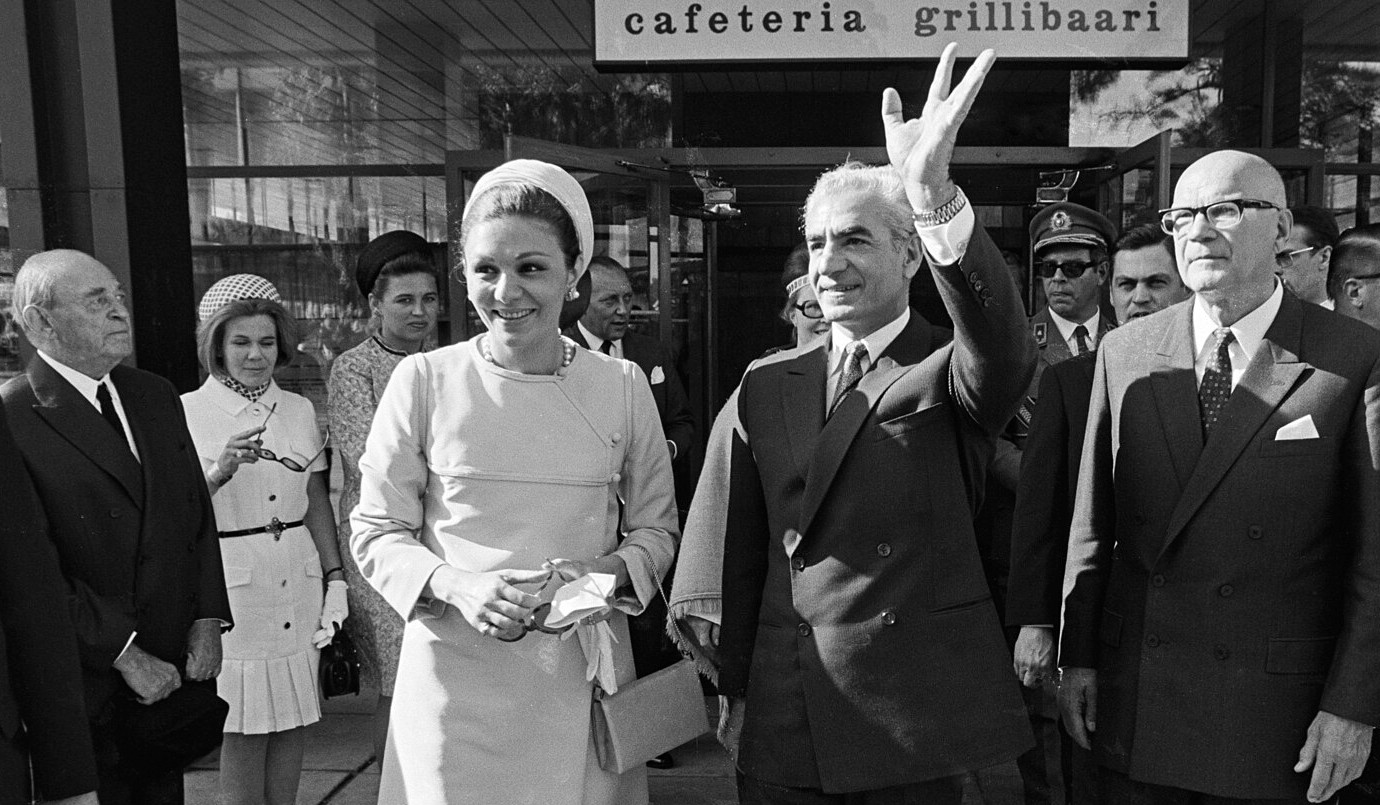
 The Shah of Iran visits Finland, 1970. Photo:
Markku Lepola, Wikimedia Commons CC BY 2.0
The Shah of Iran visits Finland, 1970. Photo:
Markku Lepola, Wikimedia Commons CC BY 2.0
Chris Bambery reflects on the Pahlavi’s dynasty’s autocratic regime prior to the 1979 Islamic Revolution
“Iran under the great leadership of the Shah is an island of stability in one of the most troubled areas in the world. This is a great tribute to you. Your Majesty, and to your leadership, and to the respect, admiration and love which your people give to you.”[1]
President Jimmy Carter, 1978 New Year’s toast to the Shah of Iran.
Reza Pahlavi is the son of the deposed Shah of Iran, Mohammed Reza Pahlavi, who fled the 1979 Iranian revolution, and touts himself as the potential new leader of Iran, although the US does not endorse him. He gets significant support from Israel and is pro-Zionist.
Some in Iran are so desperate they are looking to a restoration of the Pahlavi dynasty, with Reza Pahlavi on the throne. Yet his father’s autocracy was a highly repressive dictatorship, backed to the hilt by America, which created widespread opposition. Despite intense repression this erupted into a mass, popular revolution in 1979.
Saying this does not discount the repressive record of the Islamic Republic, which began by turning on the substantial Iranian left. The vast majority of the Iranian left looked to Moscow or Beijing and accepted the argument from there that Iran was not ready for socialism, and they instead had to ally with the progressive bourgeoisie, represented by Ayatollah Khomenei. They paid a high price for that.
The regime of the Shah pre-1979 had a truly awful record.
In 1941 Reza Shah, father of the ruler deposed in 1979, was pro-Nazi and the Russians and British occupied the country. The Allies forced the Shah to abdicate, and his son was installed as constitutional monarch, sharing limited power with a national parliament and Prime Minister.
In 1951 the elected Prime Minister of Iran, Dr. Mohammed Mossadeq, leader of the nationalist National Front, nationalised the Anglo-Iranian Oil Company. In London, MI6 was immediately charged with preparing a coup.
The Iranian elite turned against Mosaddeq with little prompting from the CIA and MI6:
“The majority of the urban landed rentier class soon abandoned any nationalist pretensions they might have had for a government controlled by the Court and the army.”[2] The internal contradictions within the National Front in the face of an imminent right-wing putsch came into play. The middle-class nationalists supported it.
The Mosadeq government refused the Communists’ demands for armed resistance to the counterrevolution, and instead ordered the army to repress working class unrest in Tehran:
“In the course of doing so, the Army was undoubtedly swayed by the reactionary lumpen mobs whipped up by the CIA and ultimately turned against the government. This action proved decisive, and the National Front collapsed.”[3]
The CIA shepherded the Shah about and played a large role in sponsoring street demonstrations during the coup. The then CIA Director Allen Dulles wrote ten years later:
“In Iran a Mosaddeq and in Guatemala an Arbenz came to power through the usual processes of government and not by any Communist coup as in Czechoslovakia.
Neither man at the time disclosed the intention of creating a Communist state. When this purpose became clear, support from outside was given to loyal anti-communist elements in the respective countries, in the one case to the Shah’s supporters, in the other, to a group of Guatemalan patriots. In each case the danger was successfully met. There again no invitation was extended by the governments in power for our sides help.”[4]
The Director of the Defense Department’s Office of Military Assistance at the time, Major General George C. Stewart, later testified before Congress:
“Now when this crisis came on and the thing [the coup] was about to collapse, we violated our normal criteria and among the other things we did, we provided the army immediately on an emergency basis, blankets, boots, uniforms, electric generators, and medical supplies that permitted and created the atmosphere in which they could support the Shah . . . The guns that they had in their hands, the trucks that they rode in, the armored cars that they drove through the streets, and the radio communications that permitted their control, were all furnished through the military defense assistance program.”[5]
Mossadeq was overthrown, and the army, with Washington’s backing, imposed the Shah as an all-powerful ruler and thousands of other National Front supporters were jailed:
“… newspapers and magazines were suppressed, printshops closed, books confiscated and placed on an index, and every sentence intended for print or public lecture was subjected to strict censorship.”[6]
Ervand Abrahamian points out:
“The 1953 coup not only overthrew the popular leader Dr. Mossadeq, but also destroyed labor unions, professional associations, and all independent political parties, and dug a wide, even unbridgeable, gulf between the regime and the two modern classes. Second, the regime further widened this gulf by implementing policies benefiting the upper class rather than the middle and lower classes, who had no pressure groups through which they could alter or peacefully oppose government decisions.”[7]
In 1957 a new organization for total political control, the Sazman-i-Amniyat va Kishvar (Organisation for State Security) or SAVAK, was formed. In the words of a former World Bank adviser in Iran it was created, “with the assistance of a retired Captain of the Chicago police and the active co-operation of the American Central Intelligence Agency.” [8]
The USA, Israel and Iran viewed Arab nationalism as a threat. The Shah informally, but not formally, recognised Israel, and the two regimes began co-operating against the Nasser regime in Egypt and the Baath Party in Iraq:
“Iran and Israel also viewed Iraq as a common threat, providing another rationale for cooperation. By the 1960s, Israel was supporting Iraqi Kurds fighting the central regime; Iran also viewed the Iraqi Kurds as the Iraqi regime’s Achilles’ heel. Thus, the Mossad and the SAVAK, Israel’s and Iran’s intelligence organizations, joined forces in aiding the Kurds in their struggle against the Iraqi central government.
Mossad created a formal trilateral intelligence alliance (code- named Trident) with Iran and Turkey in 1958; the three countries exchanged intelligence and performed joint counterintelligence operations. Iranian-Israeli ties, driven by Ben-Gurion and the Shah, solidified by early 1959, and Tehran and Tel Aviv developed a close military and intelligence relationship that would continue to expand until the Islamic revolution.”[9]
The number of political prisoners in Iran ranged between 3,500 – the admitted official figure – and 125,000 -the top figure given by opposition leaders. Torture regularly occurred. In 1976, Amnesty International reported on human rights in Iran. Its report said this of the widespread use of torture:
“Alleged methods of torture include whipping and beating, electric shocks, the extraction of nails and teeth, boiling water pumped into the rectum, heavy weights hung on the testicles, tying the prisoner to a metal table heated to white heat, inserting a broken bottle into the anus, and rape.”
Asked about this by Le Monde[10], the Shah replied:
“Why should we not employ the same methods as you Europeans? We have learned sophisticated methods of torture from you. You use psychological methods to extract the truth: we do the same.”
On 8 September 1978, which became known as Black Friday, as many as 4,500 unarmed demonstrators were shot to death.[11] Inequality rocketed:
“Between 1967 and 1977, the percentage of urban families living in only one room increased from 36 to 43. On the eve of the revolution, as much as 42 percent of Tehran had inadequate housing. And, despite the vast oil revenues, Tehran, a city of over 4 million, still had no proper sewage system and no proper public transportation system. In a statement reminiscent of Marie Antoinette, the Shah’s younger brother, who owned a helicopter assembly plant, asked: “If people don’t like traffic jams, why don’t they buy helicopters?”
Ervand Abrahamian adds:
“By 1973-74, the top 20 percent of urban families accounted for as much as 55.5 percent of the total expenditures, the bottom 20 percent for as little as 3.7 percent, and the middle 40 percent for no more than 26 percent.”[12]
At the Sultan of Oman’s request, in December 1973 the Shah sent 1,200 troops to bolster the royalist forces fighting left wing guerillas in Dhofar province, increasing the number to 2,000 in 1975. By 1976, the rebellion had virtually collapsed and Iran withdrew its forces by mid-1977. “Pan-monarchical” solidarty between Saudi Arabia, Iran and the Sultan of Oman defeated a revolutionary threat.
Links between the American and elites expanded enormously:
“It was during the 1973-74 explosion of oil revenues that US Iranian economic cooperation began to soar. Between January 1973 and September 1974, private American companies signed $11.9 billion worth of contracts and joint ventures with Iran. Later, an economic accord signed in March 1975 committed Iran to the purchase of $15 billion of American products over a five-year period, including the construction of eight large nuclear power plants; this was the largest agreement of its kind ever signed between two countries.”[13]
In 1953, Iran’s oil revenues totalled less than $34 million. By 1973, they reached near $5 billion. And by 1977, after the quadrupling of world oil prices, they topped $20 billion. Between 1953 and 1978, the cumulative oil income came to as much as $54 billion.
Some of this was wasted on princely palaces, royal grand tours, major festivals, solid gold bathtubs, nuclear projects, and ultra-sophisticated weapons too expensive even for many NATO countries. By the mid-1970s, the Shah was the largest purchaser of US arms in the world, with over $20 billions delivered or on order for his armed forces.[14]
But in 1977, the military and security establishments consumed over 40% of the Iranian
government’s budget.[15] The Shah relied on constant repression, and in this he was supported by Washington:
“In the 1970s his emphasis shifted decidedly to repression. Instead of working to solve the social and economic disparities that ultimately drove their ally from power, American officials strengthened the Shah’s intelligence agencies and armed the regime’s forces to the teeth.”[16]
The British had been replaced by the US as the Number One imperialist power in the region, but they retained links to the Shah.
“Iran is an autocracy and all power flows from the Shah”, the British Ministry of Defence (MOD) wrote in an internal file of April 1975. At the time, the UK had an array of military training teams in Iran and a contract to sell its ruler, Mohammad Reza Pahlavi, over 1,500 tanks.
“British ambassador Peter Ramsbotham recognised in 1973 that the Shah was “effectively a dictator”. The year before, he told London that Iran’s ruler was “becoming increasingly autocratic… and every year the Shah is taking more power into his own hands.”
The Foreign Office was so aware of the true nature of their client that one senior official thought the Shah “may be moving towards megalomania”. None of this mattered. The UK supported the Shah’s army precisely since it was an “instrument of that power”. “By our standards”, the Ministry of Defence noted, the Iranian army “is essentially feudal in both its loyalties and attitudes”. “The word of the Shah is gospel”, it stated:
“Iran under the Shah had the advantage of being Britain’s biggest customer for arms exports in the world. Not only tanks, but destroyers, support ships, armoured vehicles and ammunition were also supplied.”
The UK ambassador to Iran, Anthony Parsons, pointed out:
“The benefits to the United Kingdom of our arms sales to Iran are enormous and we must continue to reap them.”
The British government was well aware of what was going on in Iran:
“By 1974, the UK documents contained a report from Newsweek noting there were 50,000 political prisoners in Iran. Somewhere between 30,000-60,000 people worked for the notoriously brutal and feared internal security service, SAVAK. Amnesty International and others documented numerous cases of torture. SAVAK was “extremely efficient and certainly as brutal as any secret police in the area”
Nick Browne, an official in the British embassy in Tehran, anonymously told one media outlet that SAVAK was “extremely efficient and certainly as brutal as any secret police in the area”.”
The Foreign Office summed up its view in September 1975, in a brief for foreign secretary James Callaghan: “We consider that Iran is an important factor for stability in this area which produces over 70 per cent of our oil imports and the Shah sees us a counterweight to Russian influence in the region… Iran is a major overseas customer for British defence equipment.”
The powers of SAVAK, the secret police, grew so that it pervaded all walks of Iranian life and torture became a regular instrument of interrogation. Political imprisonment increased so that, on a modest but informed estimate, there were at least 10,000 political prisoners in the mid-1970s. The official political and cultural life of the country was totally fraudulent and was perceived as such by the whole population. The press was censored on the basis of regular circulars sent out by SAVAK specifying what issues could not be mentioned, and those which had to be given prominence.[17]
The US and UK were well aware of the corruption at the top of Iranian society:
“The Shah’s own family had massive holdings of undisclosed kinds in hotels, casinos, banks, land, tourist projects and the like. All major economic projects in Iran involved under- the-counter payments of some kind – 1 million here on an arms sale, a bit more on an around-the-rules permit to use land for speculation, and so on. An illustrative case concerns one court officiaI who used court funds to finance a huge tourist project on Kish Island in the Persian Gulf, granted 90 per cent of the construction jobs to a company he owned, and then sold the whole thing to the oil company, and to the head of the secret police, General Nassiri. Nassiri, and the former Prime Minister Hoveida, were imprisoned on corruption charges in late 1978 but nearly all members of the royal family were also involved. It was a sickening system of nepotism, bribery and greed that grew out of the rotten court system the Pahlavis had created, but which was made all the worse in the scramble for money that was unleashed by the rise in oil revenues after 1973.”[18]
All of this came crashing down in 1979. Mass street demonstrations shook the regime, but they attempted to impose martial law to break the back of them. In response, 40,000 oil workers struck. They brought the country to a standstill and sparked a mass strike wave. Workers struck and took over factories, offices, hospitals and universities nationwide. They set up democratic workers’ committees (called shoras), and either bypassed or simply chased out owners and managers. Slum dwellers set up neighborhood committees around local mosques.
The security apparatus began to disintegrate and the left urged sections of the armed forces to mutiny and to arm the people. That began with technicians and air force cadets but spread across the armed forces. The Shah fled.
Support for the Pahlavi dynasty simply evaporated. For the US it was a massive blow. The CIA’s regional headquarters was in Tehran and Iran had been a key force – along with Israel and Saudi Arabia – in policing the region on behalf of Washington. The US has waited nearly half a century for its revenge.
[1] Najibullah Lafraie, Revolutionary Ideology and Islamic Militancy: The Iranian Revolution and Interpretations of the Quran, IB Tauris, 2009, P2
[2] Helmut Richards, America’s Shah Shahanshah’s Iran, MERIP Reports, No. 40 (Sep., 1975), P3
[3] Helmut Richards, America’s Shah Shahanshah’s Iran, MERIP Reports, No. 40 (Sep., 1975), P5
[4] Tarak Barkawi, Democracy, Foreign Forces, and War: The United States and the Cold War in the Third World
https://www.files.ethz.ch/isn/21022/5_Democracy_Foreign_Forces_War.pdf
[5] Tarak Barkawi, Democracy, Foreign Forces, and War: The United States and the Cold War in the Third World
https://www.files.ethz.ch/isn/21022/5_Democracy_Foreign_Forces_War.pdf
[6] Bahman Nirumand, Iran: The New Imperialism in Action, Monthly Review Press, 1969, P96
[7] Ervand Abrahamian, Structural Causes of the Iranian Revolution, MERIP Reports, No. 87, Iran’s Revolution: The Rural Dimension (May, 1980), P22
[8] E. A. Bayne, Persian Kingship in Transition, American Universities Field Staff, 1968, P17
[9] Dalia Dassa Kaye, Alireza Nader and Parisa Roshan Israel and Iran: A Dangerous Rivalry, Rand Cooperation, 2012, P11
[10] https://www.encyclopedia.com/history/legal-and-political-magazines/human-rights-abuses-shahist-iran
[11] Richard W. Cottam, Human Rights in Iran under the Shah, 12 Case Western Reserve Journal of International Law, 121 (1980), P131
[12] Ervand Abrahamian, Structural Causes of the Iranian Revolution, MERIP Reports, No. 87, Iran’s Revolution: The Rural Dimension (May, 1980), P22
[13] Stephen Brannon, Pillars, Petroleum and Power: The United States in the Gulf, The Arab Studies Journal, Vol. 2, No. 1 (Spring 1994), P5-6
[14] Fred Halliday, The Genesis of the Iranian Revolution, Third World Quarterly, Vol. 1, No. 4 (Oct., 1979), P11
[15] Ervand Abrahamian, Structural Causes of the Iranian Revolution, MERIP Reports, No. 87, Iran’s Revolution: The Rural Dimension (May, 1980), P21-22
[16] Stephen Brannon, Pillars, Petroleum and Power: The United States in the Gulf, The Arab Studies Journal, Vol. 2, No. 1 (Spring 1994), P6
[17] Fred Halliday, The Genesis of the Iranian Revolution, Third World Quarterly, Vol. 1, No. 4 (Oct., 1979), P5
[18] Fred Halliday, The Genesis of the Iranian Revolution, Third World Quarterly, Vol. 1, No. 4 (Oct., 1979), P5

Chris Bambery
Chris Bambery is an author, political activist and commentator, and a supporter of Rise, the radical left wing coalition in Scotland. His books include A People's History of Scotland and The Second World War: A Marxist Analysis.