
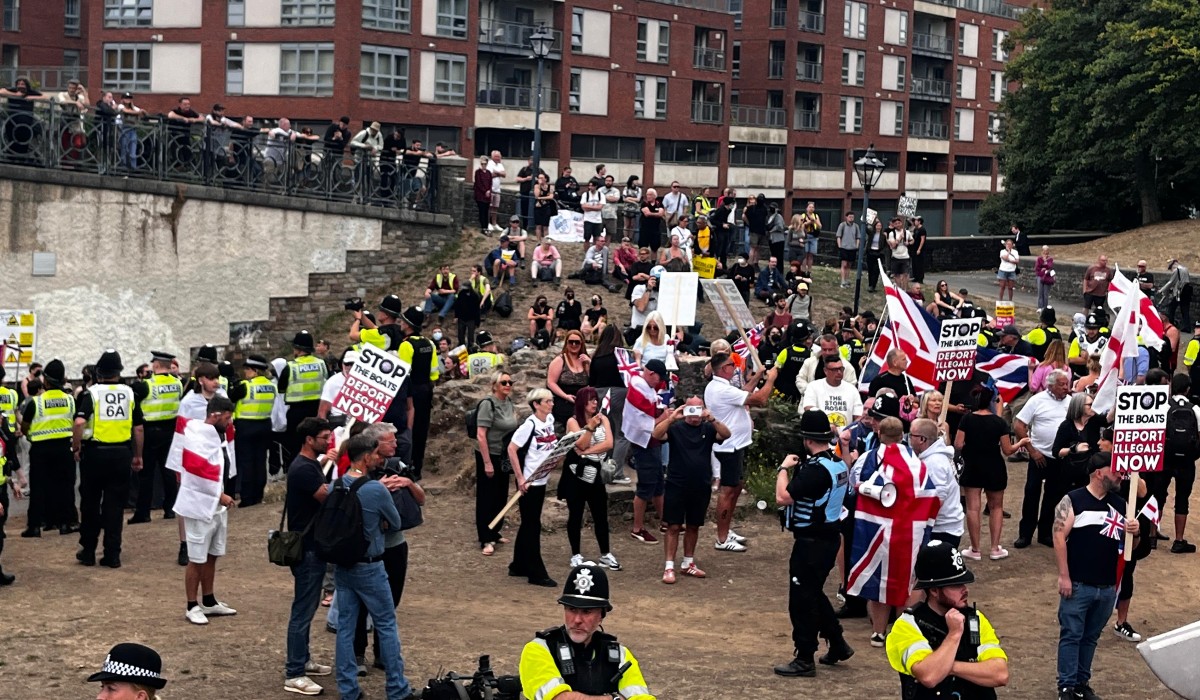
 Far-right protest in Bristol, 23 August. Photo: Shabbir Lakha
Alex Snowdon on an emboldened far right and why the nature of the new left party matters
This year, we have again seen racism being one of the dominant political issues of the summer. Last July and August, a big far-right demonstration in London (led by fascist Tommy Robinson) was followed quickly by a wave of racist riots and protests.
We have thankfully not seen racist street activity of quite the same scale and severity in recent weeks. It has still been very disturbing, though, and has been evident in two linked phenomena.
One is the protests outside hotels housing asylum seekers. Starting in Epping, these have spread to other locations and have happened every Friday and Saturday for the last few weeks. These are menacing and aggressive protests, involving far-right agitation but pulling in some wider elements.
The scale ought to be kept in perspective – no more than a few thousand took part in this weekend’s protests – but they are widespread, persistent and threatening. Anti-racist protests have provided a counterpoint. I was part of Saturday’s Stand up to Racism protest in Newcastle, where we outnumbered the racists a little but not by much. In a few places anti-racists have massively outnumbered the racists, but there have also been worrying instances of the opposite.
The other area of street activity has been the ‘raise the flag’ (or ‘raise the colours’) initiative influenced by a number of far-right networks. This has seen people painting England flags in public spaces – on roundabouts, road crossings and blank walls – and placing flags in public or on their own property. Sometimes it is the Union flag that is promoted.
The intention is clearly to promote a message of racist hostility and make people who might not ‘look English’ or ‘look British’ (in the eyes of racists) feel uncomfortable. The symbolism of these flags is well-established and they are always waved aloft on racist protests. To some extent, this appears to be a way for hardline racists to make a public impact in communities without the risks associated with last summer’s rioting.
While all of this activity has been widely dispersed, there has not yet been a big, unifying and centralised focus for the far right. That will change with the demonstration led by Tommy Robinson on 13 September. Organisers hope that the local activities currently taking place will flow into something huge and coordinated in London that day. It requires a massive response from the anti-racist and labour movements.
If these protests and stunts are the thick wedge of racism today, there are wider layers to consider too. There is a close relationship between the street activity and Reform UK’s more respectable, election-oriented presence in British politics. While Nigel Farage might scrupulously maintain his distance from anything that might turn violent, the electoral and polling breakthroughs for Reform have undoubtedly boosted the racist protesters.
There is also evidently a lot of overlap at grassroots level between these different strands of the radical right. For example, I have noticed social media accounts for local Reform branches promoting the ‘raise the colours’ stunts. Protesters outside asylum seeker hotels tell local journalists that what we need is Nigel Farage in Downing Street.
Reform’s consistently good polling, combined with taking control of several county councils in May, is legitimising often hardline racist attitudes to a degree we are not accustomed to. Reform is feeding off a range of economic and social discontents and channelling it into hostility to immigrants. It is a politics of powerlessness and despair – every grievance is directed towards false targets.
But there is another crucial dimension to this. Racism wouldn’t be flourishing so much if it wasn’t legitimised by the two traditional parties of government.
The Tories compete with Reform to see who can shout ‘stop the boats!’ the loudest. Robert Jenrick, regarded as a likely future replacement for party leader Kemi Badenoch, has firmly positioned himself in the tradition of Enoch Powell. The right-wing papers amplify such politics and Badenoch follows suit.
Labour is very much part of the problem too. Instead of mounting a principled case for why we must welcome those seeking sanctuary, or highlighting positive aspects of immigration, it repeatedly allows the radical right to shape the agenda and responds on its terms.
In the last week, Labour’s public statements have boasted that ‘returns of asylum seekers are up 30%’ and declared that ‘foreign criminals will face immediate deportation’. It has talked of ‘securing our borders’. All of this merely reinforces the negative framing of asylum – constantly linking it to criminality – and encourages hostility to those who are seeking asylum.
If Labour thinks it can win over Reform voters this way, it is mistaken. Polls always indicate that such ‘tough talk’ doesn’t work. It merely gives respectability to more hardline rhetoric from Reform and the far right, while deeply alienating many natural Labour voters.
Support for Reform has grown on the back of this government’s failures. Labour could undercut Reform by actually delivering in areas with mass building of social housing, investment in public services and making material improvements to people’s lives. Farage has thoroughly right-wing economic positions, tempered by some populist opportunism (he opposed cutting winter fuel payments, for example), but in the absence of an alternative his party can appear to offer hope.
What kind of party?
The new left-wing party announced by Jeremy Corbyn and Zarah Sultana is an exciting development. It holds out the hope of a left-wing party that has a broader vision than elections. A major area of emerging debate is around whether it focuses overwhelmingly on electoral politics or has a broader approach encompassing social movements, community campaigns and trade unions.
A key consideration here is that other political forces are not sticking to the old, conventional approach of focusing on electoral politics. Racist currents, as I indicated above, are operating on every front available.
It is complicated because it isn’t the same organisations doing everything. For example, Reform is winning elections, but other groups and networks are doing the street mobilisations and flag stunts. But there is massive overlap – ideologically and in terms of personnel – between these different developments. They feed off each other.
The right wing grasps the relationship between electoral activity and protest movements. We should be matching them.
This is particularly true at a time when the Gaza protest movement is truly massive – reaching into every corner of society in a way that only happens occasionally with social movements. This is on an ongoing basis and involves every form of activity imaginable. Another huge national demonstration will take place on 6 September, but there’s also a flowering of local activities: protests, fundraisers, cultural events and more.
The Palestine solidarity movement has lacked much of a political voice. Rarely has the disconnect between Westminster and public opinion been so extreme. It is time to put that right by building a credible mass left-wing party that gives political expression to justice for Palestine.
However, it would be a fatal error to simply turn to party politics – on Palestine as on any issue – and neglect wider social mobilisations. We need to integrate these different elements.
Before you go
The ongoing genocide in Gaza, Starmer’s austerity and the danger of a resurgent far right demonstrate the urgent need for socialist organisation and ideas. Counterfire has been central to the Palestine revolt and we are committed to building mass, united movements of resistance. Become a member today and join the fightback.

Alex Snowdon
Alex Snowdon is a Counterfire activist in Newcastle. He is active in the Palestine Solidarity Campaign, Stop the War Coalition and the National Education Union. He is the author of A Short Guide to Israeli Apartheid (2022).