
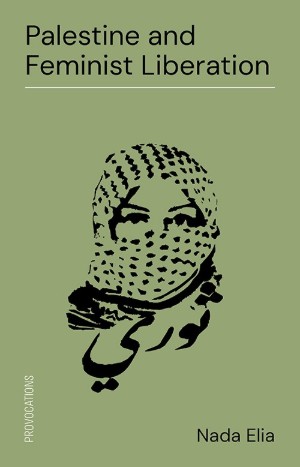
 Nada Elia, Palestine and Feminist Liberation (Between the Lines, 2025), 87pp.
A critique of liberal feminist positions on Palestine by a Palestinian feminist living in the US helps expose their usefulness to imperialism, finds Elaine Graham-Leigh
It is perhaps stating the obvious to point out that within feminism there is no consensus on Palestine. While many Western feminists have opposed Israel’s atrocities in Gaza and take a pro-Palestine stance, others argues that the rapes committed by Hamas fighters on 7 October 2023 mean that support of Israel is the only feminist position.
The latter view can be seen to be following the longstanding argument that Israel should be supported by Western progressives because it is a beacon of liberal values in a backward and repressive region, ‘the only gay-friendly society in the Middle East.’ One result of this line of argument is that diaspora Palestinian women can find themselves being regarded as fortunate to have been exiled from their homeland if it meant that they ended up in the West. Elia recounts how she is asked ‘if we are not better off, really, living in “modern” societies, where we can wear whatever we want, go wherever we want’ (p.7).
Elia argues that, as women from the Global South, Palestinian feminists are on the receiving end of the liberal feminist view that for them, only feminist campaigning against oppression within their own societies is acceptable. For Palestinian feminists, making the connections between women’s oppression and wider politics is not allowed. This can be presented as the need to keep politics out of feminism, as for example when, in 1985, Betty Friedan told Nawal El Saadawi, an Egyptian feminist about to speak at the United Nationals International Conference on Women, ‘“please do not bring up Palestine in your speech”’ (p.9). It can be extended to argue that if feminists from the Global South insist, despite instructions, on making links between feminist politics and issues like war and imperialism, they must have a malign agenda behind it, as for example when some of the organisers of the 2017 Women’s March on Washington were accused of antisemitism for including Palestinian women’s circumstances on the platform. This is all in contrast to the freedom that Western liberal feminists have to bring in wider politics as much as they like.
For Elia, this is primarily an issue of racism within Western feminism, but what becomes particularly clear in this discussion is the role that liberal feminism has played and continues to play in supporting Western governments’ interests around the world and in suppressing dissent. The accusations of antisemitism levelled around the organisation of the 2017 Women’s March clearly made articulating the case for a connection between feminist struggles and the Palestinian struggle more difficult. When noting this dynamic around accusations of antisemitism, it is important, however, to reject actual antisemitism. While discussing issues of racism within Western feminism, Elia includes a passage where she states that ‘an almost equal number of other communities also perished in the Holocaust’ as the six million Jewish victims, and the omission of this fact is ‘proof that Jewish suffering is elevated above the suffering of others’ (p.42). This is factually incorrect and appears to repeat the antisemitic trope of Jews as a privileged community crying victim. It should have no place in any discussion of Palestinian feminism.
Palestine liberation a feminist struggle
In showing how the struggle for Palestine and feminist struggles are connected, Elia recounts how Palestinian women have been integral to the fight for Palestinian freedom from the beginning. Individual women and women’s organisations like the Arab Women’s Union were involved in protests against Palestinian land being given to Jewish settlers in the 1920s and 1930s and women were also active in the Palestine revolt of 1936-9. Elia gives the example of how, when the men of the village of Baqa al-Gharbiya were arrested by the British, the women proceeded to storm the barracks to get them out. This female involvement in the resistance continued through to the first Intifada in 1987, in which women used sexist stereotypes to their advantage, transporting banned materials as they would be less likely than men to be searched. Palestinian women are continuing to play central roles in the struggle now, as shown for example by Razan Najjar, the paramedic shot dead by Israeli troops while helping the injured during the Great March of Return in 2018.
Elia argues that the struggle for Palestinian liberation is directly a feminist struggle. This is clear from the use of sexual violence by Israel against the Palestinians, whether that is by Israeli soldiers on the ground or in the rhetoric of Israeli politicians, such as for example when Mordechai Kedar called for the systematic rape of Palestinian women in order to demoralise Hamas. There is also the point that the effects of the Israeli occupation amount to a far more thorough-going restriction on Palestinian women’s freedom to live as they choose than anything that Palestinian men could do. While these restrictions apply of course to Palestinian men as well, Israel’s oppression of the Palestinians has specific effects on Palestinian women. They have, for example, the highest rates of stillbirth, deaths in labour and newborn fatalities in the world.
When comparing the restrictions imposed by Israel with the effects of women’s oppression within Palestinian society, Elia is careful not to minimise the latter. She does though point to signs of hope for the position in Palestinian society of both women and gay people. In 2019, for example, the separate murders of a young man and a young woman by members of their families for homosexuality and for going out with a man outside marriage sparked protests against honour killing and homophobia. It is hard to judge the scale of such developments from the brief account here, but what Elia does make clear is that Israel makes such developments in Palestinian society more difficult. The liberal feminist argument that feminism requires support of Israel against the Palestinian resistance is on the side that makes the cause of Palestinian feminism harder to achieve.
Elia touches at various points on the effect of the Palestinian struggle on Palestinian feminism, but this is another area which would have benefited from a longer and more nuanced consideration. Women’s central role in the first Intifada was, she argues, positive for women’s emancipation, which was then dealt a blow by the 1992 Oslo Accords. For Elia, Palestinian armed resistance since then has been broadly bad for Palestinian women, entailing a militarisation of Palestinian society which intensifies women’s oppression. In this, it perhaps reflects the hyper-militarisation of Israeli society, which Elia notes comes with high rates of violence against women.
Strategies for resistance
Elia sees armed struggle as a factor driving the intensification of women’s oppression in Palestine, and also as self-defeating, arguing that it has not won any victories. What has worked, she contends, is ‘sumoud’ (steadfastness). This is a form of resistance upheld across Palestine, but Elia here casts it as specifically feminist, as enabled by women’s work in sustaining Palestinian communities and enabling boycotts of Israeli goods. This latter Elia sees as uniquely successful as a method of struggle. The BDS campaign is undoubtedly important, but Elia’s insistence here on its singular role to the exclusion of other forms of campaigning seems to miss the range of tactics which have together succeeded in shifting Western public opinion from a broadly pro-Israel position to a pro-Palestinian one.
While Elia does acknowledge examples of Palestinian women involved in active resistance, the analysis here does seem to counterpose male-coded armed resistance with a specifically female vision of sumoud. This seems to lean towards the argument that women should be allowed a role in public life because they are innately gentle and good, rather than just because they are people, and does not seem a particularly helpful analysis. Elia’s contention is that sumoud will win out in the end, but without a consideration of strategies for Palestinian resistance, and pro-Palestine activity in the West, it is difficult to find this argument convincing. Her closing comment that ‘we will free ourselves by creating different living conditions’ (p.76) does seem to beg the question of how.
Elia states from the outset that Palestine has to be understood as ‘a progressive, decolonial, Indigenous, feminist, and queer issue’ (p.23). The framing of Palestinian struggle as an Indigenous one reflects progressive politics in the US (where Elia lives and works) and Canada (where the book is published), but doesn’t seem entirely useful in this context, where the nature of indigenousness and who gets to claim it is part of the struggle. More seriously, the focus here purely on Israel as a settler-colonial state has the effect of minimising the role Israel plays for US interests in the Middle East. For Elia, Western liberal feminists who argue that it is feminist to support Israel, or who are hostile to Arab feminists talking about Palestine, are expressing anti-Palestinian racism, rather than Islamophobia. Elia argues that anti-Palestinian racism has ‘specific political manifestations’ and is separate from the vaguer Islamophobia, which in European countries ‘goes back centuries’ (p.73). This is to miss the vital structural role that Islamophobia plays for modern Western states, in justifying imperialist foreign policies abroad and border controls and other authoritarian measures at home.
It is surely the case that we should see the use of liberal feminism against support for the Palestinian cause in the context of the history of use of liberal feminism to justify that Western imperialism. This history is a long one, arguably going back at least to the ‘civilising mission’ of nineteenth-century British imperialism. When Elia is asked if she isn’t better off living in the West, it is presumably these justifications for Empire, from seraglios to suttee, that her questioners have in mind. In the modern day, these uses have also been explicit, with figures like Cherie Blair and Hillary Clinton defending the invasion of Afghanistan by pointing to the treatment of women under the Taliban and arguing that the US and UK occupation of the country was good for women’s rights. While the use of these arguments was particularly pronounced in the case of Afghanistan, they have also surfaced in defence of other imperialist adventures, such as in the disputed claims of the Gaddafi’s regime using rape as a means of repression, which were used in justifications for the attack on Libya.
The important point here is that liberal feminist arguments in favour of Israel are not simply expressions of racism but are carrying on a political argument for Western imperialism. Rebutting such arguments as racist or exclusionary is likely to be less effective than employing the cogent political arguments that Elia also makes, that Palestinian women are more oppressed by Israel than by Islam and that oppression hinders rather than helps their liberation.
Before you go
The ongoing genocide in Gaza, Starmer’s austerity and the danger of a resurgent far right demonstrate the urgent need for socialist organisation and ideas. Counterfire has been central to the Palestine revolt and we are committed to building mass, united movements of resistance. Become a member today and join the fightback.

Elaine Graham-Leigh
Elaine Graham-Leigh is an activist and writer of history, politics and fiction. She is the author of The Southern French Nobility and the Albigensian Crusade, (Woodbridge: The Boydell Press, 2005), A Diet of Austerity: Class, Food and Climate Change, (London: Zero Books, 2015), Marx and the Climate Crisis, (London: Counterfire, 2020), The Caduca, (Canterbury: The Conrad Press, 2021) and Revolution in Carcassonne: The Story of a Fourteenth-Century Rebellion, (London: Whalebone Press, 2025). She is a founding member of Counterfire.