
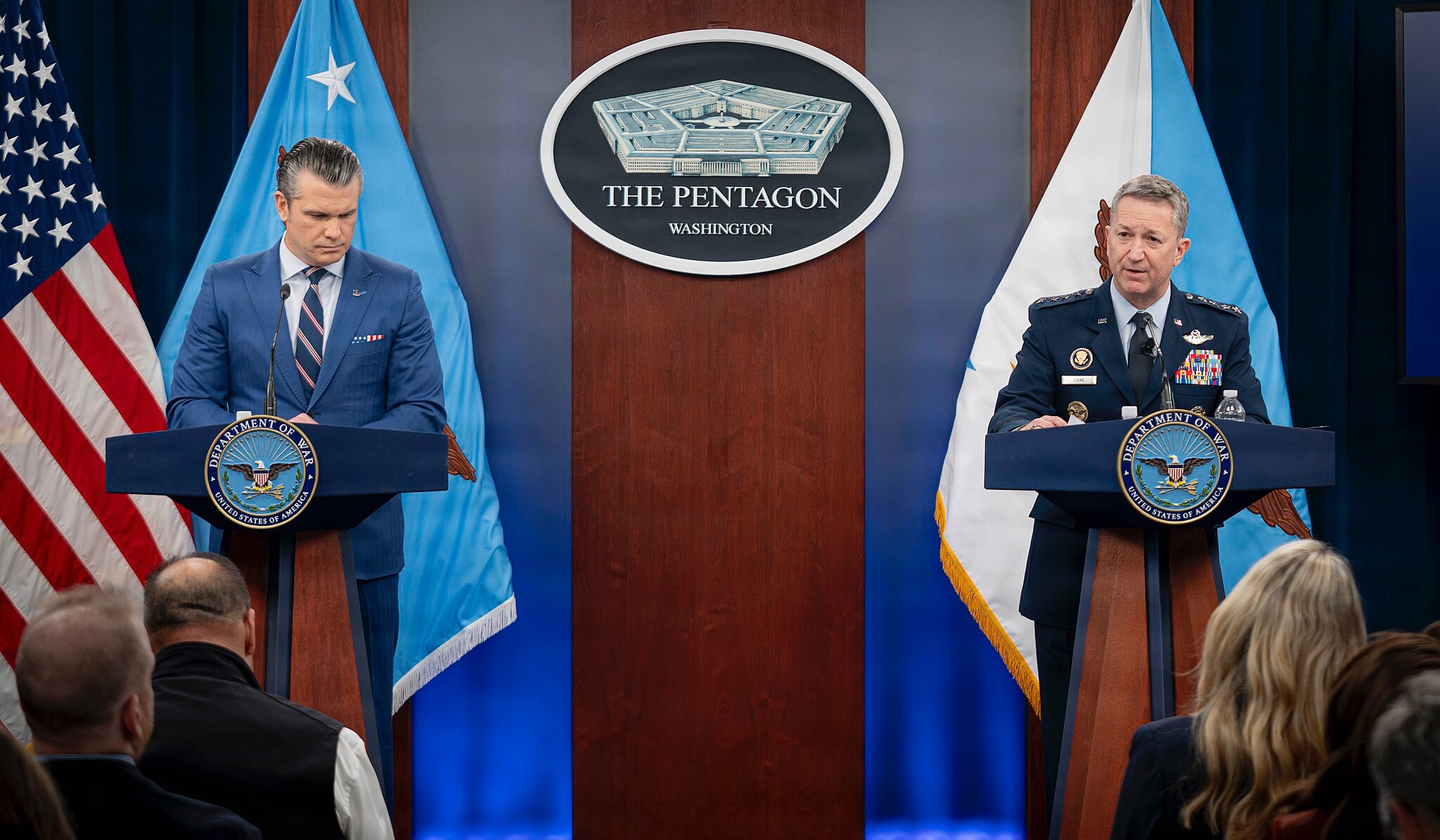
 Operation 'Epic Fury' press briefing with Pete Hegseth and Dan Caine/ Chief Petty Officer James Mullen, Public domain, via Wikimedia Commons
Despite the claims of Secretary for War Pete Hegseth, the US is a long way from its war objectives, argues Chris Bambery
‘I think the war is very complete, pretty much. They have no navy, no communications, they’ve got no air force.’
That is what Donald Trump told CBS News at the start of this week. Addressing Republicans on Monday afternoon, he said: ‘We took a little excursion because we felt we had to do that to get rid of some evil. I think you’ll see it’s going to be a short-term excursion.’ But he also indicated he was not yet declaring the US mission accomplished in Iran. ‘We’ve already won in many ways, but we haven’t won enough’, he said.
Pete Hegseth, the self-designated Secretary of State for War, told reporters on Tuesday that the US is focused on three main objectives: to neutralise Tehran’s missile capabilities, destroy its navy and ‘permanently deny Iran nuclear weapons forever’.
Top US General Dan Caine said that US forces are continuing to ‘hunt and strike mine-laying vessels’ in the Gulf.
Hegseth claimed as evidence that Iranian resistance was crumbling and that over the 24 hours prior to his Tuesday press conference, Iran had fired the lowest number of missiles yet. Despite the intense bombardment of Tehran and other Iranian cities, in which more than 1800 have died so far, the majority civilians, there is no sign that the war is nearly over with Iranian resistance crumbling.
From day one – and, unlike in June last year, the Iranians were ready and waiting for an attack – the Iranians have concentrated their missile strikes on American assets in the Gulf States. Their long-term aim is to get those states to accept the American presence is a liability not a security asset. Hegseth should know that, unlike in the June 12 day war, the Iranians have chosen not to concentrate fire on Israel. Despite that they have struck Israel and news of this does get out, even with intense Israeli censorship extended now to 26 March. Added to that Hezbollah strikes into northern Israel have led the Israeli Defence Force to contemplate evacuating those areas, which will impact on the Israeli economy.
There is considerable evidence that Iran has used older missiles and drones thus far in an attempt to degrade missile defence systems. The US has limited stocks of these.
On 6 March, Military Watch reported:
‘Reports from multiple Western sources confirmed on March 5 that the United States Army has expended over 800 anti-ballistic missiles from MIM-104 Patriot long range air defence systems during just five days of hostilities with Iran, after the U.S and Israel both launched a large scale attack against the country on February 28. This exceeds the total estimated number of Patriot interceptors launched throughout the entire Russian-Ukrainian War, in which the Patriot has been operated for close to three years, and is estimated to have furthered worsened the already very severe shortage of interceptors available. Patriot interceptors cost approximately $3 million each, with costs varying depending on the types of interceptors in use. The PAC-3 MSE interceptor, for example, costs the U.S. Army approximately $3.9 million, although it has been sold abroad for $6.25 million.’
Iran is planning on a longer term war and keeping missile and drone stocks in reserve, particularly the newer models.
On Tuesday Hegseth talked of US escorts being used to take ships through the Straits of Hormuz but Caine was more cautious, suggesting on Tuesday that the decision to use the US military to reopen the waterway has not been taken. ‘If tasked to escort, we’ll look at the range of options to set the military conditions to be able to do that,’ he said.
As I write, the US says it is targeting Iranian minesweepers after they mined the Straits of Hormuz, and one vessel is ablaze after a missile strike. If Hegseth was right that should not be happening. The Straits at their narrowest are some 30 miles wide. Any US warship entering them would be a target in range of Iranian missiles, drones and anti-ship missiles.
If Trump is right and the war is near completion what would a US victory look like?
Trump began by calling for regime change and the Israelis, following their regular pattern of assassination, obviously thought that by murdering Khamenei in his office that the regime would collapse. So far that has not happened.
In a letter to Sir Keir Starmer some 100 British-Iranians, including Nazanin Zaghari-Ratcliffe, who served six years in an Iranian jail being released in 2022, state:
‘Nobody can claim to want the end of the Islamic republic more than we do. But attacking the country in this way will have the opposite effect. It will entrench the authoritarians and give life to the fiction that has sustained them internally for decades: that they are fighting western imperialism.
‘When Netanyahu – a man charged with international war crimes after killing countless civilians in Gaza – assassinates Iran’s dictator, that kills the man but immortalises the myth. Iranians wanted him tried and punished for his crimes, not given the martyr-ending he craved.’
I think they are broadly correct.
Because of the awful record of US and British imperialism there is a strong sense of nationalism that the regime can tap into. The killing of Khamenei, who was the second most important cleric in Shi’a Islam, which is centred on martyrdom, also backfired. Add into this the fact that aerial bombing has never succeeded in turning a civilian population against the authorities – think Britain and Germany in the Second World War.
Growing numbers of Iranians are aware too that Netanyahu does not just want regime change but to divide up Iran, as in Libya and Syria, so it can never challenge Israel again and as a lesson to Türkiye, for instance.
The selection of Mojtaba Khamenei as Supreme Leader in place of his father is also a symbol of defiance. Trump can dismiss the younger Khamenei as a ‘lightweight’, criticising Mojtaba’s selection. ‘I think they made a big mistake,’ Trump told NBC. ‘I don’t know if it’s going to last. I think they made a mistake.’ But the appointment is a signal that the Iranian ruling elite will not go down the Venezuelan road, where former Chavistas are now doing Trump’s bidding after the abduction of President Maduro by US Special Forces.
When as I said above Hegseth says the US needs to destroy Iran’s arsenal of missiles, its navy and to ‘permanently deny Iran nuclear weapons forever,’ it is important to remember that it has not achieved those aims. It has not destroyed the missiles. Iran is the 17th largest country in the world by area, just behind Sudan and Libya. It covers about 1.65 million square kilometres (636,000sq miles) with lots of desert and mountains. Tracking down the missile launchers will not be easy. The navy is much more vulnerable. As for Iranian nuclear sites, last year Trump said the US air force had ‘obliterated’ them – they hadn’t. Given how far underground they are it’s a difficult, if not impossible, task.
Regarding Iran building a nuclear bomb, by murdering Khamenei the Israel and the US removed the man who declared it would be un-Islamic to do so. There must be growing numbers of Iranians envying North Korea now.
Within Israel there is growing concern Trump will pull out of the war, declaring victory when there is none. Netanyahu said he was not concerned by his talk of the war ending soon but he would say that, wouldn’t he. Trump told The Times of Israel on Sunday that a decision on when to end the war with Iran will be a ‘mutual’ one:
‘The US president was asked whether he alone would decide when the war with Iran ends or if Netanyahu would also have a say.
“I think it’s mutual… a little bit. We’ve been talking. I’ll make a decision at the right time, but everything’s going to be taken into account,” he responded, indicating that while Netanyahu will have input, the US president will have the final say.’
Not so reassuring for Netanyahu.
Interestingly, Netanyahu has also cited opposition to the war within the US. A Quinnipiac poll released on Monday found that a narrow majority of Americans were against military action in Iran — 53 per cent, a striking level of opposition just days into a war — and that 44 per cent believed the United States was too supportive of Israel.
The impact on oil and gas prices will add to American doubts over this war.
Michael Singh, who served as the top White House advisor on the Middle East under former president George W. Bush, points out:
‘The U.S. may not have as much of an appetite for a long conflict, especially because we have priorities in other theatres that Israel obviously doesn’t have, and we can pack up and go home whereas Israel can’t.’
The ‘other theatres’ must surely be a reference to China and the miltary and naval build up in the Pacific and South China Sea. As I have written previously China will not involve itself in this war but it will increase its nervousness over Trump and the US.
To me the outcome of this war will be decided by two things: will the US commitment remain solid, and will the Iranian regime survive.
There is one final thought. Trump and Hegseth don’t seem to grasp wars are fought by two sides. Would Iran agree to a ceasefire? It did in June last year but there was much opposition to that because the boot was on Iran’s foot in the war with Israel (the US had ducked out after its opening strikes on the nuclear facilities). Now it has been grasped that the US and Israel only see a ceasefire as a breathing space and would come again as they have done now. A ceasefire is simply that. Iran knows that its survival is on the line and would look to gaining a settlement, not a ceasefire, including an end to the crippling Western sanctions.
We are not spectators. The bigger the opposition to this war globally the more impact that will have. Go to it!
Before you go
The ongoing genocide in Gaza, Starmer’s austerity and the danger of a resurgent far right demonstrate the urgent need for socialist organisation and ideas. Counterfire has been central to the Palestine revolt and we are committed to building mass, united movements of resistance. Become a member today and join the fightback.

Chris Bambery
Chris Bambery is an author, political activist and commentator, and a supporter of Rise, the radical left wing coalition in Scotland. His books include A People's History of Scotland and The Second World War: A Marxist Analysis.