
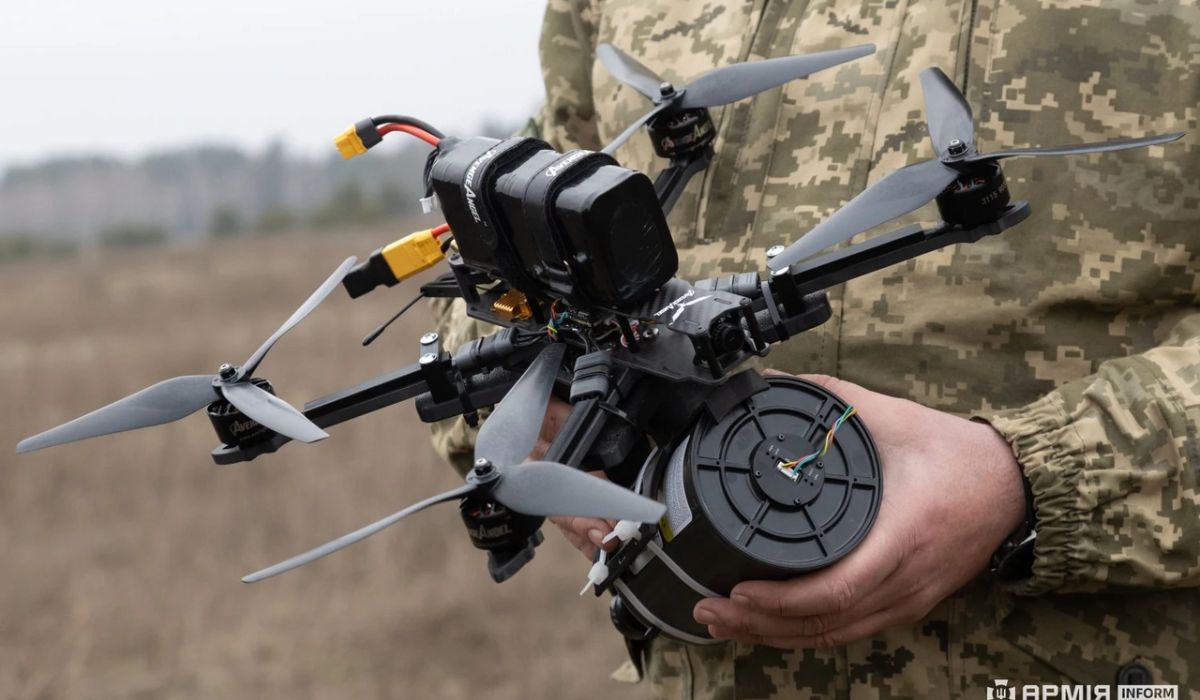
 Ukrainian FPV drone with fiber-optic communication channel. Source: АрміяІнформ - Wikicommon / cropped from original / CC BY 4.0
Vladimir Unkovski-Korica investigates recent developments in the Russia-Ukraine war
In recent weeks, we have heard much about Ukraine’s success in turning tables on Russia in the fifth year since Moscow’s troops started their war of aggression against its neighbour.
This media narrative has intensified since Ukrainian president Volodymyr Zelensky announced a 40-day blitz against Russia’s energy sector using mid and long-range drones in late June.
Undoubtedly, there is a significant truth to the claim that Ukraine’s innovations in drone warfare have had an impact on the economic front in the war. So far, estimates are that Ukraine has destroyed one fifth of Russia’s refining capacity.
Its success in hitting Russian shipping in the Sea of Azov and in causing blackouts in Crimea have increased the costs of holding what Russia has seized since 2014. The emergence of petrol queues symbolises the costs for Russia’s population too.
Russian president Vladimir Putin’s poll ratings have taken a dent, though they remain stubbornly high at over seventy percent. Nonetheless, this spring there has been a shift towards support for negotiations with Ukraine. Just over two thirds of Russians polled by Levada in March preferred this option, compared with a quarter who wanted to carry on military operations.
The pace of Russian military advance has also slowed noticeably since November 2025. This is to a large degree explained by the increased cost to offensive operations facilitated by advances in drone technology. Ukraine’s frontline ‘robotic kill zone’ has expanded from 3-5km in 2023-4 to an alleged 15km, making traditional troop movements more dangerous.
While all this will be worrying for the Kremlin, we should be careful about accepting the media narrative in full. Like many previous Ukrainian offensive manoeuvres, such as the unsuccessful 2023 summer offensive and the ultimately ill-fated Kursk incursion in summer 2024, the current bombing campaign has multiple goals.
One of Kyiv’s principal goals is to shore up support in NATO countries. The 40-day blitz was timed in advance of the NATO summit in Ankara on 7-8 July. In terms of soft power, the offensive worked. Finland’s president Alexander Stubb told the Financial Times on 6 July that NATO backed Ukraine’s drone campaign.
Ukraine in fact achieved a diplomatic coup when US president Donald Trump announced he would grant Ukraine a licence to build US Patriot air defence missile systems. Even though experts suggested it would take years before such a programme could go fully online, the message coming from the West was that Ukraine had its full support.
Stalemate
The reality behind some of the more bombastic headlines is not as favourable to Ukraine as all that. Writing for The Telegraph on 8 July, Valery Zaluzhny, former Ukrainian commander-in-chief and currently ambassador to the UK, argued that the war was effectively a military stalemate: neither side could hope to achieve its full ambitions.
In a war of attrition, Zaluzhny went on, endurance counts for much, and Ukraine in that sense depends on its Western allies. That confirms the analysis the anti-war movement in the UK has long advanced: that the Russian war of aggression quickly turned into a proxy war between NATO and Russia with Ukraine for all intents and purposes a proxy for the Western alliance.
The degree of Ukrainian dependence on Western aid has been repeatedly made clear, most recently in Ukrainian requests for Western air defence systems. Just as Ukraine’s drone attacks on Russia have been increasingly devastating, causing as much damage so far in 2026 as in the whole of 2025, so Russian ballistic missile volleys against Ukraine’s energy and military infrastructure have encountered no effective resistance.
Hence the latest race by NATO states to arm Ukraine with air defence systems. The prospect of another crippling Russian aerial assault and the potential for the collapse of Ukraine’s energy grid ahead of a fifth winter of war must be concentrating minds in Western capitals. If Russia’s economy is screeching to a halt, Ukraine’s is utterly dependent on Western economic and military support.
War weariness
No surprise that, as in Russia, war weariness is palpable in Ukraine and among its backers in the West. A poll in May this year suggested three quarters of Ukrainians wanted direct negotiations to end the war, while only a fifth preferred fighting until victory. Only a third of those polled believed Ukraine could win back all its lost territories, while just as many thought the cost of doing so would be too great.
As poverty has risen in Ukraine, its political elites are mired in corruption. Zelensky has just sacked his Prime Minister Yulia Svyrydenko, after only a year in post. There was speculation she would be posted as Ukraine’s ambassador to the US, to replace Olga Stefanishyna, who faces looming embezzlement charges. Svyrydenko allegedly refused.
This comes on the back of the so-called Midas case, involving allegations of a $100 million kickback scheme at the state nuclear power company Energoatom, in which two allies of Zelensky, a former business partner, Timur Mindich, and Zelensky’s influential former chief of staff, Andriy Yermak, are suspects.
Press gang resistance
It is no wonder that desertion rates in Ukraine’s armed forces continue to be high, and that conscription has become ever more unpopular. Ukraine witnessed unprecedented scenes in early July as rioting broke out against heavy-handed draft officials in the Western city of Lviv. Hundreds of people, allegedly led by active servicemen, fought off territorial recruitment officers, toppling their vehicle and stripping an officer.
Meanwhile, the European establishment actively seeks to use the threat of Russia to rearm, but the European public has become more sceptical of Ukraine’s chances of victory. Polling conducted in May suggested that while majorities in the US and UK still favoured continuing support for Ukraine until victory, even if that meant prolonging the war, the opposite was true in Poland, France and Germany, where populations preferred a quicker end to the war, even at the expense of Ukrainian territory.
Moreover, it is true that Russia has lost a key ally in Europe this year, with the defeat of Viktor Orban in Hungary, but it has also gained an ally with the election of Rumen Radev as Prime Minister in Bulgaria. The truth is that the West continues to be deeply and increasingly divided over the pursuit of the proxy war with Russia.
The danger is that, while populations in Russia, Ukraine and much of Europe prefer a speedier and negotiated end to the war, their state elites bet on military victory and continue to intensify the drive to turn welfare states into warfare states. Ordinary people, above all Ukrainian and Russian servicemen, continue to pay the (ultimate) price.
With the threat of escalation increasing, and some speculating that Russia may start to strike European infrastructure being used to supply Ukraine, we are inching towards catastrophe. Surely it is time to press for de-escalation and negotiation, and an end to the spiralling violence, before we face even wider war.
Before you go
The ongoing genocide in Gaza, Starmer’s austerity and the danger of a resurgent far right demonstrate the urgent need for socialist organisation and ideas. Counterfire has been central to the Palestine revolt and we are committed to building mass, united movements of resistance. Become a member today and join the fightback.

Vladimir Unkovski-Korica
Vladimir Unkovski-Korica is a member of Marks21 in Serbia and a supporter of Counterfire. He is on the editorial board of LeftEast and teaches at the University of Glasgow.