
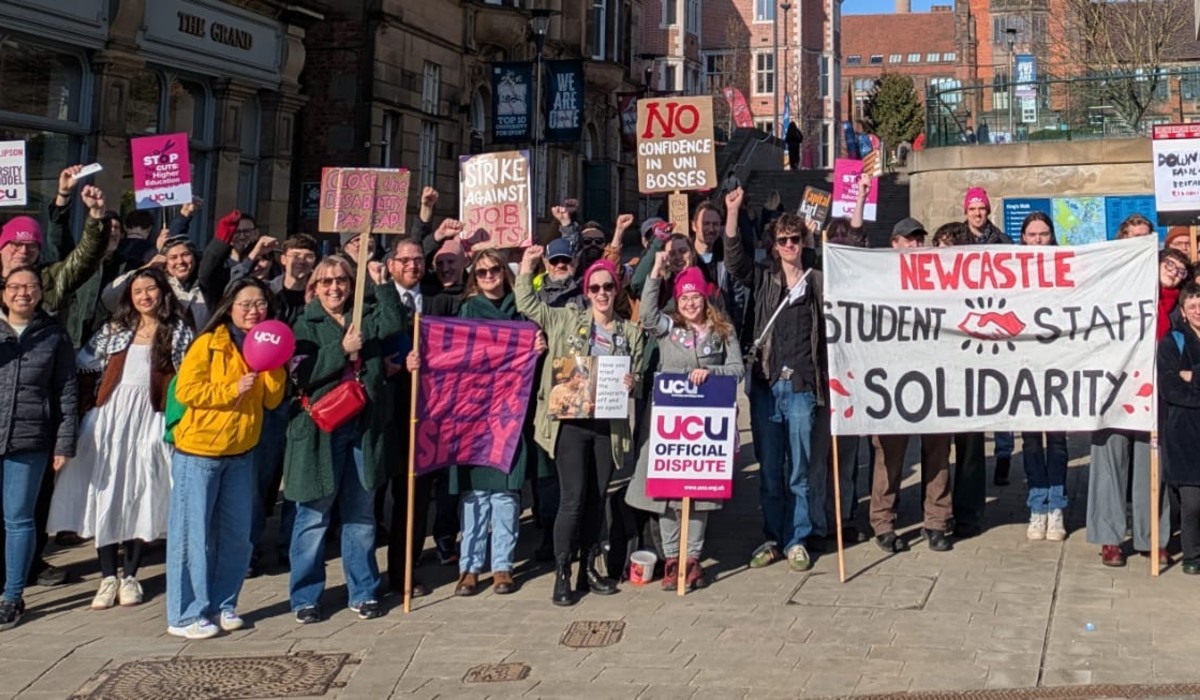
 The UCU today celebrated as it beat back the threat of compulsory redundancies at Newcastle University / X: UCU
The victory of Newcastle UCU provides a model for higher education workers fighting management cuts across the country, report Counterfire members in HE
After 44 days of strike action, Newcastle University UCU branch has scored a significant victory, receiving a commitment from university management that there will be no compulsory redundancies this academic year. All redundancy pools have been dissolved and, in return, the branch have voted to stand down the dispute and call off the re-ballot which was underway.
To make £20 million in ‘savings’ (a figure of £30 million was also discussed which included an earlier £10 million projected shortfall), management had threatened that 300 jobs would go. The branch went into dispute on 25 October last year and members have fought hard to ensure that no one left employment without an agreement.
To achieve resolution of the dispute, the management have had to curb senior staff pay for next year with no cost-of-living pay rise being given to staff on the most senior grades. They also had to run four rounds of a voluntary-severance scheme, beyond their original plans, and have given a commitment that there will be no ‘workforce-resizing exercise’ next year.
This is a really important win and a much bigger commitment than any other institution has won so far.
Management has, however, refused to rule out completely compulsory redundancy in the next academic year, 2025/26, citing redundancies that are part of the business of the university, for example when contracts come to an end. There are also still unresolved issues over increased workload and casualisation, despite a management commitment to address these issues, and concerns over management’s targeting of certain departments and of staff being pressured into accepting voluntary severance.
Despite these concerns, UCU branch chair Matt Perry was right to comment that this was ‘a big win for us after taking serious industrial action. But we believe that our dispute shows that industrial action can prevent job cuts in higher education. This is happening in nearly every university in the country.’
He is correct on both points. Dozens of universities are making plans to cut staff and programmes including the following.
- Staff at Nottingham University have voted for strike action in response to the targeting of 258 professional services staff with academic redundancies likely to follow later this year;
- UCU members at Bradford University are currently taking industrial action, including four days of strike action in the week beginning 7 July, in opposition to the threat of hundreds of redundancies;
- Members at Edinburgh University have taken strike action against a potentially enormous wave of job cuts – the biggest in the history of Scottish Higher Education – as management try to secure £140 million of cuts;
- Forty-five members of the Centre for Academic Language and Development at Bristol University are facing the axe;
- Liverpool Hope University UCU branch is currently balloting for industrial action against 39 redundancies that management wants to rush through before the end of the year.
UCU has produced a list of all the branches currently threatened with cuts that demonstrates the challenge that lies ahead.
The Times Higher Education recently warned that the scale of job cuts means that ‘forcing staff to leave could become the new normal for institutions looking to save money’, despite many of them either sitting on healthy cash reserves or having squandered years of surpluses in the ‘good times’.
In order to resist cuts and defend conditions, we should learn the lessons of the Newcastle strike and appreciate the importance of building from the ground up.
The Newcastle branch was in a good state going into the dispute. Years of building department-level union structures with reps spread throughout the university, meant local meetings could be held to involve every layer of the membership in the dispute. Weekly members’ meetings took all decisions during the dispute and made the final decision to call off the dispute following management’s agreement to cancel their plans. Engagement with local pro-Palestine activity further strengthened the branch’s connections with the community.
Hard-hitting industrial action along with a national demonstration in Newcastle, petitions, news coverage, lobbying of MPs, and solidarity from other unions and the wider community achieved this important victory. It provides a blueprint for national UCU and other institutions who are facing a similar loss of staff through redundancies.
The motion passed at UCU Congress in May to press for a national strike against the government over the question of HE funding is very welcome. However, we will need strong and vibrant branches at the local level that will be able to mobilise members.
The summer may often be a quiet period on campuses but work needs to be done straight away as the university sector itself is anything but calm.
Before you go
The ongoing genocide in Gaza, Starmer’s austerity and the danger of a resurgent far right demonstrate the urgent need for socialist organisation and ideas. Counterfire has been central to the Palestine revolt and we are committed to building mass, united movements of resistance. Become a member today and join the fightback.
