
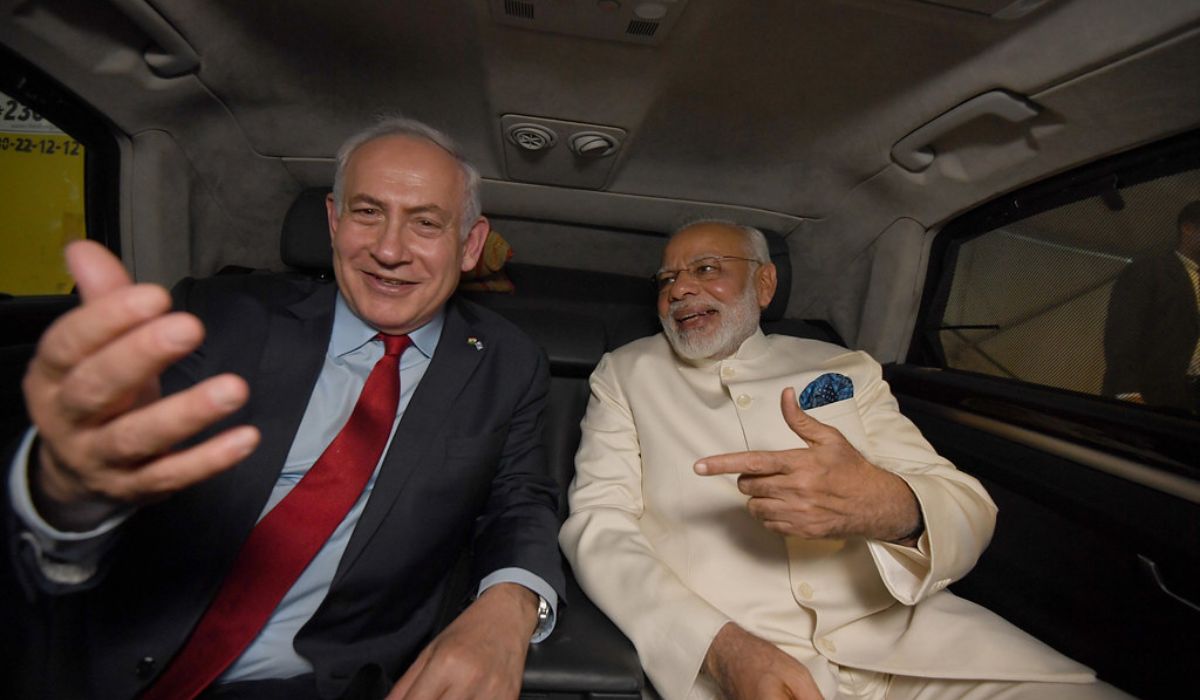
 Israel welcomes PM Modi, during his first visist in 2017. Source: Haim Zach - Israel Ministry of Foreign Affair's / cropped from original / CC BY-NC 2.0
As world oil and gas prices surge, Chris Bambery explores the impact on the Indian economy
Immediately after the outbreak of the Iran war, with the US and Israeli attacks including the assassination of the Supreme Leader, Ali Khamenei, Indian Prime Minister Narendra Modi condemned Iran’s retaliatory strikes, phoning the rulers of the United Arab Emirates, Saudi Arabia, Bahrain and Jordan to express his solidarity with them.
In doing so, Modi firmly positioned India with the US-Israeli side. That, however, comes at a cost.
India is the third-largest oil importer and consumer in the world.
The International Energy Agency (IEA) projects that India will be the largest source of global oil demand growth this decade, adding roughly 1-1.2 million barrels per day of demand by 2030 and accounting for more than 35 per cent of net global growth. India is seen as a crucial global growth driver, but that depends on its accessing oil.
Until last year, much of India’s oil came from Russia, the Russians having shifted sales eastwards after their invasion of Ukraine. Moscow offered India the oil at a discount, but last year the White House slapped 50 per cent tariffs on Indian goods – half of them to directly punish New Delhi for its Russian oil purchase. Under pressure, India switched to buying Middle Eastern oil. These have now been disrupted by the Iran war.
India’s crude imports amount to 2.5 – 2.7 million barrels per day, from Iraq, Saudi Arabia, Kuwait and the United Arab Emirates. These come to India through the Straits of Hormuz.
After Trump agreed with Modi on a 30-day waiver on some US sanctions, India has purchased 30 million barrels of oil from Russia. The state-backed Indian Oil Corporation and Reliance have bought up all unsold cargoes of Russian crude. These were bought at premiums of $2 to $8 per barrel over the price at London’s Dated Brent, costing India a great deal more.
India is also concerned about its natural gas and cooking gas supplies. It is the fourth-largest liquefied natural gas (LNG) buyer, and second-largest buyer of liquefied petroleum gas (LPG), such as that used for cooking, much of which is imported from the Middle East.
On Tuesday, it ordered tighter controls on the distribution of liquefied natural gas (LNG), requiring supplies to be prioritised for households, transport sectors and the production of LPG:
‘That would mean other sectors, including fertiliser plants, tea industries, ceramics and tile firms and restaurants and hotels would need to brace for uncertainty and potential disruptions.’
Another hit has been taken by Indian airlines. On Wednesday, Reuters reported:
“The country’s biggest international carriers, Air India and IndiGo, did not operate 64 per cent of their 1,230 scheduled flights to the Middle East, Europe and North America in the last 10 days. Pakistan has banned Indian carriers from its airspace since last April following military tensions between the two neighbours.”
The danger for India is higher inflation due to higher energy and transportation costs. That in turn could lead to further depreciation of the rupee. India has strong foreign exchange reserves and is thus protected from any such desperate situation, but these have been accumulated from foreign loans and foreign investments in India, and these liabilities are now bigger than the foreign exchange reserves, meaning that India is now in danger from any shifts in the international markets.
Modi stands with Israel
Two days before this war began, Modi went on a state visit to Israel, addressing the Knesset. That visit increased the existing ‘strategic partnership’ between the two countries to a ‘special strategic partnership’, encompassing defence and security, technology, cybersecurity, trade, and supply of Indian labour to Israel. Modi announced to the Israeli Parliament that ‘India stands with Israel, firmly, with full conviction, in this moment, and beyond.’
The Israeli and Indian economies are closely tied, particularly in the arms sector with both countries selling each other weapons. After Modi’s visit, one report noted:
‘… several news reports indicated Israel’s willingness to share technology of its Integrated Air and Missile Defence (IAMD) systems with India, specifically the Iron Dome and the Iron Beam, with some reports suggesting Arrow and David Sling systems besides offensive weapons such as the Golden Horizon air-launched ballistic missile, Spice munition guidance kits, Rampage air-to-ground missiles, Ice Breaker cruise missiles and the supersonic AIR LORA Air Launched Ballistic Missile (ALBM) missiles.’
In January, Trump said he would reduce trade tariffs on Indian goods from 50 to 18 per cent after New Delhi agreed to stop buying Russian oil. On social media, Trump wrote ‘… that Modi had also committed to “‘BUY AMERICAN’, at a much higher level, in addition to over $500 BILLION DOLLARS of U.S. Energy, Technology, Agricultural, Coal, and many other products.’
China will be watching this with interest. After Trump imposed the 50 per cent tariffs, Modi flew to Beijing to discuss closer trade links. But the two countries have long been at odds over their border, while China is a long-term ally of Pakistan. Now Modi has moved India into the US camp, we can expect Indo-Sino relations to go back to as before – a permanent state of tension. This will not play badly with Modi’s base among Hindu fundamentalists who are anti-Muslim and anti-Palestinian.
Before you go
The ongoing genocide in Gaza, Starmer’s austerity and the danger of a resurgent far right demonstrate the urgent need for socialist organisation and ideas. Counterfire has been central to the Palestine revolt and we are committed to building mass, united movements of resistance. Become a member today and join the fightback.

Chris Bambery
Chris Bambery is an author, political activist and commentator, and a supporter of Rise, the radical left wing coalition in Scotland. His books include A People's History of Scotland and The Second World War: A Marxist Analysis.