
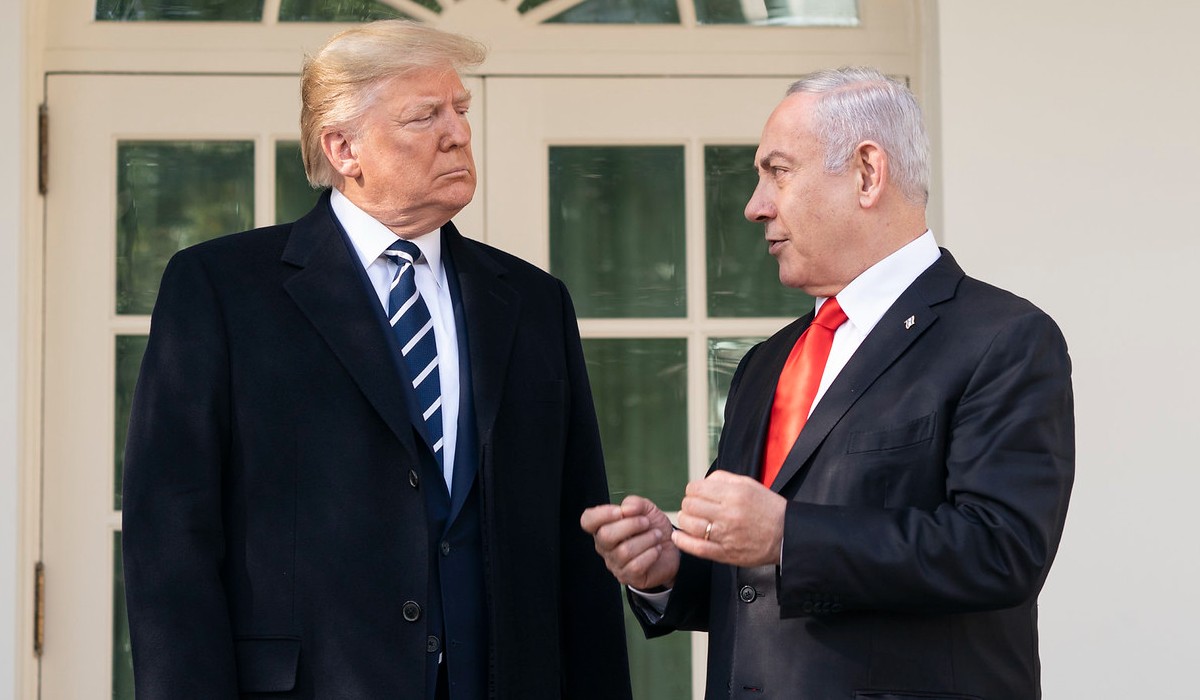
 Donald Trump and Benjamin Netanyahu. Photo: The White House
Chris Bambery dissects an opinion piece from Liberal Zionist on the Iran War
One of the myths around Israel is that within the Zionist community there is a parliamentary democracy. This only applies to Jews and not to Palestinians, including those living within pre-1967 Israel who have Israeli citizenship. I will come back to this and the argument that Israel is the only democracy in the Middle East.
The Israeli media can be quite robust. Haaretz, for instance, is a liberal-Zionist newspaper that is highly critical of the Netanyahu-led coalition government.
At the weekend, it published an opinion peace by Chuck Freilich, a former deputy national security adviser in Israel. Freilich is a liberal Zionist who has stated “only Israelis bear the responsibility for determining their future.” Self-determination for the people of Palestine is off the agenda then.
He sees the US-Israeli war on Iran as serving Netanyahu’s self-interest:
“There can be little doubt that the war is an almost desperate attempt by him to stave off electoral defeat in this year’s general election, or that this is the moment that will seal his legacy – the war he believed for three decades would be necessary to ensure Israel’s long-term security. Still, in this case, contrary to his behavior at various points during the war against Hamas, his interests and those of Israel’s are essentially the same.”
This shows the contradictions of liberal Zionism. Its supporters hate Netanyahu, but when push comes to shove and Israel is at war, those differences take second or third place.
Freilich, like many in Israel, including in the government, are worried that Trump will not stay the course in this war:
“… although the U.S. and Israel began the war with Iran with congruent strategic objectives, subsequent conflicting statements by President Trump and his administration are mudding the picture.”
The “congruent strategic objectives” were regime change. Trump’s initial statement after the bombing started and the Supreme Leader, Ali Khamenei, was assassinated, was to call on the Iranian people to rise up.
For the Israelis, the US made no secret that they wanted to divide up Iran, as in Libya and Syria, to ensure no nation state capable of challenging it would remain.
Freilich is very aware that Trump does not reflect popular opinion in the US on this war:
“Talk about paradoxes. As recent polls show, Israel’s standing in American public opinion has never been lower, but strategic cooperation between the two countries has never been closer. For only the second time ever – and the second time in less than a year – the United States and Israel are fighting a war together. This time it’s a major war in which Israel is an almost equal partner, contributing more than virtually any other American ally is capable of.”
Freilich is clearly worried about where the people of the US stand in relation to this war:
“Today, polls show a collapse of support for Israel among Democrats, a decline among Republicans and an overall majority of Americans who now favor the Palestinians over Israel. Once again, the personal role played by the U.S. president, over the objections of much of his political base, has made all the difference.”
He might have added that a majority of Americans disapprove of how President Donald Trump is managing the U.S.-Israeli conflict with Iran and 56% oppose the military action outright.
But what Freilich shows is just how much more important Israel is compared to European allies such as the UK, France and Germany:
“Israel’s conventional military capabilities, in the air and on the ground, exceed those of all of Washington’s allies, with the exception of South Korea. Let me restate this so it sinks in: Israel, a ministate with the population of New York City, has built conventional military capabilities that exceed those of all major American allies but one.”
America can wage war with only Israel because the enemy is Iran, and Trump and Netanyahu know first-hand that Saudi Arabia, the rest of the Gulf and other states do not want an Iran able to exert its power in the region, and certainly do not want it to develop a nuclear bomb. The Saudis have had many undercover meetings with Mossad to discuss the supposed Iranian threat.
At the close of January, the head of Israel’s Military Intelligence Directorate, Major Gen. Shlomi Binder, was in Washington for a series of high-level consultations with the top leadership at the Pentagon, the CIA and the White House, on the Tuesday and Wednesday:
“The visit was said to be centered on delivering specific intelligence requested by the Trump administration, including data on potential strike targets within Iran.”
Then on the Thursday, Saudi Defense Minister Prince Khalid Bin Salman said he met with top administration figures to discuss “regional and global peace and stability.”
I’ve previously noted that The Washington Post reported on 28 February, 2026:
“Saudi Crown Prince Mohammed bin Salman made multiple private phone calls to Trump over the past month advocating a U.S. attack, despite his public support for a diplomatic solution… In his discussions with U.S. officials, however, the Saudi leader warned that Iran would come away stronger and more dangerous if the United States did not strike now.”
Underlying the enmity between Saudi and Iran is the sectarian conflict between Sunni and Shi’a Islam. If the US and Israel win in this war where else would Israel look for enemies – because a society at permanent war always needs an enemy. The obvious candidate would be Türkiye. It’s a regional sub-imperialism balancing between the US and NATO, of which its a member, on the one hand, and China and Russia on the other. It has its own interests in Kurdistan and Syria which oppose those of Washington and Tel Aviv.
On the eve of the start of the Iran war, former Israeli Prime Minister Naftali Bennett, who will lead the opposition to Netanyahu in elections this year, declared that Türkiye was a threat to Israel. Bennett said that it was part of a regional axis “similar to the Iranian one.” Going on to add:
“A new Turkish threat is emerging. We must act in different ways, but simultaneously against the threat from Tehran and against the hostility from Ankara.”
Prior to last month’s visit of Indian prime minister, Narendra Modi, to Israel, Netanyahu, declared his intention to forge a new “hexagon” of alliances that would outflank a so-called “emerging radical Sunni [Muslim] axis”, and cement Israel’s regional influence:
“Included in that alliance would be countries like Greece and Cyprus, which have historically had antagonistic relations with Türkiye.”
The same Al Jazeera report quoted Alon Pinkas, a former Israeli ambassador, thus:
“Politicians like Naftali Bennett and Benjamin Netanyahu rely on the perpetual threat of war. If it wasn’t Türkiye, it would be Iraq. If it wasn’t Iraq, it would be Hezbollah. If it wasn’t Hezbollah, it would be the Muslim Brotherhood. It doesn’t matter who. There just always needs to be a threat.”
That’s 100 percent correct.
Back to Chuck Freilich in Haaretz, who is worried about how the war is going:
“The Iranian regime may prove even more resilient to external and internal pressures for change than skeptical experts already believe. A protracted closure of the Strait of Hormuz and significant damage to Gulf states’ oil and gas facilities could trigger a global energy crunch and lead to heavy international and domestic pressure in the U.S. to end the war before the objectives have been achieved. Shortfalls in critical U.S. and Israeli military capabilities, both offensive and defensive, especially interceptors for antimissile systems (the American THAAD and the Israeli Arrow and Iron Dome) could constrain ongoing operations.”
But amidst all his worries and criticisms, Freilich believes the war with Iran is a correct war:
“For those who doubt the necessity of the current war, imagine that it took place a few years in the future, when Iran’s missile capabilities were vastly greater. It may have crossed the nuclear threshold, making its ability to deter not just Israel but the United States far greater. Strategic patience is a virtue – up to a point.”
His end note is this:
“A final question is whether Israel will take advantage of its vastly improved strategic situation to promote a broader strategic agenda, including progress toward resolution of the situation in Gaza and even toward a broader political settlement with the Palestinians. This would also include normalization with the Gulf states, with all the attendant advantages of regional economic integration, and the opportunity to salvage Israel’s relations with the United States, before the damage becomes irreparable.”
How he thinks either Netanyahu or Bennett would make “progress toward resolution of the situation in Gaza and even toward a broader political settlement with the Palestinians,” is anyone’s guess. Both are committed Zionists and, at best, want the Palestinans on their knees before Israel.
I read one more article in Sunday’s Mail in which they interview Edinburgh-born Danielle Bett, who now lives in Tel Aviv. She said that air raid sirens ordering her to go to the nearest bomb shelter had woken her three times the previous night with a further three as of mid-afternoon.
In the interview she said:
“The first two days were the worst but it’s not like it’s gone down to only a couple of sirens a day. Last night we had three through the night. Iranian missiles are not like Hezbollah or Hamas rockets. These are very serious weapons that can take out a whole street so you have to get a bomb shelter very quickly and jump out of bed and get to safety.
There hasn’t been massive destruction but a lot of people have had to leave their homes.”
Danielle concludes:
“I do question, what is the plan? Do I believe in Netanyahu and Trump’s ability to bring long-term peace and security to this region? No, I don’t trust my government when it comes to delivering this. I’m not just going to trust and not ask questions.”
I do not know how many Israelis concur with her, I believe she is in a minority. But her description of what life in Tel Aviv is like in this war rings true. Netanyahu has imposed tight censorship on reporting Iranian strikes on Israel. It’s clear they are getting through which rather goes against the American and Israeli narrative that have degraded Iran’s ability to resist.
What is interesting about Freilich’s Haaretz piece is what’s said in the chat. Ann, clearly from the USA, writes:
“Worrying? Most Americans are worried sick about how much our golden calf America is being sacrificed for Israel’s objectives. We have no healthcare, no education, but we’ve sent billions to Israel to enact Greater Israel and the zionists’ plan for regional hegemony. Nothing would relieve us more than daylight between Netty and Trump. We’ll have no such luck of course as long as the pdf files are a threat.”
Like so many the last point is that Trump launched this war to divert attention from the Epstein files. Whether it is true or not, this is what many Americans believe.
Returning to Chuck Freilich, the one thing he and I agree on is that this is not going to be a quick war. How that plays out in the US will be crucial.
Before you go
The ongoing genocide in Gaza, Starmer’s austerity and the danger of a resurgent far right demonstrate the urgent need for socialist organisation and ideas. Counterfire has been central to the Palestine revolt and we are committed to building mass, united movements of resistance. Become a member today and join the fightback.

Chris Bambery
Chris Bambery is an author, political activist and commentator, and a supporter of Rise, the radical left wing coalition in Scotland. His books include A People's History of Scotland and The Second World War: A Marxist Analysis.