
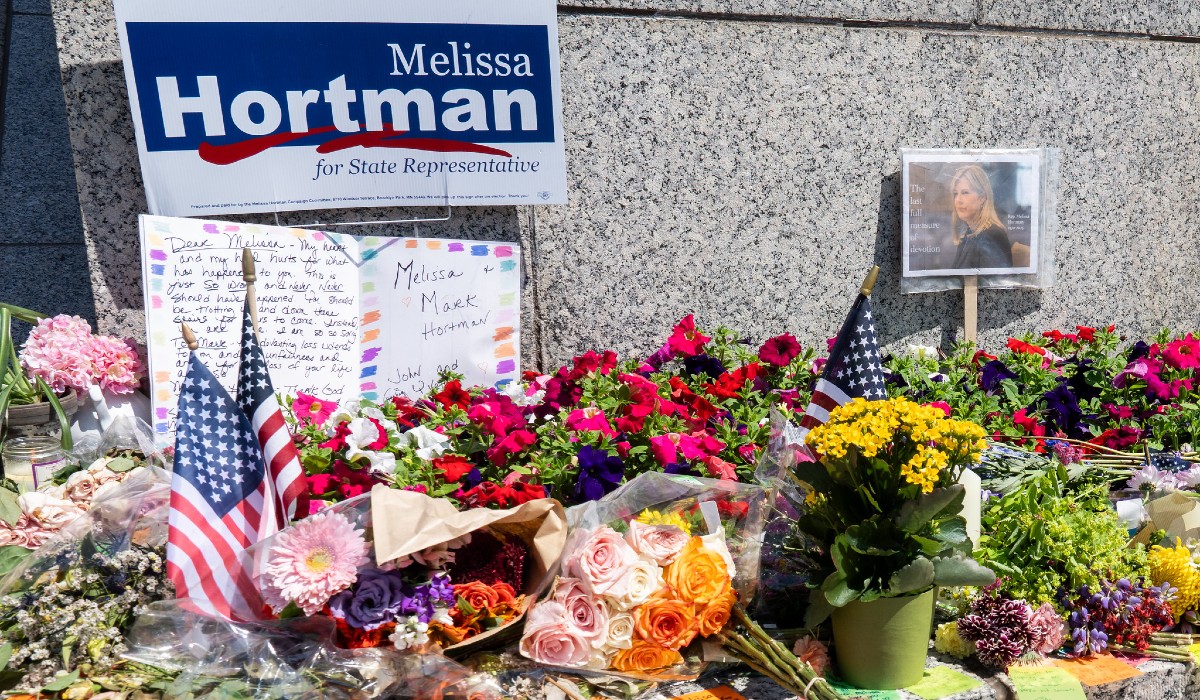
 A growing memorial at the Minnesota State Capitol for State Representative Melissa Hortman / Flickr: Chad Davis / CC BY 2.0
The recent political assassinations in the US flow directly from Trump’s strategy of stirring up reactionary rage against his opponents, characterised as the ‘enemy within’, argues John Clarke
On 14 June, Democratic Minnesota State Representative Melissa Hortman and her husband were shot and killed in their home by a masked man disguised as a police officer. Shortly before this, State Senator John Hoffman, also a Democrat, was shot and wounded along with his wife. With full justification, Minnesota Governor Tim Walz described the killings as a ‘politically-motivated assassination’ and stated that both of the attacks were acts of ‘targeted political violence’.
Shortly after the shootings, police announced that they were seeking a suspect, Vance Luther Boelter, with whom they had exchanged gunfire at Hortman’s residence. According to ABC News, the ‘suspect’s vehicle — which looked like a police vehicle, including police lights — was in Hortman’s driveway.’
Boelter ‘helped lead the private security firm Praetorian Guard Security Services’ and he has ‘an extensive background in security and military training.’ Police also say that he ‘had a target list with the names of dozens of Minnesota Democrats.’ In addition, ‘the names of abortion providers and pro-choice activists’ were included among the potential victims.
Police arrested Boelter the next day and say he was armed when they captured him. They also reported that he had visited the homes of four Democratic politicians on the night of the shootings ‘with the intent to kill them’. Al Jazeera reports that Boelter has been ‘charged with four felony charges: two counts of second-degree murder and two counts of second-degree attempted murder.’
Political context
From the evidence that has so far emerged, it seems entirely reasonable to infer that the attacks in Minneapolis were part of a wave of right-wing violence in the US. As such, they must be placed in a political context and viewed from the standpoint of the hateful climate that has been created by the Trump administration.
Trump himself only made a very limited effort to deplore the attacks on the Democratic politicians. He did issue the kind of formal condemnation that is customary in such circumstances, saying, ‘Such horrific violence will not be tolerated in the United States of America. God Bless the great people of Minnesota, a truly great place.’ At the same time, however, he also used the occasion to attack his Democratic rivals. He told the media that, ‘Well, it’s a terrible thing. I think [Walz is] a terrible governor. I think he’s a grossly incompetent person. But I may, I may call him, I may call other people too.’
The Democratic Party is one of the two political formations that serves the interests of the US capitalist class both domestically and internationally and there is no question of any political support for the representatives of that party. At the same time, however, the spread of right-wing violence and the increasing authoritarianism of the Trump administration are matters of great concern for working-class organisations and popular movements. As such, the horrible attacks on Democratic representatives in Minnesota are extremely alarming and represent a major threat.
The Contrarian has pointed out that the ‘United States continues to lurch toward authoritarianism under Donald Trump—and his repeated incitements to violence have dangerously normalized the use of deadly force against politicians. He has created a political climate that makes it likely that assassinations will become a more frequent part of America’s news cycle.’
The article goes on to argue that at ‘every opportunity, Trump has played the arsonist. He has deliberately heated up a climate in which targeted violence has become part of the normal realm of politics.’ It is not, however, simply a matter of Trump’s inflamed rhetoric or his confrontational style. His political agenda is largely based on the promotion of hatred, the targeting of sections of the population and the crushing of dissent.
Trump has promoted intolerance and hatred across a wide front, sparing no effort to castigate and weaken measures designed to compensate for systemic forms of discrimination. Prior to Trump’s re-election, the American Civil Liberties Union warned that he intended to ‘eradicate both public and private diversity, equity, and inclusion (DEI) policies. This attack on DEI is part of a larger backlash against racial justice efforts ignited by the 2020 killings of George Floyd, Ahmaud Arbery, and Breonna Taylor, and the nationwide protests — unprecedented in size and diversity — that followed.’
Last year, during a presidential debate with Kamala Harris, Trump was ready to repeat the vilest and crudest forms of racist slander. With regard to Haitian immigrants in Ohio, he stated that ‘they’re eating the dogs, the people that came in, they’re eating the cats. They’re eating the pets of the people that live there.’
The racism that Trump has promoted has been utilised to build a base of support for his deliberately high-profile efforts to ramp up the deportation of undocumented immigrants. The now notorious Ice raids that his administration has set in motion have been very deliberately operated as a public spectacle fully intended to whip up the most hateful emotions.
At the beginning of Trump’s second term, the Conversation pointed to this effort to engender racist sentiment. ‘“Animals,” “aliens” and “people with bad genes” – President Donald Trump and his supporters often use this kind of dehumanizing language to describe immigrants.’ With such thinking as a driving force, the Trump administration has laid plans to round up and deport a staggering 3,000 people a day or a million per year.
Enemy within
Trump’s agenda requires a mood of reactionary rage to carry it forward and, as it is set in motion, it intensifies this same mood to the level of a frenzy. Though, as I have suggested, the Democratic Party is actually only a moderate agent of the same capitalist interests that Trump serves, as far as he and his supporters are concerned, it is both a political impediment and a rallying point for dangerous liberal ideas and practices that need to be stamped out. As such, the rival party is to be demonised and attacked with full vigour.
In 2024, Trump railed against the Democratic forces behind the legal challenges that he had faced. He told Fox News that ‘I always say, we have two enemies. We have the outside enemy, and then we have the enemy from within, and the enemy from within, in my opinion, is more dangerous than China, Russia and all these countries.’
Though Trump may not be quite ready openly to endorse lethal attacks on his opponents, there is no question that his use of the enemy within image can only justify and encourage such behaviour on the part of his base of support. Trump may choose to distance himself from the murderous actions that Vance Luther Boelter is accused of but these attacks are not simply the conduct of a warped individual. They flow from the political logic that Trump consistently promotes.
Indeed, during his second term, Trump has shown a greatly increased readiness to impose his agenda by the most authoritarian means. He is ready to defy court orders, to criminalise protests and stifle democratic freedoms. He is prepared to dispense with the niceties associated with liberal democracy and to crush dissent without hesitation. Relatively early in this presidency, he is behaving in ways that are highly dangerous but that also suggest that there is very much worse to come.
The shootings of the Democratic politicians came from within the base that Donald Trump relies upon. They give expression to a hateful violence that he has unleashed and they point to the ugly future for which he and his supporters are working. As people across the US challenge the racist immigration raids and millions take to the streets to oppose Trump’s agenda, the reactionary and dangerous nature of what they are confronting can be seen clearly in the brutal political violence that has been unleashed in Minnesota.
Before you go
The ongoing genocide in Gaza, Starmer’s austerity and the danger of a resurgent far right demonstrate the urgent need for socialist organisation and ideas. Counterfire has been central to the Palestine revolt and we are committed to building mass, united movements of resistance. Become a member today and join the fightback.

John Clarke
John Clarke became an organiser with the Ontario Coalition Against Poverty when it was formed in 1990 and has been involved in mobilising poor communities under attack ever since.