
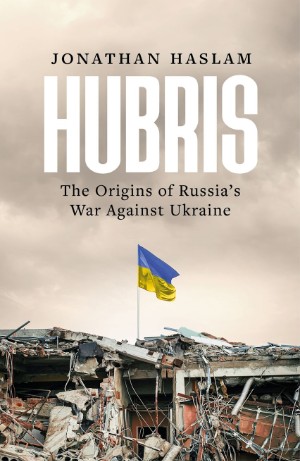
 Jonathan Haslam, Hubris: The Origins of Russia's War Against Ukraine (Bloomsbury 2025), 368pp.
Hubris accuses Nato of a history of arrogant unilateralism which frightened and antagonised Russia such that it must share the blame for the current war, finds Zahid Rahman
The war in Ukraine has been raging for the past three and a half years, claiming hundreds of thousands of lives. It is the biggest war fought in Europe since World War Two. Jonathan Haslam, an expert in Soviet foreign policy and espionage, explores the origins of the war in Ukraine and the events leading up to Russia’s invasion in February 2022.
By the title of the book, Hubris, followed by the subtitle, The Origins of Russia’s War in Ukraine, one might expect the book to explore Russian arrogance and self-overconfidence about waging a war in Ukraine. Instead this book charts the role of the arrogance of the world’s sole superpower, the United States, in the wake of winning the Cold War.
Hubris follows each US administration from the late 1980s onwards and lays a compelling case directly connecting the decision of the US to maintain the existence of Nato after the Cold War, and even to enlarge Nato to justify its existence and ‘save it’, to the Russian invasion of Ukraine. This was despite US Secretary of State Jim Baker’s assurances to Soviet foreign minister, Eduard Shevardnadze, of ‘iron-clad guarantees that NATO’s jurisdiction or forces would not move eastward.’ The 1999 inclusion of Poland, Hungary, and the Czech Republic into Nato marked a clear departure from earlier post-Cold War promises made to the Soviet leadership the alliance would not expand ‘one inch eastward’.
The 2004 ‘big bang’ enlargement, bringing in seven more countries including the Baltic states, further deepened Moscow’s perception that it was being encircled. Haslam draws a singular metaphor for this, describing a couple’s wish to save their marriage by having another child; in this case having a child is Nato enlarging itself. The core idea for the US to have embarked on this project, that of expanding a superfluous alliance, was to maintain hegemonic dominance through a political and military presence in Europe.
Neither the Americans nor many of their European partners, save Germany and France at times, heeded Russia’s loudly expressed anxieties over the enlargement of Nato, begun under President Bill Clinton. There was also significant tension within the American establishment on the topic of expansion in the 1990s with those opposing expansion including figures such as George Kennan and surprisingly, Kissinger. Leonty Shevtsov, a colonel-general in the Russian military who was part of the Nato-led peacekeeping missions in former Yugoslavia, reflected how he struggled to find a single American general in favour of expansion. This reflected a deep divide within the political and military elites in the United States.
Unilateral actions
Haslam goes on to highlight a significant lack of foresight in Western interventions around the world which had also helped to antagonise Russia. Nato intervention in Kosovo was preceded by Western intelligence services abetting Kosovan separatists to break a ceasefire This was the most significant of the interventions that made Russia wary. Nato acted unilaterally without UN approval, setting a precedent for bypassing international law. Russia, having historically close ties with Serbia, interpreted this not only as a threat to Slavic solidarity but also as a warning of Nato’s willingness to act without consensus. This sense of betrayal was exacerbated by the fact that Russia had supported Western diplomatic efforts in the region, only to be ignored when military action was taken. This had a cumulative effect when tied together with the invasion of Iraq and the destabilisation of Libya which both severely antagonised Russia.
One of the signals that Nato quite arrogantly ignored was when the US had plans to accelerate the process of membership for Georgia and Ukraine in 2008, two ex-Soviet states. Russia had lashed out by invading parts of Georgia that same year. This mistake was repeated in Maidan Square in 2014 where US officials as high-ranking as the Assistant Secretary of State for European and Eurasian Affairs were, with their physical presence at the square itself, working to have Yanukovych removed from power. Rarely has such an incident of open imperialist ambition been seen in the post-Cold-War world. Again, Russia retaliated by annexing Crimea and fomenting a war in the Donbas region in Ukraine between Russian-backed separatists and the new Kyiv government.
However, further Western negligence of the very wide gap that had emerged between Russian and American policies led directly to the full-scale war in Ukraine that began in 2022. The military quagmire that exists currently in Ukraine, characterised by a snail-paced Russian advance on several fronts, continue to pile the bodies high in this attritional war. Haslam’s book is a useful addition to the case against the Western proxy war in Ukraine. It challenges the narrative of many historians in the West that the cause of the Russo-Ukrainian War is exclusively Russian territorial ambitions. I highly recommend this book for those who want to study the post-Cold War history of Russian-American relations.
Before you go
The ongoing genocide in Gaza, Starmer’s austerity and the danger of a resurgent far right demonstrate the urgent need for socialist organisation and ideas. Counterfire has been central to the Palestine revolt and we are committed to building mass, united movements of resistance. Become a member today and join the fightback.
