
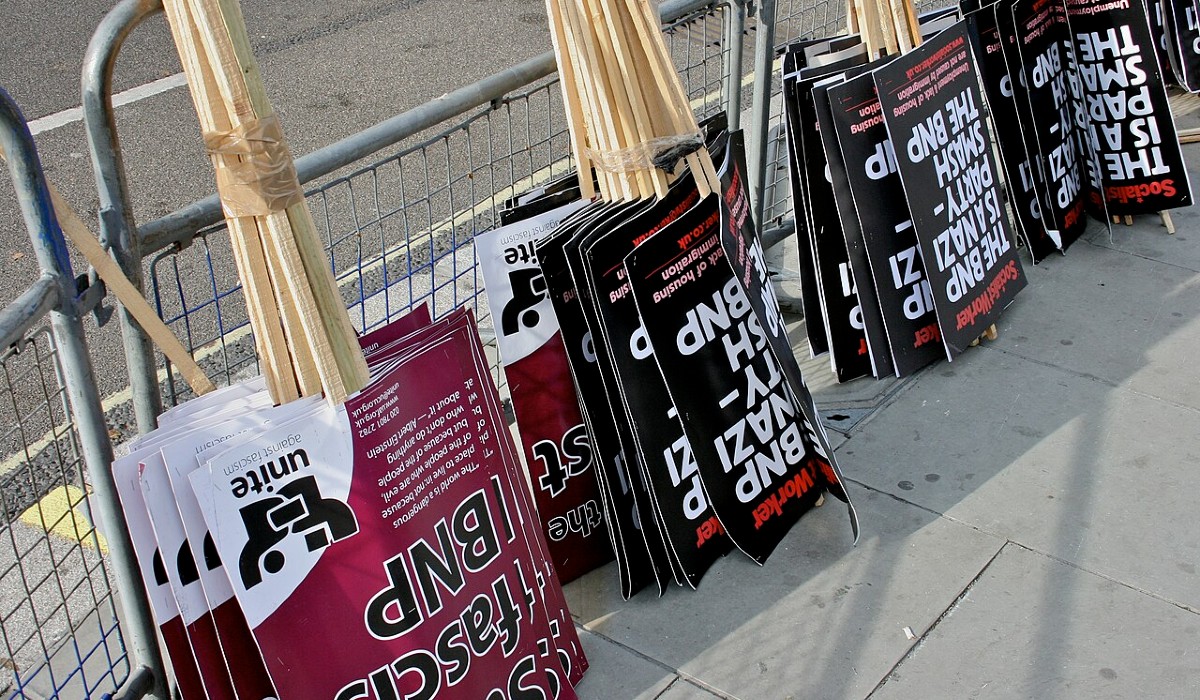
 Anti-BNP placards outside BBC Question Time. Photo: Mike Peel / Wikimedia Commons / CC-BY-SA-4.0
The danger we face from racist, right-wing forces now can be faced, but we need to learn from the victories of the past in how to organise the working class, argues Chris Bambery
We should brace ourselves for further protests outside hotels where migrants are accommodated following the court cases over migrants staying at the Bell Inn in Epping. The overturning of the original verdict ordering them to be moved will only anger the various hardcore racist and Nazi groupings behind many of these protests.
While they are present, and often play a lead role, the majority on these protests are usually local people who have fallen for lies about migrants getting luxury accommodation but are also angry over the lack of affordable accommodation for their families. Shouting ‘Nazi scum’ at these people will simply alienate them from the anti-racists and, possibly drive, them further into the hands of Nazis.
History never repeats itself but in the 1970s and then the 1990s, when first the National Front and then its offshoot the British National Party were on the rise, the Anti-Nazi League set out not just simply to oppose the Nazis physically whenever they tried to march or hold a rally, it also set out to drive a wedge between the Nazis and the soft racists who voted for them.
Leaflets were distributed door to door showing John Tyndall, chair of the NF and then the BNP, wearing full Nazi uniform and quoting him in is admiration for Adolf Hitler. That was highly effective in drawing attention to the fact that both the NF and BNP were not just patriotic organisations but were Nazis whose leaders had a string of convictions for their Hitlerite views.
Even that was not enough. In addition to direct anti-Nazi activity, it was necessary to get into the communities where the Nazis were gaining support and to mobilise there around the economic and social issues creating the anger they sought to divert against Afro-Caribbeans and South Asians.
The BNP in the 1990s
I want to look at one example in which I was closely involved as then National Secretary of the Socialist Workers Party.
Tower Hamlets in East London at the beginning of the 1990s was run down, suffering from the closure of the docks and the traumas of the Thatcher years. Its council was run by the Liberal Democrats who used racism to build their support, claiming Labour favoured Asians over white people, particularly in the allocation of council housing. That few council houses were being built or that Thatcher had sold off so many, did not get in their way.
The Isle of Dogs was not what it is now. It was quite cut off and relatively insular. The closure of the docks had ripped the heart out of a once strong, working-class community.
The first giant office blocks at Canary Wharf had just gone up and there was the beginning of new housing developments for the well off. The contrast between that and the run-down estates on the Island was obvious.
The Island voted Labour solidly, the Lib Dems had not got an in there, but many Islanders felt Labour took it for granted (sound familiar?). The BNP saw Tower Hamlets as a crucial area for them, and began to operate on the Island, picking up on housing issues, saying that South Asians were getting houses, not Islanders.
So, in October 1992, this was where the BNP won 20% of the vote (657 votes) in a council by-election in Millwall. They began to build on that, putting out a regular bulletin they distributed door to door as part of a ‘Rights for Whites’ campaign.
After a local white boy was injured in a fight with Asian youths, the BNP organised a protest but carefully ensured the boot-boys stayed away and there were no Nazi salutes or symbols. Three to four hundred local people joined in waving St George’s flags and singing ‘Rule Britannia’ and so on (sound familiar?). In that situation, branding the bulk of the protesters as Nazis would have been gross stupidity.
Then, on 23 September 1993, a Labour councillor in Millwall resigned, resulting in a by-election. The BNP stood an unemployed lorry driver, Derek Beacon, gained 34% of the vote (1,480 votes) and won its first-ever election, admittedly by just a handful of votes. This was something Sir Oswald Mosley’s British Union of Fascists in the 1930s or the NF in the 1970s had never achieved.
I remember joining ANL members and other anti-fascists outside the count, where the BNP were just as numerous and, obviously very cocky. It was obvious too that they had local support, something we did not have, yet. As they threw bottles as well as Nazi salutes, it was very concerning. Luckily, the next morning, Tower Hamlets council staff walked out on strike after management had told them they had to treat Beacon like any other councillor.
The reasons behind the BNP win soon became obvious. Firstly, they benefitted from the Lib-Dem council’s racism. The council had introduced a ‘sons and daughters’ housing scheme that prioritised housing through a points scheme, based on how long family members had lived in the area. The slogan ‘Island homes for Island people’ soon gained traction.
In response, in the build up to the September Millwall by-election, Labour had actually played up the chances of the BNP winning, believing this would help mobilise support. It did not, instead it transformed the unlikely Derek Beacon into someone who stood a chance of winning. Faced with a real racist, many Lib Dem voters switched to the BNP.
Anti-fascism
Elsewhere in Tower Hamlets, the BNP were showing their true face. After Beacon’s win, the ANL organised street stalls in Brick Lane. These were attacked by a mob of BNP thugs who put two people in hospital.
The ANL responded by organising to drive the BNP off from their regular Sunday morning paper sale at the top of Brock Lane. We got there early and took over their pitch. They gathered on the other side of the road. It seemed a stand-off with the police lining up to pen us in. A quick chat with Julie Waterson, the ANL organiser, myself and others came up with a plan.
While Julie organised to push at police lines in the centre, so the cops concentrated there, I organised a charge across the road from our left. The Nazis took to their heels. At one stage, TV cameras caught a five-foot-tall Jewish woman, who was also a Goth, kicking a Nazi who was on the ground with her stiletto boots. That was one thing he would never boast about. The Nazis never returned.
The ANL was busy organising door-to-door leafletting on the Island. At one point, a full-scale fight took place between a canvassing team I was stewarding and a rival BNP team who came marching up the road.
We got a major boost when the Trades Union Congress called a demonstration in Tower Hamlets against racism. Some 40,000 marched, including a large ANL contingent, but crucially, there was a great turn out of trade-union branches, many from East London.
In the immediate aftermath, the SWP had decided that the ANL was doing an excellent job but another element was necessary. We had a handful of members on the Isle of Dogs but now we decided to launch a branch there.
Was this us simply seizing an opportunity to recruit? Well, we always wanted to build our organisation, but no. The primary reason was that while the ANL was doing vital anti-Nazi work, we wanted to get into the Island community and campaign on the run-down health service there, and on housing. It was important to show that the blame for problems rightly lay with property speculators, the council and the Tory government and not Bengalis. We explained the NHS had been built by migrant labour and relied on them every day.
We put out our own bulletins around these issues. We did not come up with this ourselves but were using a template laid down by Phil Piratin. He was a leading East London Communist in the 1930s. Piratin would be elected MP for Mile End and Stepney in 1945.
After the Communist Party had played a leading role in the October 1936 Battle of Cable Street, where anti-fascists stopped Mosley marching into Britain’s biggest working-class Jewish community, the Communists decided to follow this up by campaigning on housing. They formed Tenants Associations which physically blocked evictions of tenants by private landlords when they could not afford the rent; this was the 1930s with mass unemployment.
That involved Piratin and his comrades blocking the eviction of a family, the father of which was a BUF member. They succeeded and then pointed out that the BUF was absent when the family needed support. That family drew the right conclusion that Mosley was not concerned about working people, whatever background they came from. There was much wrong with the Communist Party in the 1930s due to its loyalty to Stalin, but in this approach to anti-fascism, they set a great example.
Organising the working class
Returning to the 90s, as part of the community campaigns, we also built up support among local trade-union branches and workplaces. A local fire station was under threat of closure, and we campaigned alongside Fire Brigade Union members over that.
The BNP could not get a look in here because the union was strongly anti-racist. ANL rallies and protests now involved local firefighters, NHS workers, council and civil service workers. It was hard for the Nazis to target the local nurse or firefighter!
A group of former dockers did great work on the Island reminding people there of the great union tradition in the London docks and how that involved Irish migrants who had been discriminated against just as the Bengalis were now.
Organising ANL groups in the colleges, particularly in the FE colleges, was important too. Young people mixed together, often unlike their parents. Huge numbers of teenagers joined the ANL and took part in its activity, as well as joining the TUC demo en masse.
In October 1993, after the horrendous racist murder of Stephen Lawrence, some 60,000 people joined a unity demonstration, involving the ANL and other anti-racist organisations, which attempted to get through to the BNP HQ in Welling. It was blocked by the police, who launched charge after charge by mounted police and riot squads. The march could not get through but it was headline news that night on TV. We did not feel defeated, far from it.
Come the May 1994 council elections, Beacon lost the seat to the Labour Party, although he still came second with 2,041 votes (28%). An Anti-Nazi League carnival in May 1994 saw 150,000 celebrating that victory which the ANL had done so much to achieve.
Today, as we face anti-migrant protests, we cannot just copy what we did then. But the past holds valuable lessons. In particular, we need to build into these communities around issues like housing and health care to undercut the hard-core Nazis, and indeed Reform UK.
When I see pictures of working-class woman wearing Union Jack hats obviously left over from VE day centenary celebrations, the last thing I want to do is shout ‘Nazi scum’ at them. Instead, I might ask who was the midwife who delivered their grandchildren or who is looking after a loved one or friend in care? We rely on migrant labour: do they want to send them ‘home’?
And if some hard-core racist or Nazi butts in, I might add why are Afghanis, Syrians, Libyans and Iraqis in that hotel? Isn’t the UK part of America’s ‘forever wars’ and what have they achieved? Blame Tony Blair, Gordon Brown, David Cameron, Theresa May, Liz Truss, Boris Johnson, Rishi Snak and Sir Keir Starmer, not some Afghani who fled for their life from the Taliban.
As I write, news is coming in of a protest outside a hotel housing migrants in Uxbridge, West London. Back in the 1990s, the radical left had a good presence there, linked into the local trade unions. Today that’s gone. We have to mobilise against these anti-migrant protests but we also need to build a left presence in these communities campaigning around social and economic issues, as well as spreading the anti-racist message.
Before you go
The ongoing genocide in Gaza, Starmer’s austerity and the danger of a resurgent far right demonstrate the urgent need for socialist organisation and ideas. Counterfire has been central to the Palestine revolt and we are committed to building mass, united movements of resistance. Become a member today and join the fightback.

Chris Bambery
Chris Bambery is an author, political activist and commentator, and a supporter of Rise, the radical left wing coalition in Scotland. His books include A People's History of Scotland and The Second World War: A Marxist Analysis.