
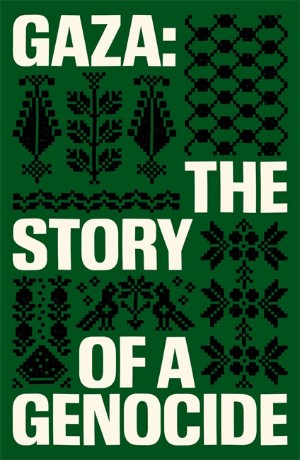
 Gaza: The Story of a Genocide, eds. Fatima Bhutto and Sonia Faleiro (London: Verso 2025), 304pp.
This collection of articles is essential reading to understand both the forces behind the genocide and the Palestinian struggle for liberation, finds Zahid Rahman
The movement for Palestinian liberation has taken on an unmistakably global character. For more than two years, millions across the world have mobilised in outrage at Israel’s genocide in Gaza, with many more continuing to do so. This has frequently been described as the ‘world’s first live-streamed genocide’. Ordinary Palestinians in Gaza have been able to document their own reality, having ‘written and published poems and stories, [and] posted videos and photos’ (pp.1–2). Central to this flow of information have been Gaza’s journalists, whose fearless reporting has come at an immense cost: hundreds have been deliberately targeted and killed by Israeli airstrikes because of their work.
Gaza: The Story of a Genocide brings together twenty contributions written by Palestinians themselves. While most focus directly on Gaza, the collection also addresses the wider system of oppression facing Palestinians in the West Bank and in exile. The contributions take varied forms including short essays, personal testimonies, artwork, and journalistic reports, collectively offering a powerful, ground-level account of life under settler-colonial violence.
A particularly important intervention comes in Yara Hawari’s chapter, ‘On Israeli Settler Colonialism’, which provides a sharp analysis of Israel’s role within the broader structures of Western imperialism. Hawari argues that the relationship between US foreign policy and Israel is not merely strategic but ‘existential’ (p.7): Israel functions as a key regional outpost of imperial power, while US political, military, and economic support is indispensable to the maintenance of Israel’s settler-colonial project. The US has been crucial to Israeli designs to devastate Palestinian life in Gaza. Israel has used more munitions than it has had in store and definitely more than it could produce; the war effort has been carried by the American arms industry.
One of the most striking and unsettling chapters in the book is ‘Unsafe Passage’ by Mosab Abu Toha. It is a deeply personal account of a man struggling to keep his family alive inside a war zone. After months of displacement and sheltering under bombardment, Mosab tells his family that he will attempt to leave Gaza through Rafah with his wife and three children. To do so, he must pass a makeshift Israeli checkpoint, positioned beside a Merkava tank; it was the first time he had seen Israeli soldiers. It is there that he is stopped, separated from his family, and detained. What follows is a harrowing description of his imprisonment by the Israeli military. Abu Toha recounts beatings, humiliation, and arbitrary cruelty, conveying a system in which Palestinians are rendered entirely powerless. The reader is left with a profound sense of helplessness as these injustices unfold, culminating in his sudden release with the chillingly casual words: ‘We are sorry about the mistake. You are going home.’ The banality of this statement, following such violence, underscores the routine nature of abuse within Israel’s detention regime.
Although the scale of destruction in Gaza has been marginally reduced under the so-called ‘ceasefire’, the future remains bleak. The systematic destruction of water infrastructure has rendered clean water a luxury for Palestinians, while dramatically increasing the risk of outbreaks of waterborne disease (p.120). The devastation of Gaza is also structural and long-term. Israel has destroyed food-producing industries – crops, greenhouses, orchards, and fisheries – undermining any prospect of food sovereignty and deepening dependency on external aid (p.124). The same external aid that Israel has been restricting to Gaza, at different levels of intensity, since the start of the siege in 2007. Recently, as of January 2026, thirty-seven humanitarian organisations, including Oxfam branches, Médecins Sans Frontières, and Medical Aid for Palestinians have been banned from entering Gaza by the IDF.
Even reconstruction carries catastrophic consequences: rebuilding Gaza is projected to generate more carbon emissions than those produced individually by over 130 countries (p.130), exposing the environmental cost of imperial violence and the lasting ecological damage. This book is an exceptionally well-written and carefully curated anthology documenting the genocide in Gaza. It offers an intimate focus on the lives of Palestinians both inside and outside the Strip, contrasting their experiences before and after the destruction of the places they once called home. Through this, the collection powerfully conveys not only the scale of physical devastation but also its profound human cost.
If one were to suggest a limitation, it would be the relative absence of sustained discussion of the global mass solidarity movement with Gaza. In many countries, particularly across Europe, this movement has mobilised millions and generated crises of legitimacy for imperialism and for political support of the Israeli state. While one chapter touches on student activism on university campuses, the sheer scale of international mobilisation that often involves hundreds of thousands in individual countries marks a significant political shift that might have been more fully explored.
Nonetheless, this remains essential reading. As both a historical document and a political intervention, the book stands as a vital contribution to understanding the realities of Gaza and the broader struggle for Palestinian liberation.
Before you go
The ongoing genocide in Gaza, Starmer’s austerity and the danger of a resurgent far right demonstrate the urgent need for socialist organisation and ideas. Counterfire has been central to the Palestine revolt and we are committed to building mass, united movements of resistance. Become a member today and join the fightback.
