
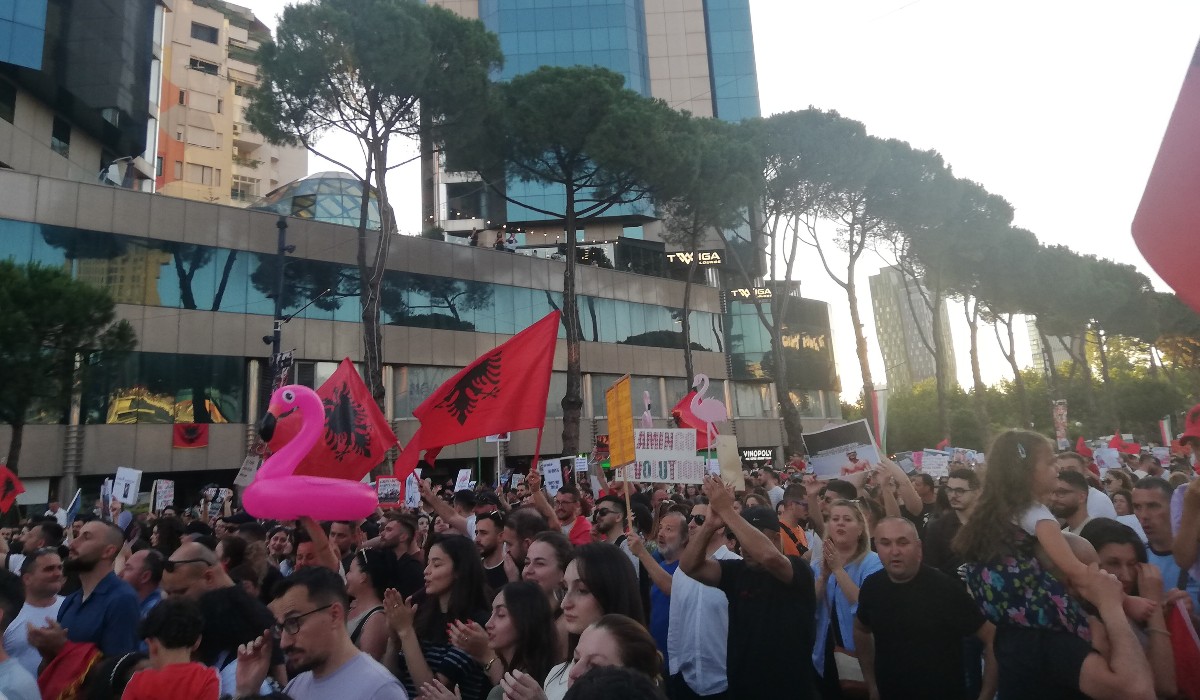
 Zvërnec protest, Tirana, 5 June. Photo: Terfili / Wikimedia Commons / CC BY 4.0
Seemingly disparate protest movements show potential for transnational unity, argues Vladimir Unkovski-Korica
In recent weeks, Albania and Serbia have seen mass protests rock their governments. Over the last week, we have been flooded with images of mass protests in multiple cities heralding what some have called the Flamingo Revolution in Albania, in opposition to a luxury resort development on Albania’s protected southern coast. Two weeks ago, meanwhile, 200,000 people took to the streets of Belgrade, demanding elections, reigniting the wave of student-led protests sparked by a 2024 train station accident that killed sixteen.
On the face of it, these protests have been sparked by different issues, and little effort in the Western media has gone into connecting them. They are reported and commented on separately.
That is unsurprising. The region is usually characterised as a troubled periphery, defined by instability, corruption and ancient hatreds, between supposedly antagonistic peoples like the Albanians and the Serbs. What could possibly unite them?
But a closer look at the recent protest waves in the two Balkan states reveals common grievances borne of the region’s incorporation into an economic system dominated by the interests of multinational capital and the Great Powers.
After their state-led development projects failed by the 1980s, along with the neighbouring Soviet bloc, both countries underwent major state breakdown or disintegration in the 1990s, followed by Western military intervention.
Their subsequent pursuit of EU integration resulted in significant de-industrialisation through privatisation, de-population through outward migration, and state-capture by plutocratic elites with no interest in democracy or rule of law.
Rather than this being extraneous to the pursuit of neo-liberal modernisation, and opposed by supposedly benign foreign actors, the process is actually deeply undemocratic and exploitative at its core.
Investors
In both cases, we find that mass protests have been sparked by anger at opaque political decision-making, masking major external investment projects. They have often been centred on environmental concerns, as the local elites have found little left that they can profit off besides the natural wealth of their countries.
In Serbia, the background to the most recent wave of mass protests involved previous rounds of opposition over the past decade, first to the re-development of Belgrade waterfront by petrodollars from the Gulf, then to the proposed lithium mine in the water-rich and fertile Jadar Valley by Rio Tinto for the benefit of the European Union, and now to the government’s handling of the disaster of the Novi Sad station renovation by a Chinese consortium, which led to the deaths of sixteen people almost two years ago.
Serbia has become the principal destination for Chinese investment in the Balkans and one of the key nodes of the Belt and Road Initiative in Europe, with major investments ranging from the modernisation of the Belgrade-Budapest rail corridor to the environmentally controversial takeover and expansion of the Bor copper mine. The Novi Sad station refurbishment formed part of this wider programme of Chinese-backed railway construction.
In Albania, too, changes to its Protected Areas law in 2024 opened the way to the current plans to construct a luxury resort linked to US president Donald Trump’s son-in-law, Jared Kushner, menacing a protected wildlife area containing rare wildlife like flamingos, seals, and turtle nesting sites. Nor is the Serbian case entirely disconnected: Kushner has also pursued controversial property developments in Belgrade, notably on the site of the former General Staff headquarters bombed by NATO during the Kosovo War in 1999.
As in Serbia, the dispute in Albania has quickly become about more than a single project, drawing attention to broader concerns about how major investment decisions are made and in whose interests they are pursued. Protesters are opposing the Kushner-linked resort while also rejecting both the governing Socialist Party and the mainstream opposition, which many see as equally implicated in a system of clientelism and land deals. Similarly, Serbia’s students will front their own electoral list independent of the mainstream opposition.
Resistance
These cases point to a common pattern, in which conflicts over land and resources become expressions of a deeper struggle over the nature of neo-liberal governance and the role of the Balkans in the global economy.
Whether the investor is a multinational mining corporation serving the EU’s ‘green’ transition, a US-backed luxury real-estate venture, a Chinese project linked to the Belt and Road Initiative, or Gulf money seeking entry into the EU, governments have cracked down on local opposition, presenting it as backward and opposed to modernisation.
But, citizens of both states are expressing discontent with a development model that treats their land, natural resources, and public space, not to mention their own livelihoods, primarily as assets to be plundered for private profit.
Their increasingly negative views of strongmen like Serbia’s Aleksandar Vučić and Albania’s Edi Rama acting undemocratically and in collusion with big investors and the Great Powers is palpable. So is their disenchantment with the mainstream opposition. The mass protests are grappling towards something new.
The recurrence of slogans centring on the country not being for sale underlines the potential for the protest movements in both states to develop a political programme that challenges the priorities of the local elites, in cahoots with global capital, and also resurrects the spirit of the old socialist slogan ‘the Balkans for the peoples of the Balkans’.
Before you go
The ongoing genocide in Gaza, Starmer’s austerity and the danger of a resurgent far right demonstrate the urgent need for socialist organisation and ideas. Counterfire has been central to the Palestine revolt and we are committed to building mass, united movements of resistance. Become a member today and join the fightback.

Vladimir Unkovski-Korica
Vladimir Unkovski-Korica is a member of Marks21 in Serbia and a supporter of Counterfire. He is on the editorial board of LeftEast and teaches at the University of Glasgow.