
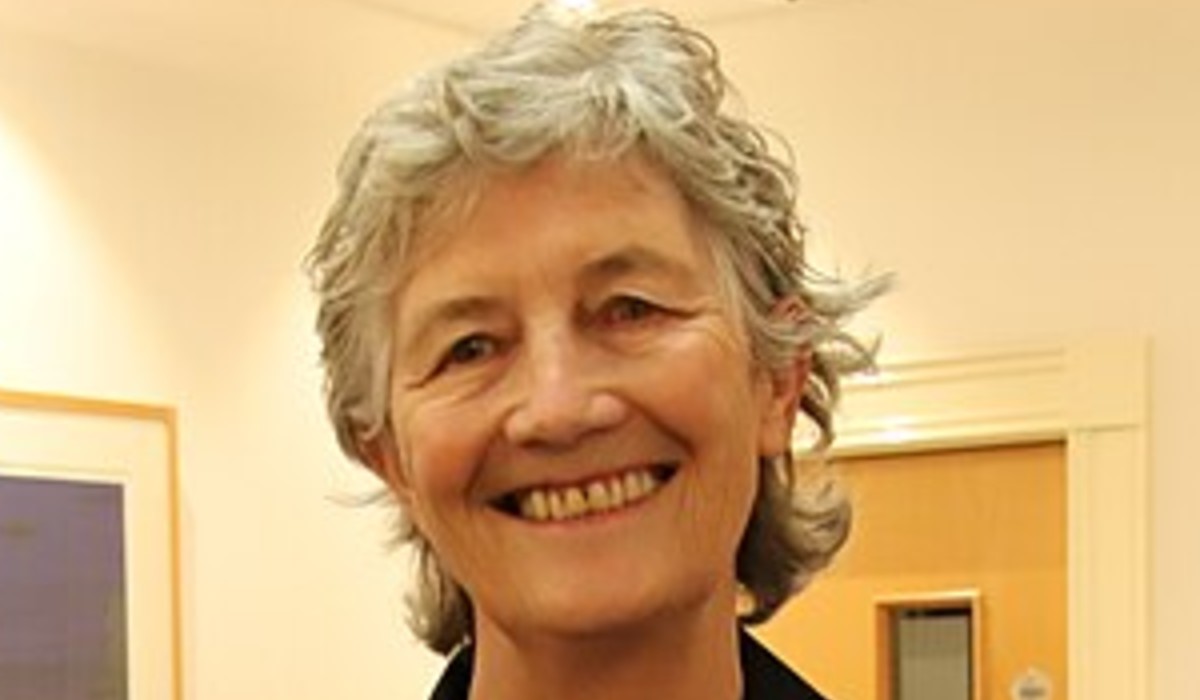
 Irish politician Catherine Connolly in November 2022. Photo: Houses of the Oireachtas / Wikimedia Commons / CC BY-SA 2.0
With a left candidate for Irish president polling strongly, this election has the potential to benefit the Palestine movement and the left internationally, argues Kevin Crane
The office of Uachtarán na hÉireann, as the president is known in the Irish language, does not run the country’s government and performs mostly ceremonial duties. The outgoing officeholder, Michael D Higgins, did get a rare opportunity to exercise some direct authority back in 2016, but even then, it was only because the newly elected Dáil Éireann (parliament of Ireland) was failing to form a government and he possessed the extraordinary power to call another general election if they couldn’t get on with it. In normal times, the president of the republic is there simply to act as a head of state, aloof from the business of passing laws and running ministries.
It is very different from becoming the president of France or the USA, and as a result, the election of presidents consequently attracts only moderate attention within the country. The 2025 election is therefore breaking new ground. Not only is the polling close, but there is a real sense of ideological struggle taking place. It may be that this is the most consequential presidential race of all time, with a deep polarisation having formed around the two candidates: Catherine Connolly on the left, and Heather Higgins on the right, and with the potential to have a significant impact beyond Ireland’s shores.
Higgins’ legacy
Michael D Higgins could not run again, even if he didn’t feel like retiring at the age of 84, because he has served the maximum of two seven-year terms permitted under the constitution. He won both of his elections to the position comfortably and has remained pretty popular throughout his presidency. In Britain, he is probably best remembered as the first Irish president to make a state visit to Britain (some of you must surely remember the striking image of Irish tricolours flying on the Mall in front of Buckingham Palace!).
At home, Higgins was known as an affable charmer, but also something of a radical. Originally a Labour Party Teachta Dála (TD, a member of the Irish parliament) who broke from it leftwards, he championed social-justice causes and has been a staunch anti-racist. In 2016, as Ireland marked the centenary of the Easter Rising rebellion that lead to its independence, he played a prominent role in steering the official narrative back to the real meaning of the event. This was against the Irish right trying to contain and obfuscate the history of anti-colonial struggle.
Higgins has been consistently anti-colonial on the world stage too, and this has been particularly important in the past two years: he was one of a very few Western leaders (Pedro Sanchez, the prime minister of Spain being the only other major example) to come in early and hard against Israel’s genocide of Palestinians.
Ireland’s strong position on Gaza was not achieved without struggle. Although sympathy for Palestinians, as a people still suffering from colonialisation, is widespread among the people in Ireland, the country’s political establishment is no reliable friend to them. Right-wing parties have been controlling the Dáil, in something resembling a cartel more than a coalition, for well over a decade now, and their foreign-policy priorities do not favour anti-imperialist stances. The right has been frustrated about Ireland’s long-held military neutrality and lack of involvement in Western military alliances, including Nato. For this reason, the establishment had hoped to join the European consensus in turning a blind eye to what to Israel was doing. A mass protest movement in the country prevented that from happening, and it was a huge advantage to that movement to have the head of state be their ally.
So, as President Higgins has been preparing to exit the stage, it was simply prudent to look for a successor who could continue his work. Catherine Connolly emerged as a natural choice pretty rapidly. Like him, she was a former TD in the Galway area, who had departed the Labour Party to move leftwards, and the two have worked together for decades. She has a decent track record as a socialist and anti-war campaigner and has of course made sure that she can be seen wearing a Palestinian scarf in all her social media: a clear signal that she will not abandon the solidarity movement.
In a display of unity that most people think uncharacteristic of the left, almost the entire spectrum of leftwing parties in Ireland have united behind her: from the revolutionary-left People Before Profit, through the Social Democrats and some of the key independent and small party TDs. The largest left-of-centre party in the Dáil, Sinn Féin (SF), dithered for a while, ostensibly because they had reservations about Connolly’s commitment to Irish reunification and a formal referendum on the Partition border. She has since said that she believes the border poll should be on the agenda, and SF leader Mary Lou McDonald subsequently came onboard and spoke at Connolly’s campaign launch.
That just leaves the Labour Party itself, of course, which has rather pathetically found itself split over endorsing the clear unity candidate. While the majority of its TDs have joined Connolly’s campaign, some have not, citing ‘concerns about her on international relations’, which is a cowardly way of saying that they share the right wing’s desire for Ireland simply to join the military-industrial complex. Given that the election is now a two-horse race, Labour TDs taking such a line are effectively endorsing the government’s candidate, which is also a bad look.
A muddled fightback from the right
The establishment has known throughout this campaign what it wants, but not how to get it. Even the process of getting a right-wing candidate onto the ballot paper seemed to be defeating them for much of the year. Ireland’s political right is, theoretically, less fragmented than the left, but you would not know it from their struggle just to get someone to stand for them.
The more populist-leaning party, Fianna Fáil (FF), completely fumbled their selection. For more than two years, former Taoiseach (prime minister) Bertie Ahern had been teasing a potential run. His career, however, had collapsed in 2008 because he was seen as being responsible for Ireland’s massive economic beating in the global financial crisis that year (as well as a lot of questions about his personal financial conduct), so there was an ‘Anyone but him!’ scramble within the party. Eventually, FF settled on former Air Corps officer and Gaelic football manager, Jim Gavin … only for him to drop out late in the game because he too had a finance scandal, in the form of owing overcharged rent to a tenant in one of his properties. In a country absolutely straining under their weight of a massive housing crisis, this is complete electoral poison. So even though it’s too late for Gavin to be removed from the ballot paper, he’s out of the race.
That just leaves the more conservative Fine Gael (FG) party. They too have had an unusually bad time finding a candidate. They initially nominated a former European commissioner, Mairead McGuinness, who was exactly the sort of person they wanted in place to bring Ireland more into line with the EU of Ursula von der Leyen and Emmanuel Macron. However, McGuinness suddenly dropped out, citing medical advice, and left FG scrabbling around like their FF frenemies.
FG eventually settled on Heather Humphreys, a former TD for a constituency right on the border with Northern Ireland, and one with considerable Orange roots, having a grandfather who signed the infamous ‘Ulster Covenant’. This was the 1912 anti-independence petition that Britain used as a justification to partition Ireland in the first place, and since FG’s own background is in a politics that regarded the continued colonisation of the Northern state as a necessity, it only adds to the very real sense that the border is an issue in this election.
Soul of the nation?
As inequality has worsened in Ireland in recent years, the press in the country has taken on a lot of the instinctively elitist qualities we are used to in Britain, and it has been covering the election in a biased way that British socialists would find familiar. Newspaper columnists have spent much of the year whining about not having candidates that match their tastes, and reporting on Catherine Connolly has been markedly hostile.
One of the problems the Irish right has, however, is that it cannot always say what it means, in the way that the English right can. Attacking politicians for being anti-war is fairly easy in a country with militaristic traditions and where massive nostalgia for both war and Empire is like an ideological industry. In an only-ever-partially decolonised country, however, it is somewhat more common for people to recognise that these are bad things. So, the forces of reaction in Ireland have to encode much of what they say. Opposition to war and solidarity with the Palestinians becomes ‘anti-Americanism’ and a humanitarian visit Connolly went on to Syria in 2018 becomes ‘support for a dictatorship’. Working with a small left-wing group in her constituency (tangentially descended from Republicanism, as they all are) becomes ‘dealing with terrorist apologists’.
Attacking Connolly, and the wider left, over the question of reunifying with the North, is even more sensitive, since open declarations that they want to leave the territory and Northern Irish nationalists under British rule forever will not fly as propaganda. So, the best the establishment media can do is dig up aspects of her past and imply as far as they can that she is a totally unsuitable person to be president. The polling seems to indicate that this is not currently working, much to their continued annoyance.
Journalists of the Irish press argue that it’s wrong be bothered with Irish reunification, or fighting for the rights of other oppressed peoples, or standing against American wars, because there are so many pressing problems in day-to-day Irish life right now, like the housing crisis. However, it is the governing parties in the Dáil that they champion who are responsible for those problems, and who are presiding over an increasingly unequal and divided country where racism and the far right have started growing for the first time in generations. The precise reason that the mainstream right doesn’t want the presidency to remain on the side of Ireland’s progressive tradition, is precisely because this is actually disruptive of the country’s failing status quo.
Overseas, we should be very hopefully that Connolly wins. Partially, this is simply because the energy from such a victory, in such a hard-fought contest, would help bolster the Irish left and working-class movements, but also because it enables Ireland to continue to play a positive role internationally. For the left in Britain, anything that brings forward a Northern Ireland border poll, we should view as raising massive opportunities for us to challenge our own government and establishment.
Before you go
The ongoing genocide in Gaza, Starmer’s austerity and the danger of a resurgent far right demonstrate the urgent need for socialist organisation and ideas. Counterfire has been central to the Palestine revolt and we are committed to building mass, united movements of resistance. Become a member today and join the fightback.
