
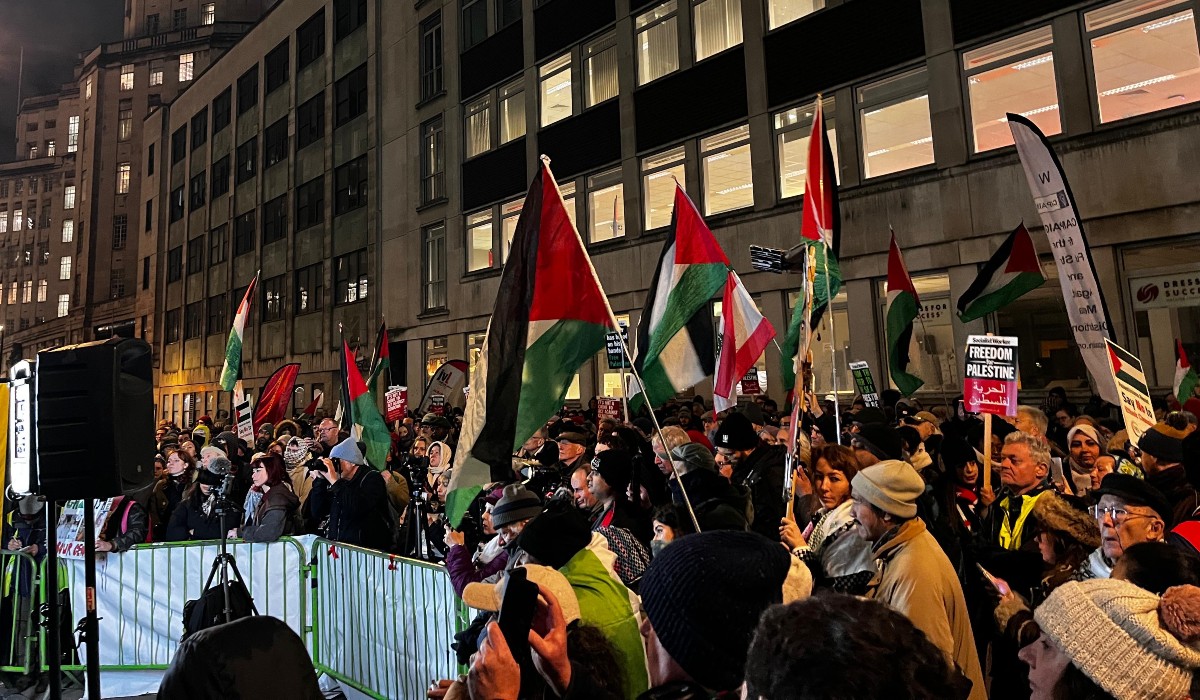
 Protest outside the Ministry of Justice, 17.12.2025
‘Intifada’ has a range of meanings, and the police must not be allowed to decide what it means themselves, explain Shabbir Lakha and Michael Lavalette
Yesterday (Wednesday 17 December) saw a loud angry protest outside the Ministry of Justice, in central London, in support of Palestinian activists on hunger strike across prisons in Britain.
At the protest, the police arrested several people for allegedly using the word ‘intifada’. It would seem that the Met are claiming that use of the word is a violation of Section 5 of the Public Order Act.
Let’s be clear what this means: without any democratic decision or legal instrument, the Met police are allowed to make political interventions in the law, literally police speech without basis and enforce them, with violence, with immediate effect.
And they can do so:
- With little understanding of what they’re doing: one copper was heard saying that ‘inFITada’ was a crime (and then admitted they didn’t know what it means.) And:
- On grounds of ‘racial aggravation’, which is a bit rich coming from the Met who have repeatedly been found to be institutionally racist. In what world can the Met police be arbiters of what constitutes racism?
This latest attack goes hand in hand with placing arbitrary conditions on all Palestine protests designed to establish as fact that Palestine protesters, including the many Jewish protesters, are antisemitic, when there is zero evidence to claim this.
We can be sure that if they get away with this, the things we can say in defence of Palestine and to criticise our government will continue to be eroded. We know that since October ‘23 they have wanted to ban ‘From the river to the sea’ and waving the Palestinian flag.
And it won’t stop with Palestine. The draconian legislation has already been used against striking workers and climate activists. The sight of police snatch squads violently arresting young people for allegedly using a word should be chilling to anyone who cares about democracy.
But what about the word ‘intifada’, what does it mean?
It’s fascinating that lots of (non-Arabic speaking) politicians and establishment figures have decided that they can determine the word’s meaning! But they do so on the basis of no evidence whatsoever.
According to Marwan Darwish, writing in 1989 [in the journal Race and Class (Vol 31, issue 2)], the Arabic root word nafada from which intifada is derived has different meanings: (1) to shudder, shiver; (2) to shake off, shake out; (3) to recover, recuperate.
According to Margaret Litvin, an associate professor of Arabic and comparative literature at Boston University, extensively quoted in the Jewish political website Forward, the term intifada is ’widely and unremarkably used in Arabic texts on the Warsaw Ghetto Uprising’ (the most important and liberatory moment in the Jewish resistance to the horrors of Nazism). Indeed, she notes, the US Memorial Holocaust Museum’s own Arabic translation of its article on the uprising used the word ‘intifada’ to describe the Ghetto Uprising as late as November 2023.
Litvin, who is herself Jewish, goes on to say that ‘intifada’ is uniformly translated as ‘uprising’ by Arabic scholars. The term is used so universally precisely because it does not inherently connote violence, Litvin said, but instead refers to the act of rising up against or standing up and shaking off a greater power and, in this sense, captures the asymmetry in power between the oppressed and oppressor.
Many intifadas
Thus ‘intifada’ refers to a multi-faceted phenomenon. It refers to a political uprising, but also to a social and psychological phenomenon; an awakening, a self-cleansing, a breaking away from the Palestinians’ own past and inherited social structure.
The Palestinian people talk of there being three major Palestinian intifadas, each quite different. The intifada of 1936-9 was an attempt to shake off British colonial rule. It included a six-month general strike, mass demonstrations, the setting up of alternative education and welfare centres and a degree of local self-rule. It was brutally repressed by the British imperial forces. It has become much better known as a result of the brilliant new movie Palestine 36.
The intifada of 1987-93 was a mass protest movement that pitted stone throwers against Israeli tanks. The Palestinians marched, went on strike, set up independent schools, welfare and youth projects (just like 1936-9) and fought for their rights. The movement took place across Palestine ’48: that is Gaza, the West Bank and in Palestinian communities within Israel. The Israeli forces responded by beating and arresting thousands, and killing, maiming and injuring thousands more. As a response, some sections of the Palestinians’ resistance responded militarily, but this was not the majority response of most Palestinians, who were active in the intifada campaigning for their civil and political rights over the period from 1987-93.
The next intifada started in 2000 and ended around 2008. This arose because Israel failed to carry through its side of the agreement to establish a Palestinian state encapsulated in the Oslo Accords. In the first three days of this uprising, the Israelis fired off over one-billion rounds of ammunition. As a result, this became a much more militarised uprising. Far more Palestinians were killed, maimed and injured during this intifada than Israelis (at a ratio of close to ten to one).
So the word intifada does not equate with any form or tactic of struggle. It is a term that simply means ’shaking off’ oppressive structures; it refers to a sustained period of people fighting for their rights. It also has an implied critique of Palestinian politicians: that they are incapable of delivering liberation, so the people themselves must ‘shake off’ their oppression by relying on their own strengths and capabilities.
The term ‘intifada’ is also used to refer to popular uprisings and rebellions in other parts of the Arab world: uprisings against unpopular and corrupt governments. It first came to prominence in the Arab world when it was used during the Iraq Intifada in 1952, a series of strikes and riots protesting against the monarchy at the time. It was used to refer to a series of ‘bread riots’ in Egypt in 1977. It has also been used extensively to talk about the Arab Spring which started in 2010 and marked a range of protests and uprisings against corrupt regimes in the Middle East and North Africa region.
To apply the term to Britain, we might say that the struggle of the Chartists in the 1840s was what Arabs would call a working-class ‘intifada’. The suffragette struggle of the early twentieth century could also, from an Arab perspective, be called an ‘intifada’. Or more recently, the mass campaign to end the poll tax at the end of the 1980s and start of the 1990s, could be termed a popular ‘intifada’. And the Great Miners’ strike of 1984-5 would be another example of a protest movement that, to Arabs, would be classified as an ‘intifada’.
There is, then, nothing remotely antisemitic about the use of the Arabic word ‘intifada’ and neither can it be interpreted as a call to violence.
Before you go
The ongoing genocide in Gaza, Starmer’s austerity and the danger of a resurgent far right demonstrate the urgent need for socialist organisation and ideas. Counterfire has been central to the Palestine revolt and we are committed to building mass, united movements of resistance. Become a member today and join the fightback.
