
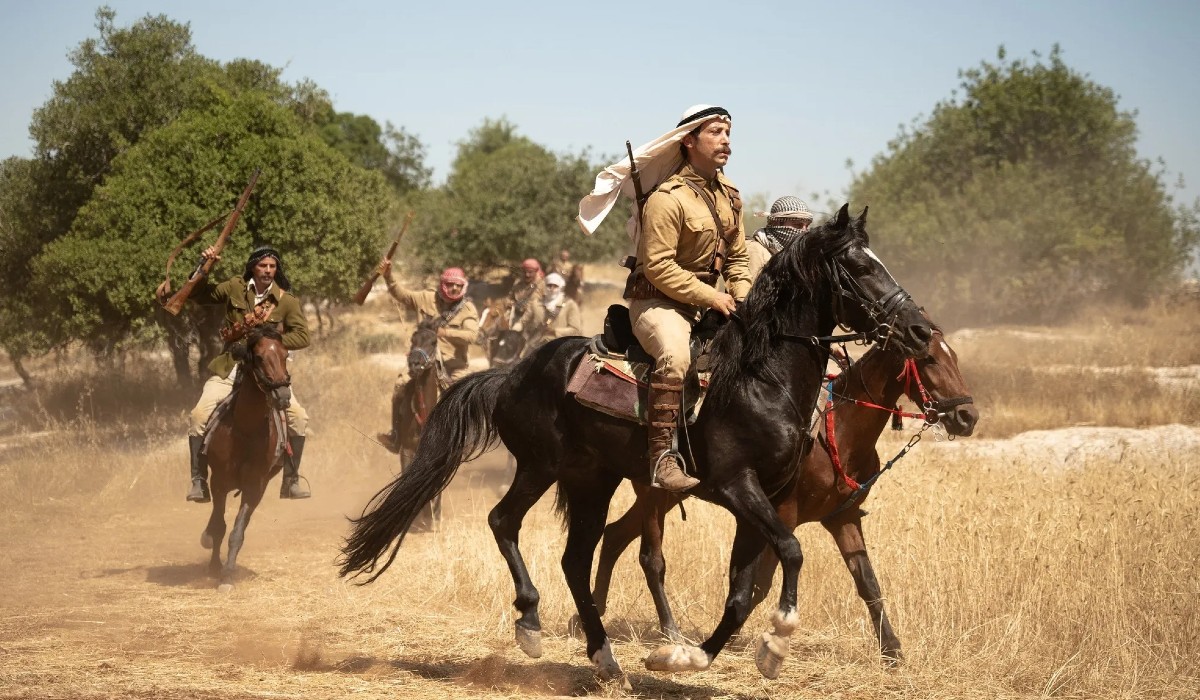
 Scene from Palestine 36.
Palestine 36 wonderfully dramatizes the Palestinian revolt against British rule in 1936-9, and the origins of today’s occupation, making it essential viewing in Britain, finds Katherine Connolly
Dedicated to ‘our people in Gaza in the years the world failed you’, Palestine 36 powerfully conveys the roots of the dispossession, violence and genocide inflicted on Palestinians today by the Israeli state. The film is a defiant tribute to the endurance of the Palestinian liberation struggle. It urgently and vividly dramatizes the Palestinian Great Revolt of ninety years ago, which combined the longest general strike in history with resistance across the countryside to British colonial rule and its facilitation of Zionist settlements. The stunning cinematography, which celebrates the beauty of Palestine’s varied and fertile land, was also only possible because of resistance to the occupation. As its director, the renowned Palestinian filmmaker Annemarie Jacir, told the Guardian, it was essential that this story was filmed on location: ‘It’s so critical that Jerusalem is Jerusalem in the film. It’s not somewhere else. These places are real, they exist.’
Denial of Palestinian history has been central to the creation and expansion of Israel. Likewise, as Britain continues to arm Israel, and arrogantly assumes the right to dictate Palestinians’ future with the butcher of Iraq, Tony Blair, grotesquely reimagined as a modern viceroy of Gaza, it is silent about its historic role in the oppression of Palestinians. It is therefore vitally important that this film is seen in Britian. This country’s fatal interest in Palestine is suggested right from the start as we watch a young girl, Afra (Wardi Eilabouni), balancing on a pipeline. Owned by the misleadingly named Iraq Petroleum Company, a consortium whose headquarters were in London, it transported Iraqi oil via Haifa in Palestine for the enrichment of Western oil companies.
Palestine and Iraq were seized by Britain as imperial spoils from the Ottoman empire, which had been defeated in the First World War. Although officially termed ‘mandates’, they were run by the British as colonies.
Palestine 36 shows very clearly the dire consequences for Palestine of twentieth-century European genocide and imperialism. The Zionist settlers are mostly seen from a distance, their repeated seizure of land constantly accompanied by the erection of a watchtower and fences secured by armed gangs. An exchange in which Rabab (Yafa Bakri) explains to her confused daughter Afra that the Jewish settlers have come because they are not wanted in their own countries underscores the role of European antisemitism and its most devastating expression in the Nazi Holocaustin the colonisation of Palestine. Zionist colonisation of Palestine is fanatically supported by the British Major General Orde Wingate who inflicted appalling collective punishments on Palestinians during the Great Revolt.
The recent review in the Guardian misses the point, however, when it argues that the ‘colonials are divided, in the traditional style, into “good British” . . . and “bad British”.’ Instead, Palestine 36 shows that violent dispossession of Palestinians resulted from British imperialism, which included extremists such as Wingate but also others who regarded themselves as the natural and fair arbiters of the land disputes between settlers and Palestinians. References to applying techniques from India, and not wanting ‘another Ireland on our hands’ makes clear that the Palestinian tragedy was not the creation of a maverick author, rather it was scripted at the heart of the British empire. Far from being a simplistic portrayal, the film shows how the power disparities in the conflict result in courageous acts of resistance but also naïve judgements and collaboration with colonialist forces.
The searing depictions of the struggle in Palestine ninety years ago painfully resemble the images of today because the former laid the ground for the latter. Using a Palestinian man as a human shield tied to a fast-moving car also happened recently in Jenin, the unarmed Palestinian girl physically resisting soldiers looks momentarily like Ahed Tamimi confronting IDF forces, and the settlers setting fire to land they intend to seize is today only accelerating. While Palestine 36 provides historical explanations, it also celebrates the power of resistance. Palestinians have been resisting British imperialism and its legacy for over a century. This film should prompt British audiences to think about the role we can play here in resistance to the British government’s continuing contribution to the destruction of Palestine.
Before you go
The ongoing genocide in Gaza, Starmer’s austerity and the danger of a resurgent far right demonstrate the urgent need for socialist organisation and ideas. Counterfire has been central to the Palestine revolt and we are committed to building mass, united movements of resistance. Become a member today and join the fightback.

Katherine Connelly
Kate Connelly is a writer and historian. She led school student strikes in the British anti-war movement in 2003, co-ordinated the Emily Wilding Davison Memorial Campaign in 2013 and is a leading member of Counterfire. She wrote the acclaimed biography, 'Sylvia Pankhurst: Suffragette, Socialist and Scourge of Empire' and recently edited and introduced 'A Suffragette in America: Reflections on Prisoners, Pickets and Political Change'.