
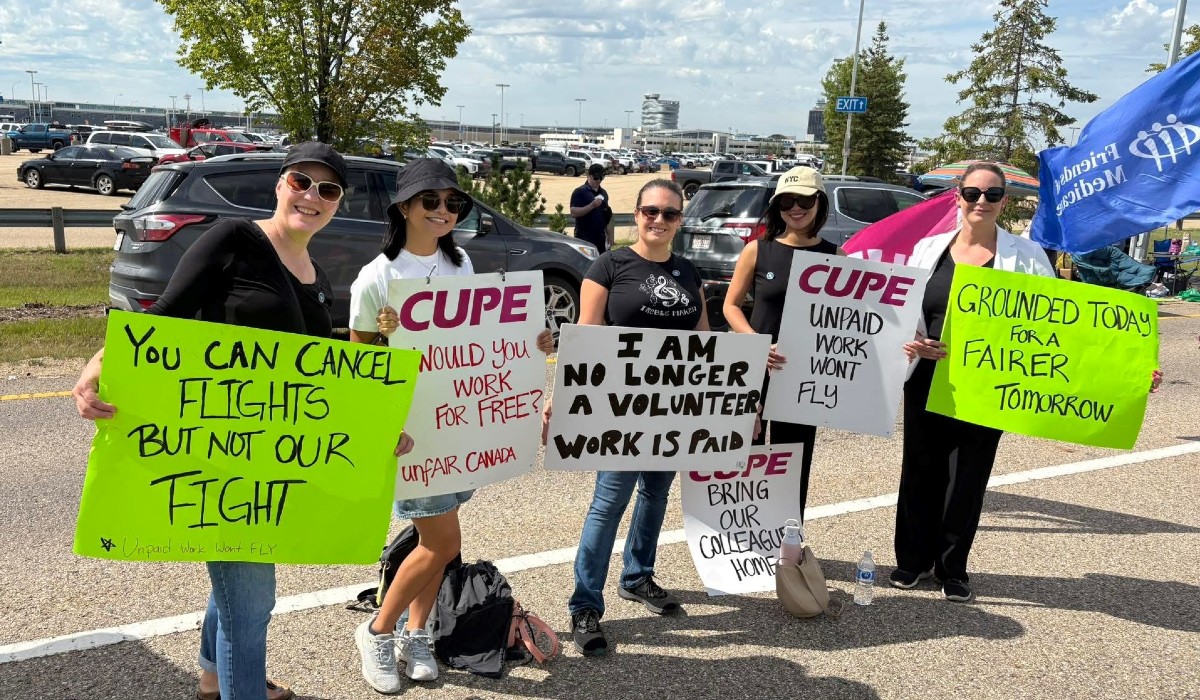
 Air Canada strike. Photo: Air Canada Component of CUPE
Flight attendants defied anti-union legislation, forcing employers into negotiation, and the government into retreat, showing the way to fight austerity, reports John Clarke
A strike this week by roughly 10,000 Air Canada flight attendants has forced the company to retreat and generated a humiliating setback for Mark Carney’s Liberal government. Within hours of their walking off the job, the workers were hit with a back-to-work order that would have forced them to accept binding arbitration, but they chose instead to defy this and forced Air Canada back to the bargaining table where a tentative agreement has been secured.
The arrogant assumption that these workers could simply be intimidated into taking down their picket lines and returning to work was a serious miscalculation. A statement issued by their union, the Canadian Union of Public Employees (Cupe) on 5 August, noted that a 97.7% vote by the workers in favour of strike action reflected ‘the deep frustration of flight attendants after months of negotiations without result, due to the airline’s refusal to fairly negotiate on key issues like unpaid work, work rules, and poverty-level wages.’
The low wages of junior flight attendants has been a particularly pressing issue. Wesley Lesosky, president of the Air Canada component of Cupe and a 24-year flight attendant, stated at a press conference that was held before the strike began that:
‘Our union offices in Vancouver and Toronto have had to open food banks to support our newest members as they struggle to house and feed themselves while working full time. We still have members living out of their cars at our Vancouver base.’
A pivotal issue underlying the strike, and certainly the grievance that has received the greatest attention, has been the practice of not paying flight attendants for the work they perform when the planes they are working on are not in motion. This has allowed the employer to ensure that the costs of delays and disruptions are reduced to a minimum on the backs of unpaid workers. It is true that this practice isn’t unique to Air Canada, but, as the country’s leading airline, its role in imposing this abuse on workers is pivotal and the challenge to it is very properly focused on this employer.
The demand for ‘ground pay’ and Cupe’s ‘unpaid work won’t fly’ campaign have been of central importance in this struggle and contributed enormously to the overwhelming popular support the strike enjoyed. The Canadian Press agency reported that new ‘polling conducted by Abacus Data confirms that nearly 9-in-10 Canadians support Air Canada flight attendants’ fight for fair pay.’ Fifty-nine percent even felt that the strike should continue without government interference even if it resulted in major travel disruption.
Back-to-work order
Since the 1970s, the use of back-to-work legislation has become common in Canada, with federal and provincial governments frequently passing special legislation to bring strikes to a halt (in the ‘public interest’ of course). In the case of the Air Canada workers, however, as the CBC reports, federal jobs minister ‘Patty Hajdu has invoked Section 107 of the Canada Labour Code to send Air Canada flight attendants back to work, less than 12 hours after they walked off the job.’ The company had consistently pressed for such action to be taken.
This section of the Code, which applies to workers who are under federal jurisdiction, ‘gives the minister unilateral authority to order the end of a work stoppage in order to ‘maintain or secure industrial peace’ without the necessity of drafting legislation and taking it before parliament. As such, it is particularly dangerous and poses a huge threat to workers’ rights and their ability to take effective strike action.
In this case, ‘Hajdu used her powers to direct the Canada Industrial Relations Board to order both sides to return to work and to impose binding arbitration to reach a new collective agreement’ and the proceedings that followed were an ugly farce. Business Wire noted that in ‘an almost unthinkable display of conflict-of-interest, a former Air Canada legal counsel, Maryse Tremblay, will rule on whether to end job action by striking Air Canada flight attendants at the Canada Industrial Relations Board.’
Despite an application from Cupe, Tremblay refused to recuse herself and chaired the proceedings that led to the back-to-work order. As the article correctly concluded, it ‘is increasingly difficult to escape the appearance of collusion between Air Canada and the Liberal government throughout this process.’
So it was that the Air Canada workers found themselves faced with this authoritarian suspension of their democratic right to strike and collectively bargain. It rapidly became clear, however, that they were not going to be intimidated. Even as they were supposed to be returning to work on the Sunday, powerful rallies, with full support from other unions and community members, were held at airports across the country.
Cupe national president Mark Hancock stated that: ‘Our members are not going back to work. We are saying no.’ As Toronto Today reported, ‘Hancock ripped up a copy of the back-to-work order outside the airport’s departures terminal, where union members continued picketing on Sunday morning as a way to signal to Air Canada that “we’re ready for a big fight”.’
It’s very clear that the decision to continue with an ‘illegal’ work stoppage took the company and the Carney government by surprise. With a body of determined strikers, strongly supported by other unions and popular sentiment, the Liberals were obviously reluctant to try to enforce the back-to-work order.
The labour minister, Patty Hajdu, even pretended to be shocked by the prevalence of unpaid work in the airline industry. Laughably, she stated that flight ‘attendants should be paid for the work that they do. The allegations of unpaid work in the airline sector are deeply concerning – we will be digging into this and will find out what is at the root of these allegations – because nobody should work for free.’
For its part, Air Canada, having assumed the workers would comply with the order, now scrambled to find a solution and was forced to go back to the bargaining table with the assistance of a federal mediator so that a tentative agreement could be hammered out.
A statement issued by Air Canada made clear that mediation ‘discussions were begun on the basis that the union commit to have the airline’s 10,000 flight attendants immediately return to work, allowing the airline to resume the operations…’ and the union bargaining committee obviously accepted this condition.
The Cupe leadership stresses the gains that have been made in the agreement, arguing in an email to Global News that this ‘is historic for Canadian flight attendants that’s all I can say. We fought the norm in the industry and we won.’ The union has also categorically stated that ‘unpaid work is over.’
The failure to force the flight attendants back to work is an enormously important development for these workers and for the broader trade-union movement. Obviously, however, a full assessment of this struggle and the gains that flow from it is impossible until the terms of the agreement and the response of the rank-and-file workers to it is known.
Struggles ahead
The Air Canada workers’ strike is clearly a prelude to even bigger battles that will be fought out in the period ahead. The Maple has pointed out that ‘collective agreements covering more than 125,000 federal public servants expire in October.’
The negotiations around these agreements, moreover, are playing out in a context dominated by ‘the threat of deep cuts to the federal public service. PSAC [the Public Service Alliance of Canada] and other federal public-sector unions have been warning for months about the potentially catastrophic impact of the Liberal government’s proposed plan to cut spending by 15 per cent.’
The prospect of massive job losses among federal public-sector workers and the gutting of the services they deliver are posed by this development. It is also obvious that provincial and territorial governments will take their lead from Carney and launch similar attacks on workers and the social infrastructure across the entire country.
The Maple correctly characterised the driving force that underlies the regressive agenda of the Liberal government, when it argued that the ‘threat posed by United States President Donald Trump’s trade war is providing the Carney Liberals with the political and economic justification to undertake their program of austerity.’
An unprecedented attack on workers and communities is now underway in Canada. The fight taken up by the Air Canada flight attendants has been massively significant in its own right but it points to even more decisive battles that are now looming. The lesson we must draw is that Carney’s class-war agenda won’t be stopped without a readiness to defy, disrupt and build a united working-class movement that can bring together all those facing this attack and mobilise decisively to defeat it.
Before you go
The ongoing genocide in Gaza, Starmer’s austerity and the danger of a resurgent far right demonstrate the urgent need for socialist organisation and ideas. Counterfire has been central to the Palestine revolt and we are committed to building mass, united movements of resistance. Become a member today and join the fightback.

John Clarke
John Clarke became an organiser with the Ontario Coalition Against Poverty when it was formed in 1990 and has been involved in mobilising poor communities under attack ever since.