
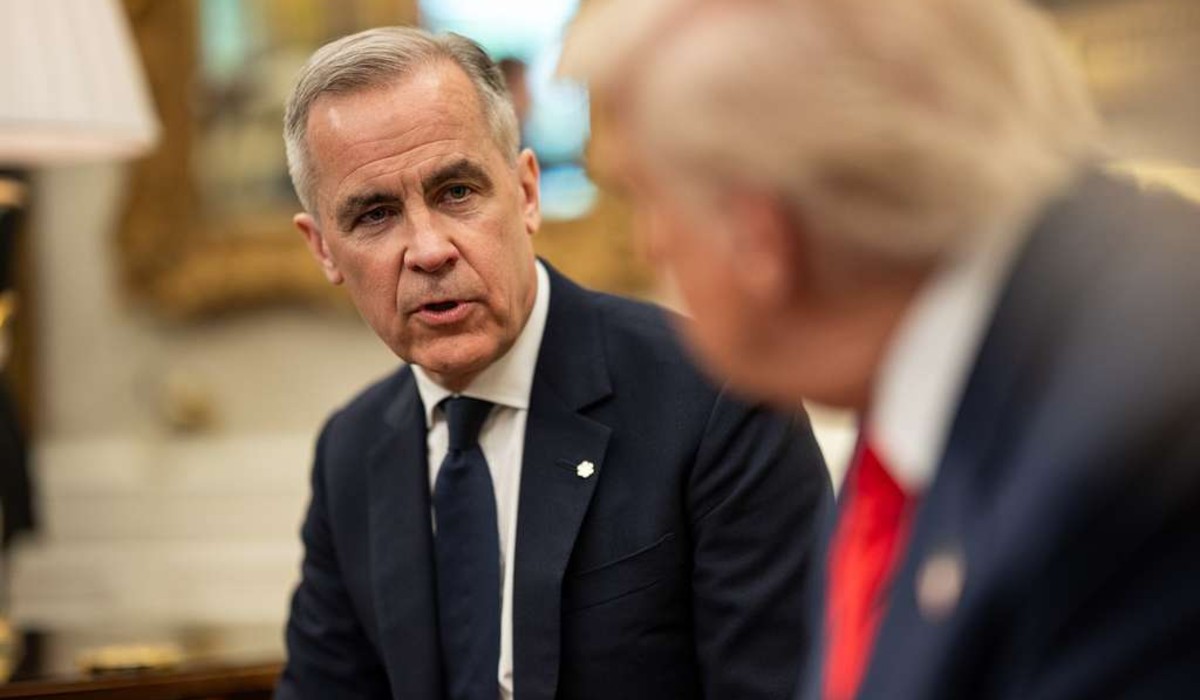
 Mark Carney and Donald Trump. Photo: Daniel Torok / White House Flickr
Whether there is a deal with Trump or others, workers will be expected to pay the costs and they must unite to fight back, because ‘we’ are not all in this together, argues John Clarke
With a shared border and a very high level of economic integration with its more powerful neighbour to the south, Canadian capitalism is exceptionally vulnerable in the face of the Trump administration’s protectionist turn. While the Mark Carney government tries to reach an understanding on revised terms of trade, it is also vigourously pursuing the objective of trade diversification. For the working class, however, both of those options bode ill, as the measures necessary to improve Canadian ‘competitiveness’ are imposed on it in either case.
On 17 April, as reported by Yahoo Finance, Carney proudly ‘announced a new “Canada Investment Summit” that will invite investors, CEOs and business leaders to Toronto this fall.’ His government hopes to bring in $1 trillion dollars investment in the next five years to finance resource extraction and environmentally destructive fossil-fuel developments, which it prefers to call ‘nation-building projects’.
Finance Minister François Philippe Champagne proclaimed for the benefit of the media that: ‘Investors are rediscovering Canada, in a way. They see us now as an energy superpower. The conflict in the Middle East just highlights how much we need to diversify the source of energy.’
It must be stressed that this initiative is entirely in line with the approach that major capitalist interests have been advancing. The Royal Bank of Canada, for example, ‘projects Canada could attract upwards of $1.8 trillion over the next decade if advances are made through the construction of new pipelines and liquefied natural gas terminals, the expansion of nuclear, hydro and renewable power, and development of critical minerals.’
Seeking to ensure that the Carney Liberals don’t hesitate in the face of opposition from environmentalists and Indigenous communities who will be impacted by these developments, Goldy Hyder, the CEO of the Business Council of Canada warned, as CBC News notes, that: ‘If we don’t get our resources out of the ground expeditiously in an investment-friendly regulatory climate, we are going to miss this window one more time.’
Global sales pitch
The impending summit is only one element of a tenacious global sales pitch that Carney has played a major personal role in delivering. In a 19 April article, the Calgary Journal captured the huge priority the government places on increasing investment and enhanced trading relationships with countries other than the US. It reported that Carney ‘plans to regularly update Canadians with a frank assessment of efforts to diversify away from the U.S.’
At the same time, ‘Carney doubled down on moves to deepen economic and defence ties with allies other than the U.S.’ He candidly stated that: ‘Many of our former strengths, based on our close ties to America, have become our weaknesses — weaknesses that we must correct.’ Though negotiations with the US are being pursued, the ‘Liberals have repeatedly said they will not ink a bad deal with the U.S.’ The notion of Canada diversifying its trading relationships to the degree that it could refuse to come to terms with the US, is highly questionable, to say the least but there is no doubt that the pursuit of fresh trading opportunities is being pursued in earnest.
On 11 March, The Hub tellingly pointed out that: ‘Prime Minister Mark Carney is living up to his self-avowed globalist status. Since taking office exactly one year ago, the globetrotting former central banker has been outside of Canada 68 days, or 20 per cent of his first year in office. The quest for trading opportunities has obviously been at the heart of these efforts.’
In December, Politico commented that: ‘Everybody is a trade minister in Mark Carney’s Cabinet.’ In an indication of the strategic thinking that is underway, an unnamed government official told the publication that: ‘Waiting out the Trump administration isn’t an option’. The official argued that ‘what’s happening in the United States reflects a generational shift — not a temporary disruption — and that returning to a policy of closer integration with America would be foolish.’
The article suggests that government planners hope ‘to double non-U.S. exports over the next decade.’ In order to do this, however, answers must be found to ‘thorny questions about where Canadian products can really compete.’ We must immediately recognise that such competitiveness comes down, in very large measure, to an increased capacity to profit from the labour of the workers in Canada who will produce these products.
As Carney balances the need to come to terms with the Trump administration with the objective of attaining greater independence from the US as a trading partner, Washington is obviously aware of the directions being taken by its northern neighbour. U.S Commerce Secretary Howard Lutnick recently suggested, according to CBC News that: ‘Carney has a problem with us. He gets on a plane and he goes to China. Does he think the Chinese economy is going to buy his stuff?’
For all the dogged efforts to recalibrate trading relationships, the previous development of Canadian capitalism had created a situation where before Trump ‘launched his trade war, roughly 76 per cent of Canada’s exported goods went to the United States, while just 17 per cent of U.S. exported goods were sent to Canada.’ The threat of US displeasure and retaliation is no trivial consideration.
Given the scale on which Canada relies on the US market, it is clear that the diversification strategy can only offer a very partial remedy at best, no matter how many airmiles Carney and his ministers chalk up in their quest for trade deals. Beyond this, however, it isn’t just a question of trade but also of how manufacturing systems have been structured. With regard to the production of vehicles, CTV News notes that the ‘supply chains are so intertwined that we may send a part to the U.S., and then it comes back, semi-manufactured, and then we finish it off here, and it goes back to the U.S.’
Though Carney is presenting his diversification efforts as one that is in the ‘national interest’ and something we all have a stake in, the reality of the situation is very different. As I previously suggested, the search for new trading opportunities will be based on enhanced ‘competitiveness.’ That will mean, quite simply, a deadly serious effort to extract more surplus value from workers.
Similarly, to the extent that diversification proves to be less than a magic bullet, which is overwhelmingly likely for all the bluster and bravado, the Carney government will have to come to terms with its US counterpart. That too will come with a price because the Trump administration will be out to impose highly unfavourable terms on the Canadian side and it has most of the cards in its hands.
A harsh deal with the Trump administration will mean a squeeze on Canadian profits and this leads us in exactly the same direction, with workers and communities being expected to foot the bill through increased exploitation and major measures of austerity. Indeed, as I have previously argued in articles for Counterfire, that attack is already well underway, with all the technocratic ruthlessness that Carney, the central banker turned prime minister, can unleash.
In this situation, it is vital that unions and social movements entertain no illusions that ‘we are all in this together.’ Our class interests and those of the capitalists that Carney represents run counter to each other and no amount of flag waving can change that.
The way forward is one of independent working-class action and social resistance. As Mostafa Henaway has argued in Midnight Sun, the ‘strategic question now is how to build a mass, multiracial, working-class resistance to Carney at the scale required, capable of sustained confrontation … We must actively build and organize a new common front from below.’
Without such an approach, Carney’s class-war solutions will be imposed on us at terrible cost. His effort to stabilise Canadian capitalism and preserve its flow of profits at our expense must be challenged and defeated as a matter of vital necessity.
Before you go
The ongoing genocide in Gaza, Starmer’s austerity and the danger of a resurgent far right demonstrate the urgent need for socialist organisation and ideas. Counterfire has been central to the Palestine revolt and we are committed to building mass, united movements of resistance. Become a member today and join the fightback.

John Clarke
John Clarke became an organiser with the Ontario Coalition Against Poverty when it was formed in 1990 and has been involved in mobilising poor communities under attack ever since.