
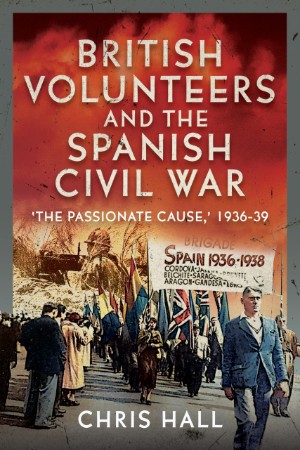
 Chris Hall, British Volunteers and the Spanish Civil War: ‘The Passionate Cause,’ 1936-1939 (Pen and Sword History 2026), 296pp.
This book on mainly English volunteers to the International Brigade rightly celebrates their heroism in the struggle against fascism, finds Chris Bambery
The Spanish Civil war of 1936-9 was a crucial stepping stone on the road to World War II. Fascism emerged victorious and emboldened. As I argue in my book, The Second World War: A Marxist History (Pluto Press 2014), Adolf Hitler took from it that because Britain and France had done nothing to help an elected government faced with a fascist uprising against it, they would not stand up to him as he grabbed for land in central and eastern Europe.
Each one of those who went to Spain to fight fascism, and who we meet in British Volunteers and the Spanish Civil War, grasped this. That’s why they went. Virtually all had already been bloodied in the fight against Sir Oswald Mosley’s Blackshirts here at home.
The majority of those Chris Hall focuses on served in the International Brigades (IB). These were formed after an appeal from the Communist International Moscow for volunteer brigades to be raised across the globe. In reality, Joseph Stalin, the dictator who ruled the Soviet Union, had not wanted it to be involved because, at that time, he was seeking an alliance with Britain and France against Nazi Germany. But when the forces of the rebel leader, General Francisco Franco, threatened to take Madrid, he grasped that would be a major blow to Soviet prestige. So rather than intervening directly, the raising of the IB got him off a hook.
Those that answered that call were among the cream of the working class; fighters who wanted to rip the head off fascism. Yet the majority featured in Chris Hall’s book were loyal Stalinists who accepted the latest diktat from Moscow.
In Spain, that meant they swallowed the lie hook, line and sinker that the Marxists of the Partido Obrero de Unificación Marxista (POUM, Workers Party of Marxist Unification), revolutionary anti-Stalinists, were fascist agents who had to be suppressed.
There is no denying the heroism of the IB members, fighting against the odds because the enemy was lavishly supplied by Nazi Germany and Fascist Italy. In contrast, when Soviet weaponry began to arrive it had to be paid for; Spain’s gold reserves were sent to Moscow as payment.
The biggest problem facing the Republicans – those defending the government of the Spanish Republic – was that the strategy adopted was one of waging a series of major offensives against Franco’s armies. The pattern emerged of initial success but then Franco pushed up his troops and artillery, of which he had more, to halt and reverse the offensive. Each Republican offensive ended in defeat with the great loss of material and manpower.
In many ways, the Republicans would have been better to hold defensively while encouraging guerilla warfare in fascist-held territory. This last they was never really attempted because the Republican government and the Communist Party did not want something that smacked of revolutionary warfare. The initial military uprising against the Republic had been defeated by a revolutionary upsurge of the working class in virtually all the major cities. In Barcelona, the working class took effective control. Moscow did not want revolution in Spain because it would upset Britain and France. The liberal and centre-left Republicans hated revolution. In May 1937, Republican troops destroyed the revolution in Barcelona and Catalonia, outlawed the POUM and murdered its leader, Andreu Nin.
Chris Hall does not set out to give an account of the Civil War. Instead, he focuses on those foreign volunteers who came to fight for the Republic. The women who came, and this book does well to focus on so many, were restricted to providing medical aid.
Within the POUM militias, Margarete Zimbal, a German volunteer, was killed in the fighting around the fascist-held city of Huesca. Captain Mika Etchebéhère commanded the POUM militia in Madrid.
Wild focuses on volunteers from England in the main, probably because excellent books focus on those from Scotland and Wales already. The majority served with the IB but Hall does feature some of those who fought with the POUM, mainly from the Independent Labour Party (ILP), including Eric Blair, AKA George Orwell.
Those who volunteered to fight in the IB were initially interviewed at the Communist Party headquarters in London. If they got through that, and many did not, they were sent to Paris and then onto Spain. As the war went on, fewer were rejected.
In southern France, they had to cross the Pyrenees at night on often dangerous paths because France had closed the border to all military aid to Republican Spain. Once in Spain, they went on to initial training, many at the IB headquarters in Albacete where iron discipline reigned. As Hall details, training was often badly inadequate and the volunteers too often were rushed into battle. These men were fighting both Spanish and Italian regular troops.
In September 1938, the IB was withdrawn from Spain. The Republican government hoped that Italy and Germany would reciprocate by withdrawing their volunteers. They didn’t.
By then, after the Munich agreements between Britain, France, Germany and Italy, handing a slice of Czechoslovakia to Hitler, Stalin had given up on any alliance with London and Paris; instead he was already looking to a deal with Hitler (it came in August 1939) and dropped aid to the Spanish Republic accordingly.
What Hall does is follow the men and women who volunteered after they returned. Many were refused service in the British armed forces during World War II because they had fought in Spain. Some of those who got round that fought in Britain’s special forces in France, Italy and the Balkans.
While I began this review on a critical note, let me end by agreeing with Hall about the importance of remembering all those who fought in Spain against fascism. Whatever our differences, they remain an inspiration.
Before you go
The ongoing genocide in Gaza, Starmer’s austerity and the danger of a resurgent far right demonstrate the urgent need for socialist organisation and ideas. Counterfire has been central to the Palestine revolt and we are committed to building mass, united movements of resistance. Become a member today and join the fightback.

Chris Bambery
Chris Bambery is an author, political activist and commentator, and a supporter of Rise, the radical left wing coalition in Scotland. His books include A People's History of Scotland and The Second World War: A Marxist Analysis.