
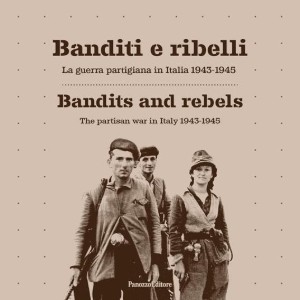
 Bandits and rebels: The partisan war in Italy 1943-1945 (Banditi e ribelli. La guerra partigiana in Italia 1943-1945), trans. P. Cooke (Panozzo Editore 2025), 144pp.
Chris Bambery reviews a pictorial history of the Italian resistance, and interviews Santo Peli, the author of its introductory text
Remember this book, come December, because it would make a wonderful Christmas present. Banditi e Ribelli/Bandits and Rebels is a mainly pictorial history of the Italian resistance which, from the summer of 1943 until April 1945, fought the occupying Germans and their Italian fascist allies, who had remained loyal to the fascist dictator, Benito Mussolini, after he was removed by the king, jailed and then rescued by the Nazis. Until his end in April 1945, executed by the partisans, he led the Italian Social Republic, a puppet government of the Third Reich.
Mussolini’s dismissal was triggered by the Allied invasion of Sicily in July 1943. A year later, Italy was cut in half, with the Germans and the fascists holding a line north of Florence. The partisans, the armed wing of the resistance, grew to number in the hundreds of thousands by April 1945. According to the Allied commander in chief, partisan activities in the north pinned down six out of the 25 German divisions based in northern Italy.
The book’s title references the description the Germans gave of the resistance: bandits! In November 1944, General Alexander, commander of all Allied ground troops in Italy, broadcast over the radio saying military operations would halt for the winter. The Germans and the fascists were able to concentrate on military operations against the partisans. That winter was very hard for them.
In the Spring of 1945, as the Allies advanced north, the partisans launched a full-scale insurrection, liberating the great northern cities. It was one of the great moments in working-class struggle internationally.
However, the Comitato di Liberazione Nazionale Alta Italia (CLN: Committee for the National Liberation of Italy) agreed to follow orders given by the Allies, recognising the Bonomi government in Rome (set up by the Allies) as the Italian government, and promised to maintain order in northern Italy until an Allied military occupation was devised. Above all, they promised to disarm upon liberation.
The Italian Communist Party (PCI) was the key force in the resistance and its leader, Palmiro Togliatti, was loyal to the Russian dictator, Stalin, who had partitioned Europe with the Americans and British. Italy was in the Allied zone and Stalin ruled revolution there as being off the agenda.
Banditi e Ribelli/Bandits and Rebels gives a great, succinct history of all this written by Santo Peli. He will forgive me if I say the pictures are both inspiring and fascinating.
The book is produced by Istoreico Reggio Emilia (Institute for the History of the Resistance and Contemporary Society in Reggio Emilia. On 24 April 1945, the city was liberated by the partisans. The President of the Italian Republic conferred the Resistance Military Value Gold Medal to Reggio Emilia, for its role played during the Italian Liberation War.
The pictures in the book will be used in an exhibition in the city opening in October of this year: a good reason to visit a lovely city in a wonderful region with gorgeous cuisine. The tourist board of Emilia Romagnai has devised three routes tracing the city’s experience of World War II, including one looking at the massacres inflicted upon the resistance and another tracing the partisans’ fight in the Apennine mountains.
I shall let the book speak for itself, which it does to great effect.
Interview with Santo Peli
Santo Peli is the author of Storia della Resistenza in Italia (History of the Italian Resistance) and of the text in Banditi e Ribelli.
Chris Bambery: Naples, Florence, Bologna, Genoa, Turin, Milan and Venice: all liberated not by the Allied armies but by the partisans. How significant was that?
Santo Peli: Naples is a completely unique case, because it was an urban insurrection in September 1943 rooted not in a political process or project, but in an unbearable attack on life and dignity, to which the working-class neighbourhoods of Naples reacted, over four days, with a violent, bloody, and victorious struggle.
In Bologna, the partisans entered the city as British troops approached; the same thing happened in Venice. Genoa, Turin, and Milan were liberated by the partisans, either at the same time (Genoa) or after (Milan), the German commanders’ decision to withdraw. This decision depended not on the military strength of the partisan formations, but on the imminent and unstoppable arrival of Allied troops. Only in Turin was the military intervention of the partisan divisions decisive for the liberation of the city.
CB: Much of the attention given to the Resistance focuses on Turin, Milan or even Florence. What happened in Emilia Romagna is less known but it was a major centre of the partisan campaign. Can you explain?
SP: On the eve of the April 1945 uprising, more than a third of the partisan formations were concentrated in Piedmont;ii furthermore, it was in Piedmont where, after 8 September, the Italian Fourth Army, returning from France, disbanded, and the presence of weapons and demobilised soldiers in this region was absolutely significant. The intensity and combativeness of the partisan formations in this region was unquestionably the most significant at the national level.
Milan was the headquarters of the Northern Italy National Liberation Committee (i.e. the political brain of the partisan war) and, from June 1944, of the General Command of the Freedom Volunteer Corps (the military brain of the partisan war).
Militarily, Lombardy was, according to the Garibaldi Brigades’ leaders,iii ‘the tail end’ of the armed struggle in northern Italy. But organisationally and politically, Milan was the hub from which projects, programs, agreements, and decisions affecting all the groups radiated, and thus Milan was ‘the capital of the Resistance’.
Emilia-Romagna was extraordinarily combative. It was certainly the region where, during the autumn and winter of 1944-45, the partisans succeeded much more successfully than in the rest of occupied Italy in maintaining their structures and fighting spirit. This was because here, the relationship with the peasants was characterised by a unity and solidarity that did not waver even in the face of the most violent reprisals. But Bologna experienced no insurrection, and this too was significant in making the Liberation memorable.
As for Florence, it was the first city actually liberated by the partisans (although this was obviously made possible by the presence of Allied troops on the banks of the Arno). Above all, it was the city where the new authorities (mayor, prefect, police chief, etc.) were appointed by the CLN, and where these appointments were confirmed by the Allies (as a sign of appreciation for the partisan commands).
CB: On the cover of the book is Oreste Colli ‘Tebe’, a member of the SAP [SAPs were wide partisan formations] in Reggio Emilia. One of the strengths of the book is it spotlights the role of women in the Partisans. Can you tell us more?
SP: Thank you for your appreciation. I believe countless stories could be added to demonstrate the indispensability of women’s participation in the partisan war. I take this opportunity to point out that in Florence, Milan, Genoa, etc., captured women, who often possessed a vast amount of information, addresses, codes, etc., generally resisted torture better than men. The male prejudice regarding women’s fragility and weakness, precisely during the harshness of the partisan war, suffered significant blows. These were significant, but too short-lived to allow for a decisive qualitative leap in the mental frameworks characteristic of the era.
CB: The British and Americans were ambivalent towards the Resistance. They wanted it to carry out sabotage but were worried about it being left wing. In the Autumn of 1944, General Alexander broadcast that the Allied offensive would halt for the winter. How did that work out?
SP: The Allies had a very clear, unambiguous vision, one that would remain unchanged throughout the war. The tasks to be assigned to the armed resistance were: gathering intelligence, sabotaging transportation, military production, etc.; ultimately, undermining the military effectiveness of the occupying German army. They were not, however, interested in creating a ‘national liberation army’, which was the political project primarily, but not exclusively, of the PCI [Italian Communist Party], the Action Party,iv and the Socialists. The Allies wanted to win the war; the partisans wanted to win the war, but also to change Italy.
As for General Alexander, announcing the end of the autumn offensive in late 1944 was psychologically idiotic, but ultimately it was merely an acknowledgement of a concrete situation. The real issue, paradoxically absent from partisan memory, is that in August 1944, in anticipation of the landing in Provence, the Allied troops engaged in the Italian campaign were halved, the Italian front became secondary, and thus the partisans too would have to endure a long, terrible second winter of war.
i Emilia-Romagna: region of central Italy with Bologna as its capital.
ii Piedmont: Region in North East Italy with Turin its capital.
iii Garibaldi Brigades: partisan units aligned with the Italian Communist Party.
iv Action Party: formed by anti-fascist republicans.
Before you go
The ongoing genocide in Gaza, Starmer’s austerity and the danger of a resurgent far right demonstrate the urgent need for socialist organisation and ideas. Counterfire has been central to the Palestine revolt and we are committed to building mass, united movements of resistance. Become a member today and join the fightback.

Chris Bambery
Chris Bambery is an author, political activist and commentator, and a supporter of Rise, the radical left wing coalition in Scotland. His books include A People's History of Scotland and The Second World War: A Marxist Analysis.