
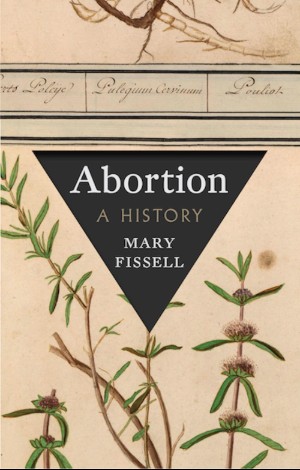
 Mary Fissell, Abortion: A History (Hurst & Company, 2025), vii, 288pp.
An ambitious attempt at a history of abortion from antiquity to today is valuable and interesting, but does not consider the structures behind the patterns of change, argues Elaine Graham-Leigh
Throughout European history, women have sought to end their pregnancies. Against this constant, the attitude taken to abortion by authorities has fluctuated, with periods of repression vying with periods where abortion is accepted or at least tolerated. Fissell’s history of abortion in Europe and in America after colonisation attempts to track the ebbs and flows of repression and toleration of abortion from the ancient world to the present day.
For Fissell, the shifts for and against in attitudes to abortion over the centuries are linked to ‘larger shifts in gender relations, in the ways a society expects men and women to behave’ (p.4). This formulation doesn’t quite express the clear connection between repression of abortion and the control of the reproduction of labour through women’s oppression, seeming to reduce it to culture or interpersonal relations. It is true, as Fissell states, that ‘abortion restriction has often been gender backlash’ (p.4) but locating it purely in cultural attitudes to women’s behaviour has the effect of hiding the structural nature of abortion restriction as part of women’s oppression. Nevertheless, Fissell is at least clear that we do have to understand the women who have sought abortions throughout her history as women, commenting that, ‘because the history of abortion is plaited with the history of how societies organized and regulated male and female behaviour, it matters that the people who sought abortions in the past … were labelled as women’ (p.3).
Fissell’s account of abortion does make clear the ways in which attitudes to it are bound up with wider social structures and mechanisms for repression and control. This emphasis is important, but it also raises the question of whether abortion can be reasonably be seen as a consistent phenomenon across the widely different societies she examines. There is a sense in which the reification of abortion necessary for this project hides profound differences in the significance of trying to end a pregnancy across these different societies. It is also possible that the argument that repression has simply oscillated may be hiding some long-term significant patterns about elite control of our intimate lives.
One way in which the nature of attempting to end a pregnancy has fundamentally changed is that the methods potentially available have become both more predictable and safer. Fissell also has little to say about the reliability or otherwise of abortion methods, or about the availability and efficacy of contraception, which would seem to elide significant variance between abortion in the pre-modern and modern age. There is a clear difference between seeking to end a pregnancy at times when, regardless of its legal status, no form of abortion was guaranteed to be effective or safe, and the modern position, where both those criteria can be fulfilled for women who are allowed to access them. Fissell rightly points out the role of nineteenth-century doctors in enabling the repression of abortion – for example by dismissing the old distinction between abortion pre-quickening (when the woman first feels the foetus move) and afterwards and opening the door to the arguments that personhood starts at conception – but the comparatively little attention paid here to the medical advances in abortion does seem like an omission.
Early modern practices
These issues aside, Fissell demonstrates that there are useful generalisations to be made about abortion in the West from the ancient world on. While our knowledge of abortion practices often comes from the repression of abortion, Fissell argues that this distorts a reality in which, in the long view that she aims to take, much of the history of abortion is the history of women quietly getting on with it, not necessarily in secret, but with little notice from the authorities.
In early medieval Europe, abortion could simply be ‘what some women are accustomed to do’ (p.58), as Bishop Burchard of Worms said in the early eleventh century. The implication of this description is that abortion was an ordinary practice, although since this is a line in a manual for priests conducting confession, it is also a clear indication that abortion was not regarded with approval. The reality of abortion as a reasonably common practice of women at grassroots level persisted into the early modern period. Fissell comments for example that ‘women in colonial America regulated their fertility using plants, and everyone knew about it’ (p.118).
The knowledge of how to attempt to bring about an abortion was presumably passed from woman to woman, although by its very nature we have little direct evidence of this outside of periods of repression. Fissell cites an example from seventeenth-century Swabia of a mistress reacting to the risk of her son raping the maid by taking her for a walk and pointing out plants which were ‘good medicine for women whose periods did not come as expected’ (p.70). This presumably represents innumerable such conversations in circumstances of varying degrees of repression. In the Swabian example, the conversation was recorded because the maid ended up in court.
Fissell touches briefly on abortion in non-Western societies such as First Nations people in America, where there are accounts of how women accompanying the men on hunting expeditions or war would abort their pregnancies if the circumstances would make it too difficult for them to continue. The implication is that this was regarded as entirely reasonable behaviour, and possibly indeed for the good of the group as a whole. While this impression may be at least partly the result of the nature of our sources, and we do not have anything like the quasi-anthropological analyses of First Nations people for Europeans or white Americans in the same period, it is noteworthy that this is the only example given here of a society where abortion practices do not appear to have come with at least a tinge of official disapproval. Although Fissell’s argument is that abortion has had long periods of quiet toleration in the West as well, her account does not bear this out to the extent that she might have wished.
Antiquity
Fissell starts her history with ancient Greece, for which our evidence of abortion practices ranges from Hippocratic medical texts to glancing references in Aristophanes’ comedies. She argues convincingly that the supposed ban in the Hippocratic rule on abortion is not what it seems. The ban was on male doctors giving women pessaries to induce abortion, on the grounds that this was more properly the work of female midwives, rather than a limitation of the practice of abortion per se. While the Hippocratic oath is therefore not evidence of disapproval of abortion, it is the case that our evidence for abortion being practised in ancient Greece is mostly restricted to its use by prostituted women, both free courtesans and enslaved women. Fissell comments that our ancient Greek sources are silent on married women having abortions. It may well be the case, as she argues, that they must nevertheless have been having them, but the fact that ancient Greek abortion appears in the surviving sources as a practice for slaves and courtesans suggests that it may not have been entirely respectable.
With ancient Rome, we have clearer indications of elite disapproval of abortion, with writers like Cicero decrying it as a property crime, robbing the father and his family of their hope of an heir, and others mentioning it as part of screeds against the depravity of elite women, who would have abortions to hide their illicit affairs or even just to preserve their figures. This was part of a reaction not so much to women’s greater freedoms in this period, as Fissell has it, but to the appearance of patrician women in public life, not as actors themselves, but as members and continuers of their dynasties.i It tells us little about the nature of actual abortion in the Roman empire, although it is worth noting that the connection with prostitution remained.
While the portrayals of abortion in these Roman sources may not have much to do with abortion as actually practised by Roman women, these two bases for denouncing abortion, as theft or a means to conceal illicit sex, would go on to be features of arguments against abortion for the next two thousand years. For slave owners in the Caribbean and in America, for example, slaves who aborted their pregnancies were effectively committing theft, depriving their masters of their property. For the slaves, on the other hand, it was a form of resistance.
Mary Gaffney, an enslaved woman, recounted after Emancipation that when she was married by her master to another slave, and forced by whipping to allow him to have sex with her, ‘I never did have any slaves to grow’, although she did go on to have children with her husband once they were both free (p.112). William Coleman, a slave in Tennessee, remembered that enslaved women he knew were severely punished for chewing cotton root, an abortifacient, but went on doing it anyway, so much so that ‘he marvelled that any babies were born on plantations’ (p.113).
Christianity and abortion
In Christian Europe, abortion was commonly regarded as a sinful attempt to cover up sexual sin, visible in our surviving evidence when that attempt at concealment had failed. As Fissell argues, in many times and places, ‘abortion was simply not understood as the kind of misdeed that was worth prosecuting unless it were part of a larger array of bad behaviour’ (p.118). It was, however, clearly understood as a misdeed when it was done to attempt to escape the consequences of having sex outside marriage. The Church in fact was rather more consistent in its condemnation of this than Fissell allows.
Fissell cites as an example of toleration of abortion the example of a miracle in the seventh-century Irish Life of St Brigit, where Brigit blessed a woman who had taken a vow of virginity but who, as a result of ‘youthful concupiscence’ had become pregnant. The result of the blessing was that ‘what had been conceived in the womb disappeared and she restored her to health and to penitence without childbirth or pain.’ii This is clearly an abortion, and does indeed indicate that abortion was part of the ordinary experience of seventh-century Ireland. However, it isn’t quite evidence of toleration. The miracle story appears in the Life as part of a series stressing Brigit’s holy purity and her power to transform or transcend actual and spiritual dirt and pollution. In this instance, it is the vileness of pregnancy in a nun which is redeemed by Brigit’s sanctity; it is not a suggestion that those repeating the miracle story would have regarded such an abortion in reality as no big deal.
The date of this apparent early-medieval example of abortion as a tolerated practice is also significant. Ireland in the seventh century was not a fully developed class society, in which a feudal aristocracy exploited a peasantry and therefore would have looked to control the reproduction of labour. The abortion miracle does not appear in later versions of Brigit’s Life, written from the eighth century on, when class society in Ireland was beginning to emerge. Attitudes to abortion were not simply about culture or religion; repression of abortion was, as part of women’s oppression, part of the structure of class society.
Alongside the condemnation of abortion as cover-up, which persisted into the central and later Middle Ages, the Church also developed the view, unknown in the ancient world, that abortion was wrong in itself, regardless of property considerations or the circumstances of conception. This was argued for example by St Augustine in the fourth century, when he equated abortion with the pagan practice of infanticide. Jurists later developed the idea that abortion before ‘the quickening’ was a lesser sin, whereas after quickening it was the same as infanticide, arguably the origin of modern limits on abortion by the length of the pregnancy.
While as Fissell says, action against women for abortion remains rare in the evidence we have for the medieval period, in the course of the Middle Ages, the Church was becoming more and more interested in regulating every aspect of life, including people’s sex lives. The social control that the Church offered was in fact a major underpinning of feudalism as it had developed from the eleventh century on, and regulating sexual behaviour was part of that. This regulation of sexual behaviour continued in the early modern period, when, with the Reformation and Catholic reaction to it, secular rulers assumed a remit for moral governance of the nation and the need to attempt to enforce a high degree of ideological conformity.
As Fissell comments, abortion was a threat to all this because it represented an attempt to avoid the consequences of acting outside accepted behaviour:
‘an unmarried woman who got pregnant revealed that their governance was shaky, that sexual desires were not controlled by their strict marriage regimes. Abortion similarly served as an indicator of local immorality, an indication that not everyone was abiding by new moral codes’ (p.84).
Modern Law develops
This set the stage therefore for a rash of secular anti-abortion laws across various states in early modern Europe, some with hair-raising punishments like the provision in the Holy Roman Emperor Charles V’s law code of 1532 that women who had had an abortion should be tortured with red-hot pincers and then drowned.
Some women offering help with abortion could also be treated as witches, although it is important to note that the connection of female healing practices and midwifery with witchcraft accusations is not as clear and dominant as some authorities have argued. It is by no means axiomatic that female healers were more likely to be accused of witchcraft than other women, and it is only one text, the Malleus Maleficarum (Hammer of Evildoers), which makes much of a connection between witches and midwives. What is clear though is that the witch-hunting panics which gripped parts of early modern Europe were part of the oppressive regime in which the repression of abortion also featured.
As Fissell describes, the background to the fights for legalisation of abortion which resulted in the UK in the 1967 Abortion Act and in the US in Roe v Wade was not simply the medieval and early modern repression of abortion, but a series of crackdowns in the nineteenth century and in the late 1940s, 1950s and 1960s. Fissell comments that the nineteenth-century abortion restrictions came in at precisely the wrong time for women: ‘women in Britain began to be at greater risk of unwanted pregnancy in the nineteenth century, just as new legislation criminalized abortion as never before’ (p.122). This was, she argues, because ‘it became ever easier for men to disappear’ once they had got their lovers pregnant (p.129).
To the extent that this is a reference to the greater opportunities for mobility, this is perhaps a little unfair on nineteenth-century men, and highlights again Fissell’s concentration on the cultural and interpersonal rather than the material and structural. There were plenty of involuntary reasons for men to leave the villages of their birth and the women they would otherwise have expected to marry, from enclosure causing rural destitution, to the press gangs. It is certainly true though that the 1834 Poor Law removed any incentive for local authorities to find and extract child support from an absent father, but instead would send destitute women to the poorhouse.
Twentieth century
Into the early twentieth century, while abortion remained illegal in the US and UK except where the life of the mother was at risk, it had slipped down the political agenda. On the quiet, abortion was provided by many doctors in reasonably safe conditions. Fissell quotes a California woman remembering how, in the 1930s, ‘“doctors understood how hard things were” and performed abortions for their patients at need’ (p.182).
This changed with a further turn to enforcing the legal restrictions on abortion in the US in the late 1940s and 1950s, which had the effect of making abortion far less safe. By the late 1950s, more than 40% of all pregnancy-related deaths in New York City were as a result of abortion complications, while at Los Angeles County General hospital, around a third of all maternal deaths were from badly performed abortions. This is a clear demonstration that the safety of abortion is in inverse proportion to the fervour with which it is repressed by the authorities.
Fissell presents the repression of abortion in the nineteenth and twentieth centuries as a form of moral panic, a response to increased mobility and personal freedom for both sexes and a backlash against women’s liberation. This much is clear, but it is important to stress that abortion repression is not simply a matter of surface concerns about morality but is part of the control of the social reproduction of labour. As such, it is profoundly material and reflects the needs of capitalism at the time.
This is also true for current attacks on abortion rights in the US. The modern round of repression reflects a range of elite concerns, from falling birthrates to pressure for higher wages. Women who have been rendered unable to control their fertility provide a more desperate and therefore lower-paid workforce than women who have been able to exercise choice. Fissell in her introduction makes a distinction between historical abortions, which she acknowledges were sought by women, and modern abortion, where ‘we talk about people who seek abortions’ (p.3). It is nevertheless important to recognise that just as in the past, the restriction of abortion is part of women’s oppression. The struggle to control our fertility is and remains a feminist issue.
Fissell’s optimistic conclusion is that the present attempts at repression of abortion are simply a moment in abortion’s long history. She argues that ‘periods of acute repression have not lasted. Like wildfires, moral panics burn out, and times of toleration usually follow’ (p.217). This may be so, but framing periods of intense repression of abortion as rather like the weather is to underestimate the role of struggle in achieving abortion rights.
Fissell has surprisingly little to say here about the feminist fight for abortion rights that lay behind Roe v Wade, for example, nor about the wider struggles against women’s oppression from the nineteenth century on that provided its context. The ebb and flow of abortion toleration and crackdown is not a natural phenomenon, but a dialectic of repression and resistance. Fissell’s history shows the importance of women being able to regulate their fertility and reminds us of the tragic consequences when we are prevented from doing so. The lesson however is not that we should simply hunker down and wait for the storm of repression to pass, but that, like women in the past, since we need abortion rights, we have to fight to defend them.
i Joan Smith, Unfortunately, She Was a Nymphomaniac: A New History of Rome’s Imperial Women, (William Collins, 2024), p.19.
ii Sean Connolly and J.-M. Picard, ‘Cogitosus’s “Life of St Brigit” Content and Value’, The Journal of the Royal Society of Antiquaries of Ireland 117 (1987), pp.5-27, p.16.
Before you go
The ongoing genocide in Gaza, Starmer’s austerity and the danger of a resurgent far right demonstrate the urgent need for socialist organisation and ideas. Counterfire has been central to the Palestine revolt and we are committed to building mass, united movements of resistance. Become a member today and join the fightback.

Elaine Graham-Leigh
Elaine Graham-Leigh is an activist and writer of history, politics and fiction. She is the author of The Southern French Nobility and the Albigensian Crusade, (Woodbridge: The Boydell Press, 2005), A Diet of Austerity: Class, Food and Climate Change, (London: Zero Books, 2015), Marx and the Climate Crisis, (London: Counterfire, 2020), The Caduca, (Canterbury: The Conrad Press, 2021) and Revolution in Carcassonne: The Story of a Fourteenth-Century Rebellion, (London: Whalebone Press, 2025). She is a founding member of Counterfire.