
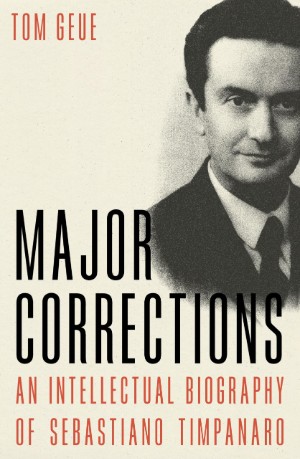
 Tom Geue, Major Corrections: An Intellectual Biography of Sebastiano Timpanaro
(London: Verso, 2025), 288pp.
Tom Geue, Major Corrections: An Intellectual Biography of Sebastiano Timpanaro
(London: Verso, 2025), 288pp.
This biography of Timpanaro, an Italian revolutionary socialist and philologist, provides a fascinating array of issues for Marxists to discuss, finds Luke Layzelle
In his 1976 study of Lukács, Michael Löwy suggested that ‘the problem of intellectuals who join the struggle of the proletariat is as old as the workers’ movements itself’.i Whilst not offering the kind of sustained examination of the relationship between his intellectual and the wider political movements in which he participated that Löwy proposed, nor indeed why this involvement might prove problematic, Tom Geue has produced an engaging intellectual biography of Sebastiano Timpanaro, a fascinating figure of the post-war Italian left.
A classical philologist and militant Marxist who wrote on topics ranging from the Enlightenment, structuralism, the Italian poet Giacomo Leopardi and Indo-European linguistics, Timpanaro became a widely read and discussed figure on the British left with the publication of two titles in the 1970s, On Materialism and The Freudian Slip. Here we have a welcome introduction to the full scope and range of Timpanaro’s work, much of which remains untranslated into English. In Major Corrections, Geue (himself a trained philologist who teaches classical studies at the Australian National University)develops an insightful and largely persuasive portrait of Timpanaro as a productively heterodox thinker whose rigorous methodology, rooted in a commitment to Enlightenment ideals of dispassionate objectivity and truth, produced an ecologically informed approach to historical materialism that remains strikingly relevant for contemporary progressive movements.
Born in Parma in 1923, Timpanaro’s childhood and young adulthood was lived in the shadow of fascism. Geue falls early for the biographers’ temptation to projection, suggesting that ‘perhaps’ guilt resulting from his solidly bourgeois parents’ ‘reluctant’ opposition to the fascist government in these years lay behind Timpanaro’s lifelong commitment to revolutionary socialism. On this latter point, there is no need for such retrospective psychologising: joining the then revolutionary Italian Socialist Party in 1947, Timpanaro remained a committed member of the radical left wing of Italian socialist politics throughout his life. Consistently critical of the reformist tendency which fatally undermined the Italian Communist Party (PCI) from the late 1940s on into the 70s, it is a reflection of the fractious and fractured nature of the Italian left in these years that Timpanaro was a member consecutively of a series of different political formations within the broader socialist left: moves necessitated by his revolutionary stance and the need to be ‘always to the left’ of the PCI.
Post-war Italian politics
Though at first appearing to retain some of the unity established during the years of resistance against the common enemy of fascism, the post-war settlement in Italy quickly revealed itself to be riven by conflict between two increasingly opposed fronts: on the one hand, representing the interests of the employing classes, the Christian Democrats (DC) (supported at the international level by a triumphant United States in the early stages of consolidating its status as global hegemon); in opposition, centred on the working classes and Palmiro Togliatti’s politics of national unity, the communists (and their own heavyweight backer, Russia). The years 1945-48 were shaped by a series of industrial disputes in which labour and capital drew the battle lines for the next thirty years of political struggle.
From the purview of a radical leftist such as Timpanaro, it is a familiar story. Marshall Plan aid, intended to serve the dual purpose of boosting the post-war US economy, and of undermining attempts by socialist and communist governments to restrain the power of a resurgent capitalist elite over the state and labour, was channelled directly to the ‘truly democratic’ elements of Italian politics: namely, the Christian Democrats. Led by the politically shrewd Alcide De Gasperi, the DC eventually secured the consent of the bourgeoisie and capitalist classes and, following a seismic electoral victory in 1948, would come to dominate Italian politics for the next two decades.
Though outwardly engaged in negotiation and dispute with the PCI, who sought throughout these years to engineer a lasting coalition with the DC, De Gaspari invariably held the best cards and was able to exploit the PCI’s apparent willingness to move ever further from its communist and anti-imperialist identity in the pursuit of power. The pattern for the PCI was one of steadily declining influence, increasing embrace of reformism and eventual capitulation in the politics of ‘historic compromise’ of the late 1970s. In 1976, disgusted with this trajectory, Timpanaro threw in the towel after thirty years as an active member of organised party politics on the left. Geue makes the case convincingly that Timpanaro’s gesture should not be seen as a turning away from the possibility of revolutionary politics as such, but rather a realistic assessment of the limits of all emancipatory movements when their horizon is ultimately delimited by an accommodation with the interests of capital.
Closer to home, it is tempting and perhaps productive to read this snapshot of Italian leftist politics in the post-war era comparatively with the situation on the left in Britain in the same years. What is striking is how early and persistently figures on the far left such as Timpanaro, but also the mainstream of the socialist movement more generally, foresaw and resisted the accommodationist leaning of the PCI. There are obvious limits to making any direct comparison between the PCI and the Labour party, but as the dominant party of the British left, it is possible to point to a similarly constitutive willingness – indeed ambition – on the part of Labourism to align itself with the interests of capital and the state institutions which ensure their perpetuity. It should also be noted that there has been a relative paucity on the British left of a clear-eyed recognition of this fatal commitment to compromise in contrast to how that recognition became a driving force for critical debate and political calculation on the Italian left. This lack of a proper understanding of the history and nature of the Labour Party and Labourism remains a major obstacle to progressive politics in Britain to this day.
Philosophic and political commitments
During his active years, Timpanaro would find himself most ‘at home’ in the Italian Socialist Party of Proletarian Unity, for whom he undertook the lion’s share of his militant activities. One can perhaps hear a nagging awareness of that problematic role of the intellectual in Timpanaro’s claim that ‘there have been periods of years and years in which I’ve dedicated many more hours to party activities than to study’ (p.21). There is no doubt however that the commitment to a militant Marxism here was ‘unswerving’. Timpanaro summed up his political allegiances in a letter:
‘I’ve been a socialist of the left, Marxist and Leninist without any particular orthodoxy, with sympathies also for the thought of Trotsky, but with clear hostility to Stalinism’ (p.20).
Timpanaro was perspicacious in this hostility to the Soviet leadership under Stalin, a vocal critic before 1956 and consistent defender of Trotsky throughout the period in which the thought of the latter was systematically marginalised.
Geue relays a fascinating episode in which Timpanaro and a colleague struggled to publish an essay on Trotsky in the left-wing, extra-parliamentary journal Quaderni Piacentini. Intended initially as a provocation to those who had, in Timpanaro’s view, too quickly dismissed the still-crucial theoretical insights of Trotsky on the basis of a reductive caricature of ‘Trotskyism’ as a minority current tainted by factionalism, the article was subject to editorial censure (in favour of something more ‘neutral’ and ‘desiccated’) to such an extent that Timpanaro had no choice but to withdraw it.
It is one of the recurrent themes running through Geue’s assessment of Timpanaro’s oeuvre that his ‘Enlightenment sensibility’ informs a ‘resistance to all forms of dogma and a priori assertion’ (p.25). Geue is alert to the dangers of positivism always close at hand in this territory, but argues convincingly that a commitment to scientific truth, objectivity, and material reality crucially shaped Timpanaro’s methodological allegiances. All this also had implications for the political positions he would adopt: his hostility to idealism and the interpretative sleights of hand typical of postmodernism was matched by a deep scepticism towards political manifestations of dogma which ‘stake too great an explanatory claim on the world’ (p.25).
It was during the post-war years outlined above that, alongside his militant activities, Timpanaro’s intellectual career began to take shape. Timpanaro was trained in philology – the historical study of language mostly in Latin and Greek texts – by one of the outstanding twentieth-century figures of the discipline, Giorgio Pasquali. Timpanaro was a precocious undergraduate and might well have enjoyed a fine academic career had it not been for a lifelong battle with agoraphobia, which seriously limited his professional opportunities.
On completion of his studies, Timpanaro worked as a schoolteacher and copy editor, roles which contributed to his commitment to a kind of popular pedagogic practice (something sorely missing in academic and intellectual life today) and a forensic attention to detail. Timpanaro’s position outside the academy has led some to make a claim for his decision as a principled refusal of the snares of institutional academia and the compromises that come with it, but Timpanaro himself was always quick to point out that the reality was nothing of the sort. He was simply constrained by quite mundane, but nonetheless powerful material limits: ‘neurological necessity and medical constraint’ (p.13).
On Materialism
According to Geue’s sharp reading here, Timpanaro’s life itself can be seen to reproduce a central opposition he was to devote perhaps his best known work, On Materialism, to exploring: between the belief that our lives are conducted on the basis of relatively free and voluntary decisions, and the obstinacy of the limits laid down by our bodies and the world of natural forces beyond our control.
Drawing responses on publication in English from a range of figures on the British left including Raymond Williams and Kate Soper, On Materialism comprises a series of polemical essays in which Timpanaro sought to counter the prevailing influence of ‘Western Marxism’ (in particular what he saw as the pernicious influence of Althusserian structuralism) and provide a stock-taking of the prospects for Marxism following the defeats of the 1960s and in the wake of events in Russia and China. Part reappraisal of Engels’ contributions on these questions; patient demolition of the idealism underlying crude forms of economic determinism; defence of scientific objectivity in the face of postmodern relativism – Timpanaro doesn’t pull his punches.
Geue successfully situates the philosophical critique of idealism and valorisation of a ‘pessimist-materialism’ as crucially shaped by Timpanaro’s experience of the demise of the revolutionary communist left in Italy in the years 1945-1970. The full implications of the opposition between free will and the material constraints it faces are acutely captured by Geue: ‘The political manifestation of this idealist current seeping into the left … would be voluntarism. Human will, whether individual or collective, was [for Timpanaro] a mere drop in the ocean compared to the vast swells of economy and biology actuating and restricting it’ (pp.145-6). Though not something Geue explores in detail, I was struck by the contemporary resonance of these lines in the wake of the Covid-19 pandemic, in which the interconnectedness of the biological and the social assumed a powerful new legibility. It will be for readers to decide if, in his desire to ‘expunge anthropocentrism’ and all forms of dualism from Marxism, Timpanaro avoids the pitfalls of ‘vulgar’ materialism and reproduces his own dualistic schema, but On Materialism clearly has much to offer contemporary thinking.
After a first chapter detailing Timpanaro’s political involvement (a thematic sequestering of ‘politics’ to which I will return), Geue moves through a conventionally chronological account of Timpanaro’s work. The early period comprised modest but decisively influential studies such as a critical reappraisal of a key figure in nineteenth-century philology, Karl Lachmann, studies on Virgil and the Roman poet Ennius, and the first of a series of major studies of the Italian poet Lepoardi. The latter was Timpanaro’s great and lifelong intellectual passion and a poet whose bitter cynicism and hard-won pessimistic vision, rooted in his experience of unremitting physical ailments, no doubt spoke to Timpanaro’s own unreliable constitution.
Geue moves on through a broader conspectus of Timpanaro’s engagement with a somewhat idiosyncratic assortment of Enlightenment and classical thinkers, including many overlooked Italian figures (a chapter which left me wanting a more extended analysis of these intriguing but sadly untranslated studies); to the aforementioned work on materialism and a sui generis engagement with Freud. In the latter, Timpanaro focuses on one aspect of psychoanalytic exegesis, parapraxis, or slips of the tongue, which Freud claimed reveal hidden unconscious motivations ‘in plain sight’, as it were, if we only know how to look for them. Here Timpanaro’s training in philology, providing him with the tools to submit texts to merciless scrutiny takes centre stage; suffice to say, Freud doesn’t come out of the exercise well. Geue concludes with discussion of Timpanaro’s works on linguistics and further literary criticism. Geue shows himself to be a sensitive and engaging guide in these pages, even in areas of study in which, by his own admission, he is far from expert. The sheer range of subjects Timpanaro covered is daunting, and by mining hitherto unpublished correspondence and drawing on a wide range of existing scholarship, Geue offers an excellent introduction to this ‘restless thinker’ (p.217).
It is something of a shame that Geue did not attend more to the question animating Löwy’s own study of a ‘problematic’ Marxist intellectual. Geue concedes he has ‘forfeited some of the history’ for the sake of a sustained examination of ‘the system’ of Timpanaro’s work, and within this remit, he has produced an accessible and insightful study. However, if we did want to approach Timpanaro according to the question outlined by Löwy, then we would, in his words, have to begin with the recognition that ‘the ideology of a given writer can be understood only in relation to his thought as a whole; and his thought must in turn be inserted into the world view that provides its structure of meaning.’ii It is perhaps ungenerous to level this as a criticism at Geue’s study, but there is certainly scope for further work giving more explicit and sustained attention to the dialectical relation between Timpanaro and his world.
Finally, why read a book about a relatively obscure classical philologist, Marxist radical today? As I have already indicated, what we might call Timpanaro’s ‘ecological-historical-materialism’ still has much to offer contemporary debates on climate politics. The impassioned commitment to Enlightenment principles of truth and objectivity which inform all of his work – political and intellectual – also stands as a powerful corrective to an increasing chorus of reactionary conservative and far-right figures presenting a civilisational argument in which ‘Western’ ideals from Graeco-Roman and Christian traditions are under threat and must be defended. This currently fashionable, half-baked grift conveniently airbrushes the achievements of the Enlightenment, chief among them a commitment to collective human flourishing, out of the picture. It is Geue’s achievement to put that commitment front and centre of this essential biography.
i Michael Löwy, Georg Lukàcs: From Romanticism to Bolshevism (London: Verso 1976/1979), p.9.
ii ibid. p.11.
Before you go
The ongoing genocide in Gaza, Starmer’s austerity and the danger of a resurgent far right demonstrate the urgent need for socialist organisation and ideas. Counterfire has been central to the Palestine revolt and we are committed to building mass, united movements of resistance. Become a member today and join the fightback.
