
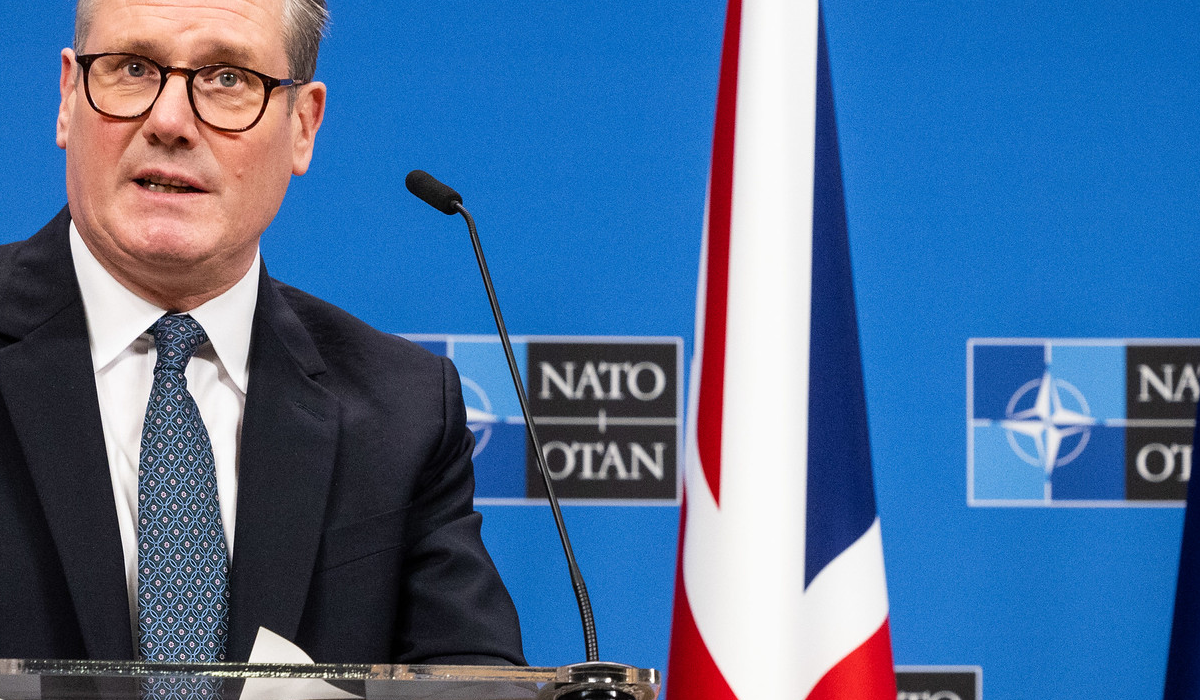
 Sir Keir Starmer visits Nato at Brussels, February 2025. Photo: Flickr/NATO
Alex Snowdon on emboldened warmongering and education battles ahead
What could we do with £15 billion a year? This is the increase in military spending announced last week.
Keir Starmer’s attempt at a legacy, as he heads for the political exit, is apparently to massively hike up UK spending on arms. Starmer reportedly hopes to become Nato Secretary General, which would make him chief cheerleader for massive arms spending increases across Europe.
This is a political choice. Politics is, in many ways, about priorities. The military is being prioritised above pay, welfare, infrastructure projects and public services.
Although framed in terms of ‘defence’ and ‘security’, it is ludicrous to suggest that Russia (bogged down in Ukraine) poses a genuine threat to Britain. Rather than being focused on defence, the ‘defence investment plan’ takes it for granted that preparations are needed for potential military aggression. The association between increased arms expenditure and ‘security’ ignores the real challenges to security in people’s lives – from climate change to unemployment, from rising living costs to Artificial Intelligence.
Much of the initial increase will be paid for by cutting spending on roads and energy infrastructure. It is extraordinary to think that politicians believe the military is a more worthy recipient of largesse than the necessary infrastructure on which we depend. It is also such an impoverished vision of industrial renewal to focus on the wasteful and destructive arms industry, considering the possibilities that exist in the green economy.
Government departments have been instructed to make cuts in capital spending. Consider education as an example. Teachers, support staff and children have recently struggled through a heatwave, for the most part in schools that are not made for such high temperatures. We desperately need investment in the school estate – retrofitting school buildings and, where necessary, constructing new schools – to manage the effects of climate change and ensure safe working and learning conditions.
It is reported that £4.7 billion of cuts have not yet been identified, leaving PM-in-waiting Andy Burnham with the challenge of choosing what to reduce spending on. Current indications are that social security could be an immediate target. The slogan ‘welfare not warfare’ has never been more relevant.
The government has previously cut international aid spending to prepare the ground for what is happening. In 2020, four times as much money was spent on ‘defence’ as on international aid. By next year, it will be an astonishing 9:1 ratio. It speaks volumes about the UK’s role in the wider world.
This is going to be one of the dominant issues in British politics for years to come – a major topic of public debate generally and within the labour movement. Higher military spending makes the world more dangerous, increasing the chances of armed conflict, while ramping up authoritarianism and being the pretext for cuts in more socially-useful areas.
Yet the mainstream media and political consensus on this issue is suffocating. We are faced with a ‘debate’ with only two permissible positions: support the government or berate it for not spending even more on the military.
The BBC has consistently foregrounded criticisms from those who want even vaster sums wasted on weapons and warfare. Anti-war voices are not given a platform.
Indeed the ‘too little, too late’ stance is treated by some as the only legitimate view. ‘Don’t leave Britain defenceless’ screeched the Daily Mail. ‘PM still puts welfare ahead of defence boost’ shrieked the Daily Express.
There is little dissent in official politics. The Greens, SNP and Plaid Cymru have all made weak, equivocal statements, if not worse. Green leader Zack Polanski has tried changing the subject, unwilling to explicitly oppose the spending rises.
Trade unions are divided. National Education Union (NEU) general secretary Daniel Kebede called for the government to ‘invest in childhood not conflict’, saying that ‘prioritising a £15 billion military increase while leaving school budgets running on empty is a political choice’. However, Unite leader Sharon Graham and GMB leader Gary Smith have welcomed the spending increases and lobbied for job creation in the arms industry.
This is part of a pattern in both the GMB and Unite. These unions are backing both investment in the arms industry and support for fossil fuel industries. We have even recently seen Graham and Smith lobbying against Ed Miliband as Andy Burnham’s prospective chancellor. These are ideologically right-wing positions and involve aligning these unions with the employers in particular sectors, engaging in joint political lobbying.
It is customary to point out that ‘there are no jobs on a dead planet’ – whether the threats to our planet derive from climate change, nuclear weapons or war. However, it is also clear that the ‘defence investment plan’ makes no sense from a jobs perspective. A new study, by the Transition Security Project, suggests that the plan will create 10,000 new jobs by 2029-30, but cost around 20,000 jobs due to cancelled investment in more productive fields.
Across Europe, we are seeing political leaders competing over who can splurge the most money in a new arms race. There will be even worse ahead – especially if governments are determined to achieve Nato’s obscene targets for spending. This week’s Nato summit in Ankara will no doubt see a renewed commitment to invest in weapons and war-readiness at the expense of everything else.
The recent international anti-war conference, hosted in London by Stop the War Coalition, created the foundations for an alternative to this destructive obsession with militarism. We must now build on those foundations.
Funding is still the issue
The pay award for teachers announced last week reflects pressure from trade unions but doesn’t go far enough – either on pay or funding. The government previously proposed a 6.5% rise spread over three years, with little or no central funding to pay for it. It has shifted to 6.5% spread over just two years, which will be partially funded by government.
This is a step forward. However, it still doesn’t restore teacher pay to 2010 levels – before Tory austerity. It is unlikely to be enough to overcome the ongoing teacher retention crisis.
It also still leaves a shortfall of £460 million in school budgets. That means cuts that schools really cannot afford. We can expect more redundancies and restructures in schools.
The recent heatwave highlighted the long-term underfunding of education, exposing how inadequate school premises are when faced with extreme heat. The increases in arms expenditure make it obvious that this government, irrespective of who is in 10 Downing Street, has no intention of investing in our schools – whether through capital spending or increased staffing.
The NEU’s Save Education campaign – calling for investment in education as well as fair pay rises for teachers and support staff – is more necessary than ever. Trade unions have a duty to organise and campaign for different priorities to a political class addicted to militarism and austerity.
Before you go
The ongoing genocide in Gaza, Starmer’s austerity and the danger of a resurgent far right demonstrate the urgent need for socialist organisation and ideas. Counterfire has been central to the Palestine revolt and we are committed to building mass, united movements of resistance. Become a member today and join the fightback.

Alex Snowdon
Alex Snowdon is a Counterfire activist in Newcastle. He is active in the Palestine Solidarity Campaign, Stop the War Coalition and the National Education Union. He is the author of A Short Guide to Israeli Apartheid (2022).