
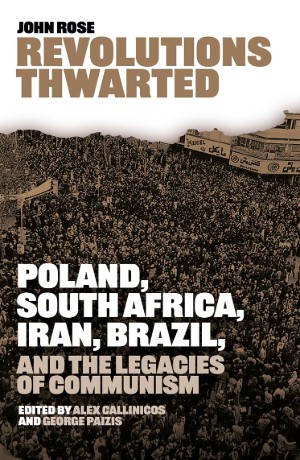
 John Rose, Revolutions Thwarted: Poland, South Africa, Iran, Brazil and the Legacies of Communism, eds. Alex Callinicos and George Paizis (London: Bookmarks 2025), 400pp.
Revolutionary crises weren’t absent from the late 1900s. John Rose’s posthumous work explains why they failed and how we can learn from this, finds Chris Nineham
In this fascinating, posthumously edited and published book, John Rose asks the most important question about revolution in the modern world.
This is not ‘is revolution still on the agenda?’ The truth is there have been revolutionary crises in several countries this century, from Bolivia and Argentina to Egypt and Sudan. Rose examines four potentially revolutionary moments from the last quarter of the twentieth century, a period widely regarded as one of successful ruling-class offensive.
His question is, why did these revolutionary moments not lead to socialist transformation? His answers, based on interviews with key activists and his own lifelong engagement with Marxism, are at a rare level of seriousness and sophistication.
Chances missed
In 1979, a revolution in Iran overthrew the Western-backed Shah. In the two-year revolutionary process, the revolutionary left contested Islamist organisations for leadership. Ultimately the Islamists won out, but Rose shows this was not inevitable. Different elements of the left had significant support amongst the working class and the poor. In the crucial oil sector and other key areas, workers formed councils or Shoras that took control of industries. It was in these areas that the left was strongest.
In Poland, almost simultaneously, one of the most powerful workers’ movements in history erupted against the Stalinist government. In a matter of months, ten million workers joined the Solidarity union led by self-confessed Marxists and organised huge strikes and factory occupations in many areas. The regime tottered, making massive concessions to survive. The turning point came in 1981 when some Solidarity leaders were brutally beaten up.
A general strike which could have toppled the regime was called off out of fear that the Soviet Union would invade. Although there were further massive waves of struggle, the movement never fully recovered, and by 1987, key Solidarity leaders embraced a pro-Western neoliberal agenda. The paradox of the Polish struggle was that it was ‘a self-limiting revolution’ that hastened the collapse of the Stalinist monolith and helped deliver Poland to the neoliberals a decade later.
In South Affica a few years later, the anti-apartheid movement reached a new level with the emergence of workerism, ‘a self-confident independent and politicised black trade union movement’ (p.181). In 1986, a strike wave ripped through the mining industry peaking in the 1987 national miners’ strike. Before that, it had spread to manufacturing, involving factory occupations that ‘brought the principle of ungovernability from the townships to the workplaces’ (p.182). Strikes and occupations raised the prospect of black workers taking the leadership of the anti-apartheid struggle and linking that struggle to the struggle for socialism.
Mass rank and file working-class action was central to bringing down the dictatorship in Brazil at the end of the 1980s. Struggle escalated throughout the decade and in May 1989, 25 million workers took part in a two-day general strike. As part of the struggle, the rank-and-file Metalworkers’ Opposition (MO) had helped build factory committees within the trade-union movement but also, when necessary, independent of them (p.295). The movement opened the possibility for fundamental change expressed in MO’s conviction that that the factory committees had the potential ‘for becoming instruments for the revolutionary transformation of society’ (p.295).
The Workers’ Party, formed in 1980 and led by charismatic workers’ leader Lula Ignazio de Silva, also expressed the mood for radical change. It organised leading militants from many political backgrounds including two sizeable Trotskyist organisations that had roots in the growing workers’ commissions. After defeat in the 1989 election, and in the wake of the collapse of the USSR, the movement subsided and the Lula leadership of the Workers’ Party took a sharp turn to the right.
Rose’s in-depth studies attest to the power of workers’ struggles in very different societies even in the face of a worldwide employer’s offensive. They show that struggles of this kind of intensity can lead to rank-and-file workers taking the offensive and seizing control of their workplaces and building new forms of rank-and-file organisation. In the process, working-class leaders are thrown up with tremendous abilities and creative capacities.
Workers at one Mercedes Benz plant in South Africa insisted on producing a bulletproof car for Nelson Mandela which was rushed out in a third of the normal time and with far fewer faults than the regular cars (p.225). In Iran, the workers’ committees or Shoras in the Tabriz and Pars Oil Company refinery completely took over production including the organisation of oil distribution. The government had no choice but to accept the nationalisation under workers’ control (p.268). There were hundreds of other similar examples during the struggles Rose describes.
Explaining defeat
Despite their enormous potential, the point of this book is to examine why each of these movements failed to overcome the challenges they faced. Why was it that the struggle against apartheid in South Africa, with all its highpoints, led to an ANC government that rallied to neoliberalism; that the Solidarity leaders ended up negotiating a privatisation agenda for Poland with Western bankers; that when Lula finally became president in Brazil in 2001, he promised to ‘respect the neoliberal policy regime’ (p.293)? And why did the Islamists emerge at the head of the post-Shah Iranian state?
The general background was not favourable; the ruling classes’ neoliberal offensive was already making headway in the early 1980s, throwing the left in many countries onto the defensive and into disarray. The collapse of the Soviet Union and its satellites, which was prefigured by the events in Poland, accelerated from 1988 and caused a further crisis of confidence and politics on the left.
It is in this context that Rose identifies the general problem was that the left in all these movements failed to develop a clear overall political strategy and leadership. There was, in particular, an over confidence in the spontaneous ability of workers’ struggle in the workplaces to solve problems, a tendency which has historically been called ‘revolutionary syndicalism’ (p.328).
In South Africa, the workerists’ focus on spontaneity led to a situation where workers outside of mining even failed to build basic solidarity with the great miners’ strike of 1987. This led to a catastrophic defeat involving 60,000 dismissals including the most active stewards (p.198). It was a blow from which the workers’ movement of the time never fully recovered.
In each case, lack of overall political leadership also led to a situation where organised workers failed to give a lead consciously to the urban poor and unorganised workers, leaving them open to the influence of other social groups. In the case of Iran, this meant the Islamic groups, in South Africa, it was the populists, based in the townships and uncritical of the nationalist ANC leadership.
The central problem with the idea that simply taking over the means of production was enough to secure workers’ control concerns state power. Syndicalism downplays the importance of the state and the ruling classes’ political response in revolutionary crises.
In Poland, for example, fear of Russian intervention led explicitly to the idea of the ‘self-limiting revolution’, the opposite of what is necessary in a revolutionary situation. The result was that the state machine was left completely intact, allowing the ruling class, once it had recovered from the first shock of the massive strike wave, to regroup and ultimately decapitate the movement with mass arrests.
In Iran, the left failed to use the occupations and the emerging workers’ councils as a bridgehead to provide leadership for the wider movement and compete politically with the Islamists. This would have involved a wider defence of democracy within the new state:
‘The struggle for popular democracy, including the defence of women’s rights, and an independent press, in 1979 was just as important as defending the workers’ shoras and the new regime’s anti-imperialist stance. This meant different tactical and strategic alliances with different groups of Islamists at different times and on different occasions. It meant elevating the importance of the struggle over the democratic content of the new Islamic Republican constitution to a fundamental priority, including, where necessary, temporary tactical alliances with Islamic liberals’ (p.289).
The influence of Stalinist politics militated against a thoroughgoing commitment to democracy but also tended to ‘rule out such essential tactical and strategic flexibility’ (p.289).
Syndicalism’s roots
The Marxist tradition has long had a criticism of syndicalism. Rose draws on the experience and work of Italian revolutionary Antonio Gramsci to make his point. Writing after the vicious repression of the wave of factory occupations in Turin in 1920 by 50,000 troops, Gramsci wrote: ‘It is essential that workers should not believe for one instant that the communist revolution is as easy to accomplish as the occupation of an undefended factory. These events on the contrary … show up with blinding clarity … the anarcho-syndicalist utopia’ (cited p.328).
The problem was illustrated very clearly in Brazil where the movement suffered a big defeat at the end of the 1980s when a strike at a massive steel-producing company CSN in Volta Redonda, turned into an occupation:
‘The strike of the steel mill lasted 17 days, but the occupation only three. This is because after cutting off the supply of water, electricity and food to the plant on the 9th of November 1988, army troops invaded CSN to expel the strikers resorting to the use of lethal ammunition … After the evacuation was over the troops did not withdraw men remaining inside the plant for several days’ (p.310).
In Brazil, the problem of syndicalism was exacerbated by the fact that much of the left, including the Trotskyist Socialist Democracy (SD), believed an election victory for the Workers’ Party would detonate mass workers’ struggle and saw building the party as the primary focus for their work. One of the leaders of SD in fact characterised the Workers’ Party as ‘a revolutionary party under construction.’ Rose points out that although other more senior people in SD criticised this formulation, they: ‘accepted the underlying implication that if such a party succeeded in winning the elections it would trigger the “moment when class alternatives clash”: in other words, a revolutionary showdown with the bourgeoisie’ (p.218).
This was a bad misjudgement based on a kind of electoral spontaneism. Lula didn’t win a presidential election till 2002, by which time electoral defeats had been used to abandon socialism, expel much of the Trotskyist left and shift the party sharply to the right. Clearly it was right to be part of the Workers’ Party initiative, but as John Rose suggests, a united far left coordinating work inside both the Workers’ Party and the workers’ commissions might have produced a very different outcome (p.325).
In general, the problems outlined here concern the downplaying of the subjective, conscious factor in the revolutionary process. This tendency is a feature of many great upheavals and as John Rose explains in the book’s opening chapter, something that Lenin warned against. This was particularly so after the capitulation of the Second International to national chauvinism and war in 1914:
‘Lenin would come to emphasise more forcefully that subjective practical activity lay at the centre of the “objective” world, and that social scientific laws should not be “fetishised” as things distinct from conscious human activity but instead be recognised as “necessarily incomplete and approximate”’ (p.81).
The tendency towards syndicalism and fatalism was reinforced by the complex influence of Stalinist politics in all the movements discussed. Stalinist communist parties were both an off-putting authoritarian caricature of genuine Leninism and at the same time largely committed to cross-class compromise rather than thorough-going revolutionary change. The South African Communist Party, when it was legalised, for example, ended up tailing the nationalist African National Congress.
To cap it all, the implosion of the Soviet Union and the collapse of the so-called communist states in Eastern Europe under popular pressure at the end of the 1980s led many activists to question the whole project of revolutionary organisation, and even of socialism. The Lula leadership of the Workers’ Party in Brazil used this mood to pass a resolution at their 1991 Congress saying: ‘We have to recognise that we are witnessing the end of the cycle of socialist revolutions begun with the Russian Revolution in 1917 and the model of society they inspired…’ (p.318).
Revolutions Thwarted vividly reclaims the history of four high points of class struggle, histories always in danger being lost. It is a great testament to the power and creativity of workers’ struggle. At the same time, John Rose has bequeathed us an all too relevant warning that syndicalism is not an alternative path to transformation and that revolution demands political strategy. In general, this is a rich sourcebook for the job in hand; the essential task of strengthening revolutionary organisation in the twenty-first century.
Before you go
The ongoing genocide in Gaza, Starmer’s austerity and the danger of a resurgent far right demonstrate the urgent need for socialist organisation and ideas. Counterfire has been central to the Palestine revolt and we are committed to building mass, united movements of resistance. Become a member today and join the fightback.

Chris Nineham
Chris Nineham is a founder member of Stop the War and Counterfire, speaking regularly around the country on behalf of both. He is author of The People Versus Tony Blair and Capitalism and Class Consciousness: the ideas of Georg Lukacs.