
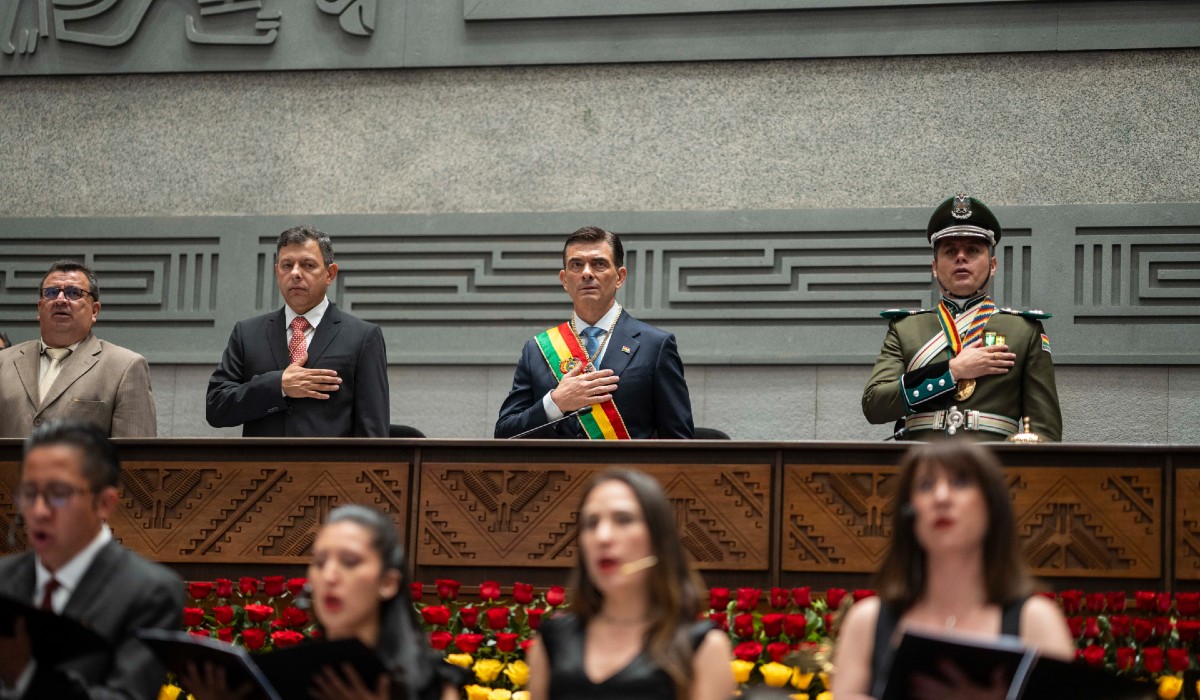
 Inauguration of the president of Bolivia, Rodrigo Paz.
Photo: Dirección de Prensa / Wikimedia commons / CC BY-SA 3.0
Inauguration of the president of Bolivia, Rodrigo Paz.
Photo: Dirección de Prensa / Wikimedia commons / CC BY-SA 3.0
Emergency legislation lays the foundations to crush the Bolivian anti-government protests argues Jonathan Maunders
Bolivia’s government is turning Washington’s rhetoric into law. After weeks of US officials describing protests as part of a coup attempt, President Rodrigo Paz Pereira has signed emergency legislation that could pave the way for military intervention against strikes and roadblocks.
The measure allows the armed forces to intervene in domestic operations when the police are deemed insufficient. Even more dangerously, it gives soldiers and police a presumption of legality during conflict situations. In practice, their actions will be treated as lawful unless proven otherwise.
This is not a minor administrative change. Paz is moving from condemning the movement to preparing to crush it.
US support
That makes the Trump administration’s intervention even more significant. US officials have backed Paz, with Secretary of State Marco Rubio promising emergency assistance and logistical support. Defence Secretary Pete Hegseth has linked the protests to threats of ‘narco-terrorist’ domination.
The language is deliberate. Once protesters are labelled criminals or coup plotters, repression can be presented as democracy defending itself.
With the new legislation, Paz’s government can now claim that clearing roadblocks, deploying troops and suspending rights are not attacks on Bolivian workers, but necessary measures to restore order. US backing helps legitimise that move.
This is the familiar pattern in Latin America. Right-wing governments are treated as legitimate, even when they attack the poor. The repression is dressed up as stability. Meanwhile, mass movements are presented as anti-democratic when they start to challenge market power.
The human cost is already severe. According to Bolivia’s independent public ombudsman, between 1 May and 2 June the unrest left ten people dead, 37 injured and 365 arrested. Blockades have also disrupted food, fuel and medical supplies, with cities like La Paz and El Alto facing shortages.
Paz is trying to use this suffering to build support for a crackdown, blaming the crisis on protesters rather than on the austerity and economic breakdown that produced the movement in the first place.
Protests continue
The government’s problem is that the protests have not simply disappeared. Even amid growing repression, the movement remains rooted in real anger: over fuel shortages, rising prices, stagnant wages, and the sense that Paz’s government represents business interests and Trump, rather than Bolivia’s workers and rural poor.
The confrontation is shifting. Paz is trying to move from negotiation and police repression to emergency powers and military force. He continues to claim he is defending democracy while preparing to crush the people democracy is supposed to serve.
Bolivia’s protest movement is diverse. It brings together miners, trade unions, transport workers, rural organisations, and indigenous groups. There are real tensions over leadership and strategy. But none of that justifies branding a social movement as terrorism or a coup.
The danger is clear. The Trump administration has helped create the political atmosphere for repression in Bolivia. Paz’s emergency legislation has now created the machinery for it.
If strikes and roadblocks are treated as coup attempts, and soldiers are handed legal cover before they are sent onto the streets, Bolivia will become a warning for the whole region.
Austerity and repression are being wrapped in the language of democracy and stability. That is why the Bolivian protest movement deserves solidarity, and why US intervention must be rejected.
Before you go
The ongoing genocide in Gaza, Starmer’s austerity and the danger of a resurgent far right demonstrate the urgent need for socialist organisation and ideas. Counterfire has been central to the Palestine revolt and we are committed to building mass, united movements of resistance. Become a member today and join the fightback.
