
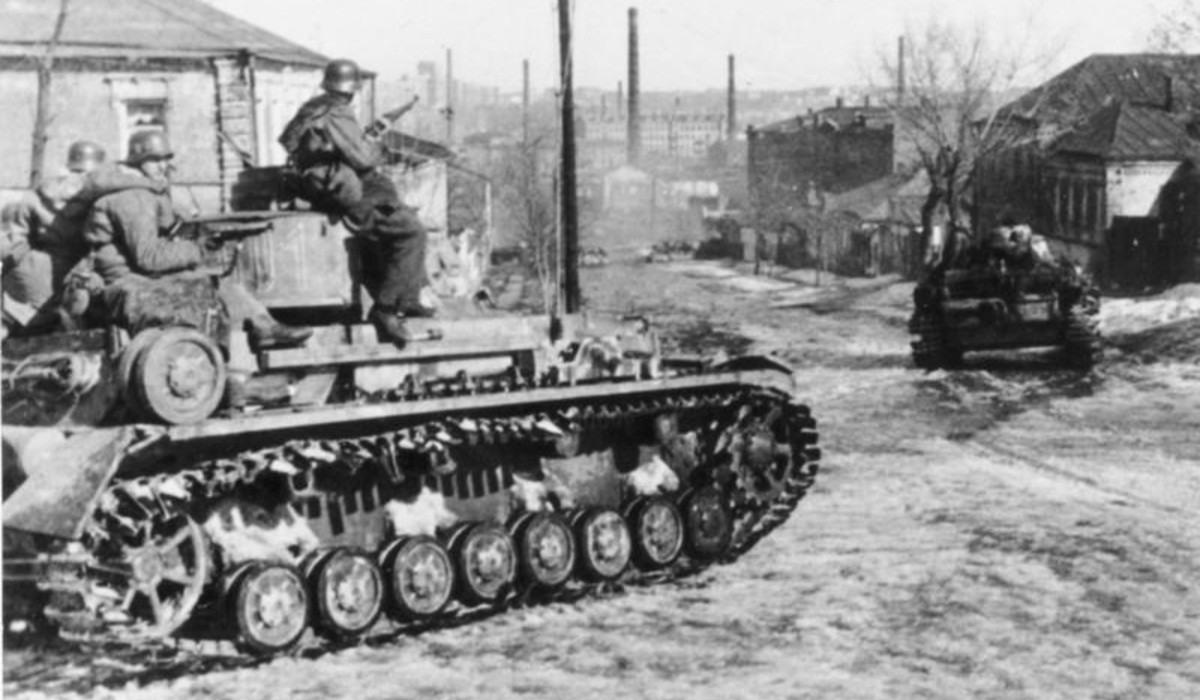
 Waffen-SS mit Panzer IV, Charkow, Russland, March 1943. Photo: Bundesarchiv / CC BY-SA 3.0
As Western leaders hype up the warmongering that Russia poses an invasion threat to the western Europe and the UK, Robert Dale unpicks some key events that underpin Russia’s concerns at Nato expansionism
As Western leaders hype up the warmongering that Russia poses an invasion threat to the western Europe and the UK, Robert Dale unpicks some key events that underpin Russia’s concerns at Nato expansionism
The information space on Ukraine is an ab-so-lute nightmare. They’ve all got brain worms. The war propaganda is so massive, so pervasive, it’s hard to know where to start. I’m going to give it a whirl.
The bee in my bonnet today is the long history of conflict and tensions between Russia and the West. It forms the backdrop to the current war. Some would say the roots. You could say I’m just filling in a few of the bits our rulers and media leave out when they crack the whip for war.
Major events in history form the backdrop to the ‘national discussion’, shaping the myths that hold together the fiction of the ‘nation’. In Britain, it’s things like the Blitz, D-Day, Trafalgar, Waterloo. Glory stories of British derring-do. Largely unsaid, everyone knows Britain is an island, and therefore hard to invade. For Russians it’s the opposite. A long history of invasion by hostile powers, the most recent – and barbaric – still in living memory.
Marching to Moscow
The first in the modern age was Napoleon in 1812. The motive, ironically, was to force Russia to join France’s economic war against the British. Long story short, Napoleon marched his armies all the way to Moscow but the Russians burnt their capital city to the ground. Freezing cold, with nothing to eat and nowhere to stay, the French beat a retreat. Soon to meet their Waterloo. At Waterloo. No not the station, a town in Belgium.
Next up the Brits, in 1856, invading with the French: the Crimean War, of Charge of the Light Brigade fame (it also gave us the balaclava, the cardigan and the ‘thin red line’). What business did the British have in Crimea? None of course (like today). Something about backing the Ottomans against the Russians. The Crimean War wasn’t just in Crimea, the British forces got everywhere: the Sea of Azov, the Caucasus, the Baltic, Arkhangelsk in the Arctic, Kamchatka in the Far East. In the end it kind of fizzled out.
Tsarist Russia clashed with Germany and Austro-Hungary in the First World War. It didn’t go well, and led directly to the Russian revolution. The workers took power and set about building free and just society. So obviously it was time for the British military to invade again (along with the French, Americans, Czechoslovaks and a bunch of others). Eventually they were sent packing of course, but not before wreaking death and destruction from Arkhangelsk (again) to Vladivostok.
That brings us to the end of the ‘dim and distant past’, largely forgotten but still lurking in the collective consciousness. The next episode is still (just) in living memory, and not at all forgotten.
The beast of Berlin
The Second World War is seared into the Russian psyche. Twenty-seven million Soviet citizens lost their lives (British deaths, military and civilian, in the entire war: 450,000). Soviet losses in the last two weeks of the war, fighting the final 60 miles from the River Oder to Berlin, were higher than the total Allied casualties all the way from the Normandy beaches to the end (eleven months, 750 miles).
It’s a sprawling topic, and I can only scratch the surface here. We have to begin just before the fighting started. In 1939 the Soviets and Germans agreed a non-aggression pact (and divided Poland between them). Supporters of the current war in Ukraine often cite this deal – the Hitler-Stalin Pact – as proof that the Russians are devious, malevolent, not to be trusted.
What they conveniently forget is that in the summer of 1939 the Soviets first asked the British and French to form an alliance against Hitler. Only after the British and French turned them down flat did the Soviets cut a deal with the Germans.
As we know, it didn’t last long. In June 1941 Hitler’s armies invaded. Their treatment of western Europe – France, Holland, Belgium, Denmark – was a picnic compared to the death and destruction they wreaked across the Soviet Union. The Nazis regarded Slavs as subhuman, and treated them as such.
They routinely executed prisoners of war and gave specific orders to execute any Soviet political officer who fell into their hands. By October they had reached the outskirts of Moscow, besieged Leningrad (now St Petersburg) and captured a large part of the Soviet Union’s industrial heartland. The siege of Leningrad lasted more than two years; half the city’s population of three million died, many simply of starvation (Vladimir Putin’s elder brother among them).
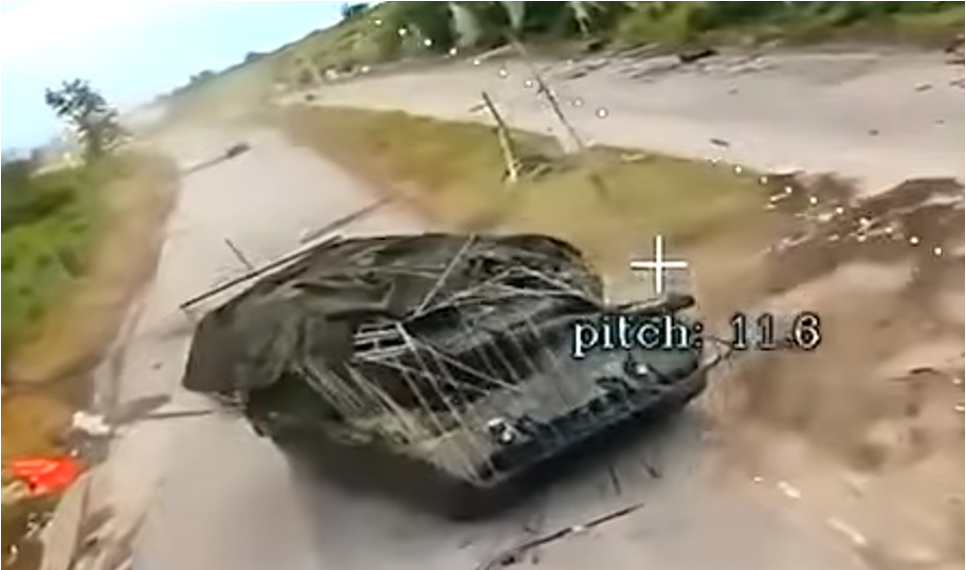
To cut a long story short, in winter 1942–43 the Germans met their nemesis at Stalingrad (now Volgograd). The Soviets forced them to fight for every block, every building, every last piece of rubble in the city (population half a million, the size of Sheffield). They held out for months in the utter ruins, until all but a handful were dead. Winter came, reinforcements came, and it was game over for the Germans and their allies. They lost a million-strong army in Stalingrad, dead or captured. Half a million Soviets died. Stalingrad was the turning point of the war in Europe (Normandy was a sideshow). After Stalingrad it was one long retreat for the Germans, all the way back to Berlin. On the way, it’s worth noting, there was bitter fighting through the industrial Donbas (eastern Ukraine). They remember that, when they see German tanks in Ukraine again today.
War is over?
So the war ended in May 1945. One leader wasn’t happy about that. Winston Churchill ordered his generals to prepare plans to gather up the defeated German armies and march on Moscow, with the Americans and Poles along for the ride. ‘Operation Unthinkable’ was only abandoned because the generals thought they would lose.
In the years after the war, the British and Americans sponsored clandestine forces in parts of the Soviet Union: western Ukraine and the Baltic states in particular. Local collaborators such as the Ukrainian Insurgent Army had fought with the Nazis during the German invasion and occupation, massacring Poles, Soviets and Jews. Now they continued as guerrilla forces, with Western support, killing an estimated 30,000 Soviet citizens. Those traditions are still widely commemorated today. In Ukraine they are state policy (for an overview, see Ukrainian historian Marta Havryshko).
Soviet collapse
Now we fast-forward through the Cold War to the collapse and break-up of the Soviet Union in 1988–92. As the dust settled, Russian workers hoped for a better life. Instead they got American ‘advisors’ in Moscow, with their grubby paws all over the ministries. International financiers and local elites embarked on a spree of monstrous self-enrichment, creating the oligarch class (another abused term, that; it just means the richest business elites using their wealth to meddle in politics; think Rupert Murdoch or Elon Musk).
As the rich feasted, the rest of the country descended into a decade of looting and lawlessness. Wages and pensions went unpaid, and life for ordinary people was miserable. Life expectancy plummeted. In 1996 the foreign financiers and Russian billionaires feared that their man – President Boris Yeltsin – would lose the election. So they effectively bought it, price tag US$10 billion through the IMF.
Vladimir Putin became president in late 1999. No friend of workers, not at all. But his government did two things that made a difference for ordinary people. It reined in the political influence of the oligarchs (ironically, you’re more likely to find a real oligarch in Ukraine or London these days) and cracked down hard on many elements of economic lawlessness, especially those that most plagued ordinary people. The difference between the awful 1990s and the decades of ‘normalisation’ that followed goes a long way to explaining why Putin is genuinely a great deal less unpopular in his country than Starmer, Merz or Macron are in theirs.
Inching east by leaps and bounds
In 1990, German reunification had to be negotiated, which meant Soviet forces withdrawing from East Germany. A tricky undertaking. Soviet leader Mikhail Gorbachev was very cooperative, and in return US Secretary of State James Baker promised that Nato would not expand eastwards, not an inch. War supporters often claim that this did not occur, but the memo is archived.
‘the East. If we maintain a presence in a Germany that is a part of NATO, there would be no extension of NATO’s jurisdiction for forces of NATO one inch to the east.’
Excerpt from official record of conversation between Baker, Gorbachev and Shevardnaze, 9 February 1990 No prizes for guessing if they kept their word. Russian leaders watched Nato expand up to their country’s borders: Poland, the Czech Republic and Hungary in 1999, the Baltic states, Slovakia, Romania and Bulgaria in 2004. In April 2008, Nato leaders meeting in Budapest announced that Georgia and Ukraine ‘will become members of Nato’. This was a turning point.
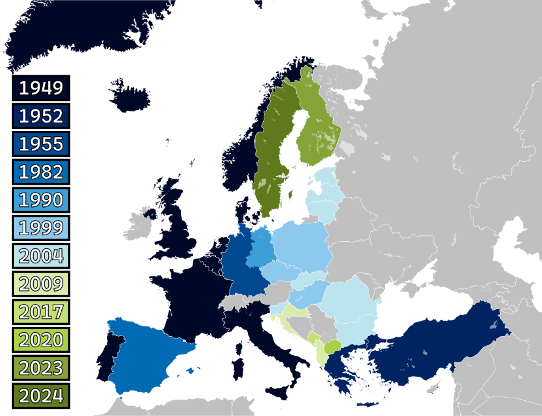
In August 2008, Russia fought a brief war in Georgia over a scrap of land called South Ossetia. An EU-funded-investigation concluded that Georgia had initiated hostilities (the Tagliavini Report). And Russia began overhauling its dilapidated military, as its economic recovery now allowed. In 2010 Washington upped the ante, announcing new missile bases to be constructed in Poland and Romania.
From tensions to war
Ukraine’s president at this time, Yanokovich, is portrayed as pro-Russian. A popular movement against him began in late 2013 and had toppled his government by February 2014. The events that followed are murky, and need to be turned over properly sometime. Suffice to say, the outcome was a vehemently anti-Russian government in thrall to the Americans and the EU, and enthusiasm strongly divided on east/west lines.
Russia ‘took back’ Crimea (which had been transferred to Ukraine within the USSR for administrative reasons, in 1954). Separatist entities were established in Donetsk and Luhansk, and were regularly shelled by Ukrainian forces. The imperial powers on both sides were now pulling the strings.
The CIA built a string of listening posts along the Russian border. The British announced plans to build naval bases on the Black Sea, including one at Ochakov. (Right back in 1791, the British Navy was mobilised to assault and seize Ochakov; Prime Minister William Pitt the Younger came close to resignation over the mission’s failure). By 2020, Nato was rotating 20,000 troops annually through Ukraine.
In 2019, Volodymyr Zelensky won a landslide across Ukraine’s internal divides, on a platform of ending the conflict in the east. On a visit to the front lines, he told the the hard-right irregulars to pull back. They said ‘no’, and threatened his life. And that was it, apparently.
In autumn 2021, the Russians proposed a set of mutual security treaties. Both sides should limit their intermediate-range missiles and Nato should restrict its activities to its 1997 borders. The Americans said ‘no’, the Russians said there would be a ‘tough response’.
And so the stage was set for a hot war between imperialist powers, initially fought in and through Ukraine. The rest, as they say, is not yet history.
Robert Dale lives in the Berlin region, where he has been active in socialist politics since the 1980s.
Before you go
The ongoing genocide in Gaza, Starmer’s austerity and the danger of a resurgent far right demonstrate the urgent need for socialist organisation and ideas. Counterfire has been central to the Palestine revolt and we are committed to building mass, united movements of resistance. Become a member today and join the fightback.
