
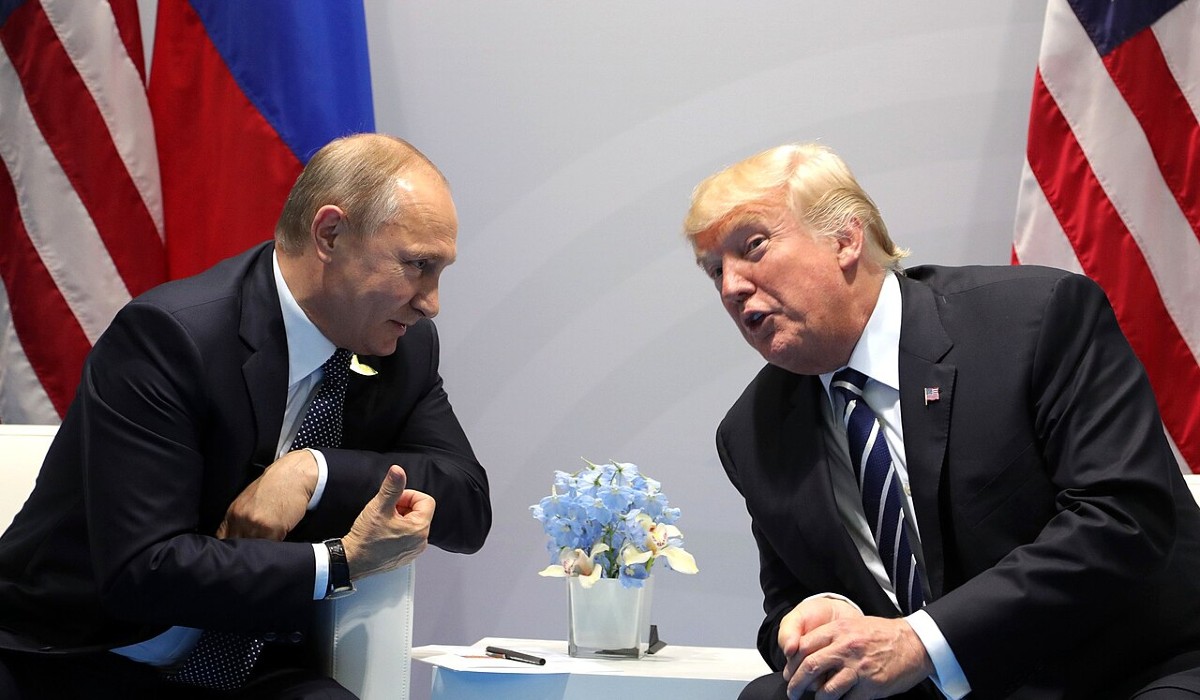
 Vladimir Putin and Donald Trump meet at the 2017 G-20 Hamburg Summit / Wikimedia Commons / CC BY 4.0
Chris Bambery argues that the war in Iran will strengthen Putin’s hand in the Ukraine war
The Western media’s abiding refrain is that Ukraine is, militarily and economically, on the point of collapse. It is part of whipping up anti-Russian feeling on the one hand, and encouraging a more rapid pace of militarization on the other.
On occasions, to bolster confidence that ‘we’ can win, there are reports of Russian defeats and difficulties with manpower and morale.
On Sunday the Independent ‘reported’ that Russia is deploying recovering alcoholics, rounded up from rehab facilities, at the front. The ‘report’ is alleged to come from a Russian serviceman, but is more likely to have been created in Kyiv.
That Russia is struggling with manpower is surely wishful thinking. And, with US-brokered peace talks between the two warring states on hold, and with Washington focused on Iran, it looks like Russia is seizing the opportunity of a spring offensive.
The war, begun with Vladimir Putin’s criminal invasion of Ukraine, is now over four years old. It is a horrific war of relative stalemate but one in which the odds benefit Russia. Russia has greater manpower and a larger industrial base to feed the front with ample weaponry, particularly artillery shells, drones and missiles.
Ukraine, on the other hand, has serious manpower problems and relies on US and European arms, intelligence and service personnel to operate Western-provided equipment and to train Ukrainian forces.
The US is happy to leave supplying Ukraine to its Nato allies and prefers to sell (at full price) the weaponry and munitions Kyiv needs to European states. However, the war with Iran means that the US is diverting resources to the Middle East theatre. Ukraine is now last in the queue for interceptor missiles like the Patriot, behind Israel, behind Saudi Arabia and the Gulf States.
On Thursday the Washington Post confirmed that the Pentagon is weighing up whether to redirect weapons originally meant for Ukraine to the Middle East. The redirected weapons could include crucial air-defence interceptor missiles.
The Independent reports that Russia may have begun its spring offensive last week, launching ‘the largest aerial attack in a single day so far’. In one day, Russia launched a thousand drones that killed six people, along with twenty-three cruise missiles and seven ballistic missiles that hit ten locations.
US media is reporting in a similar vein. An NBC report confirms the shifting focus to the Middle East that is leaving Ukraine exposed: ‘With the world’s attention shifting to the escalating conflict in the Middle East, Russia is pushing forward with a spring offensive in Ukraine despite months of peace talks that no longer appear to be Washington’s priority.’ Russia’s Defence Ministry said on Sunday that its forces had captured the village of Kivsharivka in Ukraine’s Kharkiv region.
Moscow clearly sees the Iran war as an opportunity to advance. Its objective may well be the so-called ‘Fortress Belt’, the main Ukrainian fortified defensive line in the fiercely contested eastern region of Donetsk. Over the last week, Russia has launched a battalion-size assault northeast of Sloviansk, the Belt’s northern anchor, and smaller attacks near the cities of Pokrovsk and Kostiantynivka on its southern end, seeking to create conditions for a wider offensive. Retired Vice Admiral of the US Navy Robert B Murrett, told France 24 that the region is ‘a veritable highway for any army that wanted to conduct operations further into Ukraine and beyond.’
Russia’s war relies on attrition, scale and firepower, which suits them because of their advantages in men and materiel.
In many ways, the wars in Ukraine and that with Iran parallel each other. Both wars are becoming stalemates, and this has been noticed by the international affairs think tank, Chatham House:
‘Russia’s ability to demonstrate resilience under sanctions, maintain influence in energy markets, and project strategic reach strengthens its relative standing.
‘Recent US decisions to ease certain restrictions on Russian energy flows are primarily aimed at stabilizing global markets amid disruption caused by the [Iran] war. They are not intended as support for President Putin. Nonetheless, by being forced to alleviate pressure on Russia’s most critical revenue stream, Moscow’s economic resilience is reinforced thanks to Washington.’
The boost to Russian finances through extra oil sales at high prices is to the detriment of Ukraine. As the Chatham House report notes, ‘Ukraine, by contrast, risks being framed less as a US strategic partner than as a protracted liability that is resistant to rapid resolution.’
Putin has maintained Russia’s close links with Iran without becoming involved in the war or alienating Trump. Whatever you think of Putin, it is a clever diplomatic feat. Putin wants to demonstrate to Trump that Russia is a reliable partner while Ukraine is not.
If Trump escalates the war with Iran by sending in ground troops, Russia will be freed up to escalate its war. The symmetry between the two wars becomes more intriguing by the day.
Meanwhile at home, the Keir Starmer government issued a statement on Friday, the start of the Easter holidays, that Britain will commit an additional £100m ($133m) to bolster Ukraine’s air defences, bringing total support over the past two months to £600m.
Starmer’s willingness to hitch the UK’s wagon to an increasingly lame horse is not going to earn him much praise here. Given the state of the National Health Service, and given a cost-of-living crisis worsened by the hikes in oil and gas prices because of Trump’s war with Iran, people are asking why are we lavishing so much on Ukraine? In the May elections, Nigel Farage, for one, will be asking this question.
Before you go
The ongoing genocide in Gaza, Starmer’s austerity and the danger of a resurgent far right demonstrate the urgent need for socialist organisation and ideas. Counterfire has been central to the Palestine revolt and we are committed to building mass, united movements of resistance. Become a member today and join the fightback.

Chris Bambery
Chris Bambery is an author, political activist and commentator, and a supporter of Rise, the radical left wing coalition in Scotland. His books include A People's History of Scotland and The Second World War: A Marxist Analysis.