
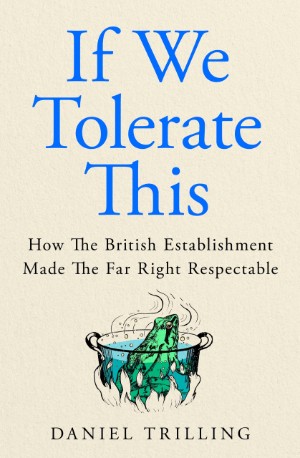
 Daniel Trilling, If We Tolerate This: How the British Establishment Made the Far Right Respectable (London: Pan Macmillan 2026), 208pp.
If We Tolerate This is a persuasive analysis of how the ruling class fuelled the far right through neoliberal austerity and anti-immigrant scapegoating, finds Chris Nineham
Anyone who wants to understand the rise of the far right in the UK would do well to start here. Amongst other things, Trilling’s short book is a warning against British exceptionalism: ‘Like the proverbial frog that sits in the water as it slowly heats up, rather than jump to safety, we have allowed something incredibly dangerous to creep up on us’ (p.3). The British far right is an amalgam of forces, but:
‘it does pose a threat to our freedom. In its most extreme guises, it is openly violent. Even in its milder forms it will roll back the progress we have made towards equality and make our society less democratic’ (p.15).
At the same time, this not a doom script. In the process of explaining the far right’s relative success so far, Trilling is always on the lookout for weaknesses and contradictions on their side.
At the risk of oversimplifying a very rich account, Trilling’s explanation has three main themes. The first revolves around social and economic factors. There is a general problem, he rightly points out, with ‘the awkward combination’ of liberal democracy and capitalism. Democracies promise equal rights for all, but capitalism depends on inequality. As he says, ‘When times are bad, the problems stack up’ (p.19).
Capitalism’s neoliberal incarnation, especially since the 2008 bank crash, has generated massive disparities in wealth and an openly pro-business politics that has been devastating for working people. Governments’ responses to the banking crisis were catastrophic. They could have borrowed cheaply and tried to rebuild, but they opted instead for austerity, leading not just to ‘the slowest wage growth in peacetime since the Napoleonic wars and the worst contraction in living standards for half century’, but to a dysfunction across society’s institutions (p.71).
The second theme is the weaponisation of immigration. To deflect anger at austerity, the Tories quickly set about targeting migrants. Cameron attacked migrants with the ‘hostile environment’ and normalised anti-immigrant rhetoric. He complained they were not integrating properly and at one point referred to refugees crossing the channel as a ‘swarm’ (p.82).
The effects were toxic, particularly as the British economy heavily relied on continued immigration. Citizens of the former empire who had the right to be here were viciously targeted by the immigration authorities and anti-terror legislation was used to deport hundreds of skilled workers from Asia and Africa. At the same time, government immigrant baiting created a sense that immigrants, particularly those crossing the channel, were to blame for the country’s problems.
Toxic austerity
Trilling is suitably damning of the results of the Tories’ fourteen-year rule: ‘The billions they diverted away from the public good, for instance. The collapse in investment and trade that followed the vote for Brexit and the political paralysis that ensued. The scorched earth of standards in public life and the unprecedented advance of racist, paranoid rhetoric into our media culture’ (p.111).
But he is also scathing about Labour’s record. Broadly, Labour has followed the same path. Since Blair’s embrace of neoliberal norms, the Corbyn years excepted, it hasn’t provided any kind of alternative for working people. While in Trilling’s neat phrase, the reactionary ‘Blue Labour’ ‘is more of a vibe than a movement’, it is a vibe with reach across leadership circles. Labour, Trilling concludes, is afraid of the public ‘and can only respond by paying homage to people’s ‘legitimate concerns’. The result of all this has been a deep crisis of governance in British society. Having created economic and social conditions in which radical ideas could flourish, the British ruling class’s political response has given a leg up to the far right.
The third theme is the appeal of the far right itself. Trilling rightly takes a long view. Thatcherism’s dog-eat-dog ethos and the attacks on welfare recipients and immigrants created a paranoid society breeding resentment and distrust. The right has built on this and fed off mainstream anti-foreigner poison. As a result, they have been able to respond to the sense of alienation and atomisation created by slash-and-burn economics to forge an exclusionary nationalism promising community when communities have broken down.
Trilling emphasises two other factors. He points to the importance of the international momentum of right-wing populism, turbo charged, of course, by Trump’s second term in office. He makes the case too that the way social media has evolved has played into the hands of ‘jesters and grifters’ promoting far-right ideas. The online world has become increasingly productive for the right as it has moved away from connecting friends and become dominated by algorithms that pump out content we never asked for while remaining compulsive. For Trilling, this online landscape provides a viable alternative to the kind of ‘mass militarised political parties’ that fascism has relied on to get organised in the past (p.35).
For all these reasons, and because of the largely empty rhetoric of multiculturalism, Trilling argues that the different strands of the far right have been able to build on a sense of resentment and humiliation amongst white people to create dangerous new movements and political organisations.
Imperialism and opposition
The account is compelling. I would raise two further issues for discussion. First there is little mention of foreign policy here. It seems to me that British involvement in a series of foreign wars has played a big role in the crisis of governance that Trilling describes. Nor can the rise of Islamophobia, so important for the far right, be explained without reference to the wars in Afghanistan and Iraq, and government support for Israel’s wars. Apart from anything else, this matters because Trump and his wars are deeply unpopular. The fact that Yaxley-Lennon’s street movement has become mixed up with support for both Israel and Trump has become a real point of weakness and confusion on their side.
My other observation is that the impact of left and the movements are a little downplayed in this account. Trilling is, of course, right to say the left today is much weaker than it was in the 1920s and 1930s (p.15). Nevertheless, he himself references Vincent Bevins’ observation that we are living through a period of unprecedented mass movements. It seems to me that the movements against war and austerity, the massive mobilisations for Palestine and the Corbyn challenge are all important factors in the emergence of a new establishment authoritarianism and its toleration of the far right. A radical left and such mass movements will also be key to any effective project to pushback and undermine support for the right.
In the final chapter, Trilling argues that there is nothing inevitable about the success of the far right. Their world view is deeply contradictory. Reform is promising the world for working people but is at the same time more reliant on super-rich donors than any party in British history. It tells big business it is in favour of deregulation and tax cuts while promising economic intervention to its base. This is one of the reasons why they can be headed off.
To make this happen will require understanding that ‘there is no turning back the clock’. (p.175). As Trilling says, ‘a challenge to the far right can’t simply involve a return to the failed ideas of the politicians who brought us to this point’ (p.182). In this context, he is a little over charitable to figures like Sadiq Khan and Andy Burnham who, in my opinion, offer little more than a reheated centrism. More convincing and uplifting are the examples he gives of the New York taxi drivers, the Polish women’s strike and the mass movement against ICE in Minneapolis which all show that even after they have taken office, far-right populists can be beaten by popular organisation.
Before you go
The ongoing genocide in Gaza, Starmer’s austerity and the danger of a resurgent far right demonstrate the urgent need for socialist organisation and ideas. Counterfire has been central to the Palestine revolt and we are committed to building mass, united movements of resistance. Become a member today and join the fightback.

Chris Nineham
Chris Nineham is a founder member of Stop the War and Counterfire, speaking regularly around the country on behalf of both. He is author of The People Versus Tony Blair and Capitalism and Class Consciousness: the ideas of Georg Lukacs.