
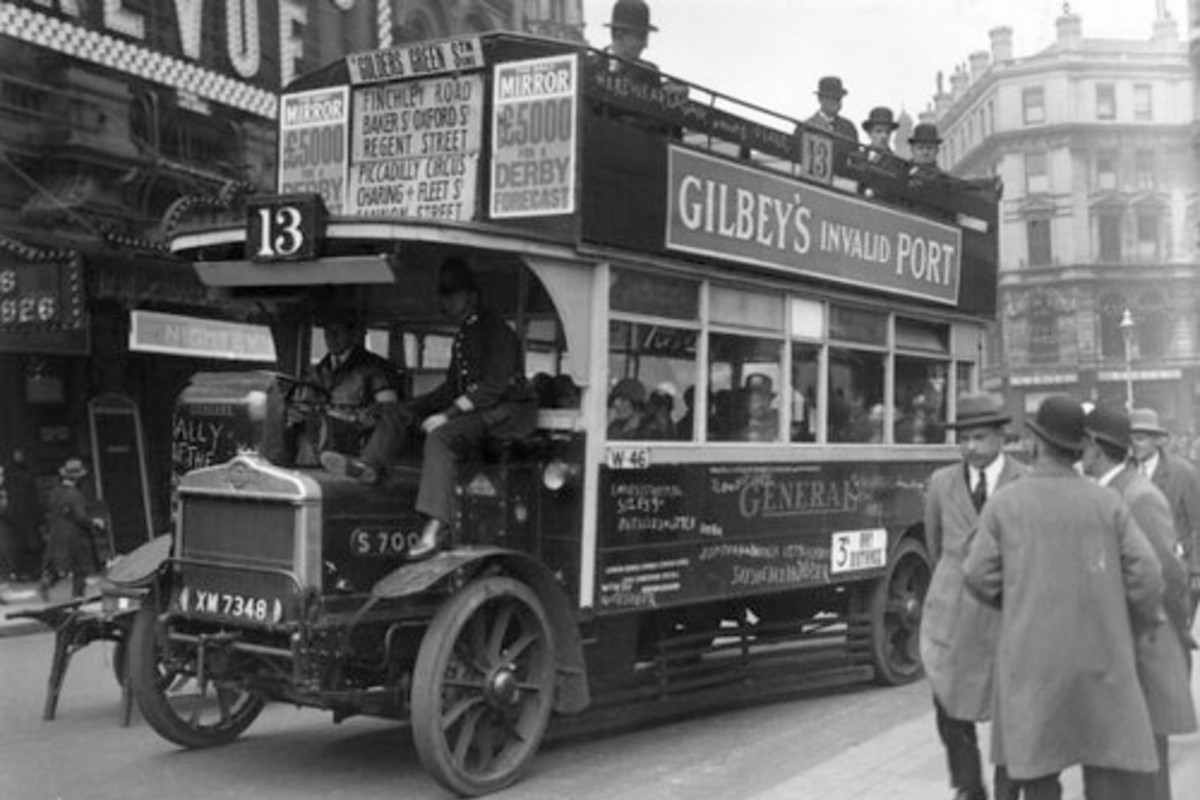
 Strike breaking bus driver with a police escort 1926 General Strike. Photo: Alan Farrow flickr / PDM 1.0
In the second instalment on the 1926 General Strike, John Westmoreland’s continues his analysis of the events before, during and after the strike
The government set about preparing for a showdown that they rightly saw as historic. They prepared on every front. A government-created scabbing operation, the Organisation for the Maintenance of Supplies (OMS), set out to recruit strike breakers. Government propaganda talked of strikers trying to starve the country into submission and threatening food supplies.
Strategies for strike breaking and intimidation included military planning. Gunships would be stationed in rivers like the Thames, Clyde, Mersey and Tyne. Key infrastructure was to be put under military protection, like power stations and government offices.
TUC passivity
If the government managed to create a febrile atmosphere of fear and tension, the TUC did all they could to cool things down. The TUC had become a professional bureaucracy with their own brand of patriotic duty. They had served the empire during the war, and since then had developed their authority to intervene in industrial disputes through the General Council. They were the industrial counterpart to the Labour Party, bringing managerial reason and common sense to matters of national importance.
The thought that the TUC would actually have to come to blows with the government horrified them. All they wanted was a bit of respect and they would happily negotiate. They thought that compromise would be possible if everybody acted in good faith. This was cloud-cuckoo land. The imperial government wanted submission and nothing less. The TUC stood between the government and the workers. They would either act as a conduit for government policy or take their share of the kicking the workers were in for.
The TUC’s preparations involved extending their control over the local Councils of Action being set up by trades councils. They insisted on the councils being little more than bodies for providing support and relaying the decisions of the general council to members. The TUC envisaged sections of the workers being brought out gradually to create enough pressure to get the government back to the negotiating table. A passive, top-down operation was as far as the bureaucrats were prepared to go. The working class couldn’t win unless they freed themselves from the control of the bureaucracy.
The workers were going to need a more determined and savvy leadership than the TUC could provide. In a national conflict, a national strategy is required and that could only be provided independently from the bureaucracy. The two parties that could provide such a leadership were the Labour Party and the Communist Party.
The Labour Party and the Communist Party of Great Britain (CP)
We don’t need to give too much space to Labour. During the nine days of the General Strike the Labour Party never met once to discuss their position. Indeed, not having a position seemed to be their position.
The Communist Party of Great Britain (CP) was much more important. Founded in 1920 from existing socialist groups and drawing in some of the best militants involved in the 1919 strike wave, membership soon went to three thousand, and was to grow to ten thousand by 1926. The CP was the product of the 1917 Bolshevik revolution in Russia, but as a new-born party it lacked the theoretical strengths that the Bolshevik leaders had amassed.
In a fight with the government, a coherent strategy had to be political. It had to be a strategy that would counter the political propaganda of the government, and the legal attacks involving the police, army and courts. For the strike to win, the workers needed to be led by political arguments that fused with the immediate needs of the struggle. This required a leadership independent of the bureaucracy and Labour Party.
The preparations of the CP were, it is sad to relate, lamentable. Instead of developing a political strategy they put everything into organisation. Strengthening trade union and party organisation became their sole activity. They thought that the trade unions were inherently revolutionary, if only the leaders were up to it. If enough workers could be brought out on strike victory was inevitable.
The CP identified with the left wingers in the TUC leadership but completely over-estimated the role they would play. The outstanding leader among them was the South Wales syndicalist Arthur J. Cook, leader of the Miners Federation of Great Britain, who was a brilliant speaker with a very strong following. The other left figures – Alonzo Swales, George Hicks and Alfred Purcell – were also sincere socialists, but the left trade union leaders were not organised by the CP, and nor was it a dedicated independent group within the General Council. This left the authority of the General Council in place and mitigated against rank and file initiatives.
All power to the General Council!
The attitude of the CP to the trade union leaders was captured in the slogan ‘make the leaders lead’. They thought that the left leaders could act as a force within the general council to keep pushing them into meaningful action. At local level the CP sought to get themselves into positions in the trade union organisations, as shop stewards and in the Councils of Action formed by trades councils and the Workers’ Defence Corps. The latter body sounds a bit Bolshevik but they were no more than a body for keeping ‘good order’ – stewarding meetings, defending union property and protecting visiting speakers.
On the eve of the General Strike the CP came up with the slogan that showed their political weakness and contributed to the defeat of the strike: ‘All power to the General Council’. This was supposed to echo Lenin’s call for ‘all power to the soviets’ in 1917. But whereas Lenin wanted the workers to take power away from reformists and exercise it themselves, the CP was doing the opposite.
Likening the general council to the soviets was something that Churchill would take up in the scab paper he used for his anti-strike propaganda, the British Gazette.
The General Strike started because the government called the TUC’s bluff by walking out of negotiations and giving the TUC no choice but to call action. The government had planned for a fight and wanted a victory.
The Samuel Commission Report as a declaration of war on the Unions
When the year-long Samuel Commission reported back, it amounted to a declaration of war on the unions, exactly as the government intended. Samuel recommended some modernisation of the coal industry but it was to be left in private hands. There was to be no minimum wage, and no union recommendations were included. The miners, Samuel asserted, would have to work longer hours for less money, or go and find another job.
The TUC’s guns had been loaded, but they still didn’t want to fire them. As negotiations got under way with the government the TUC kept reminding Baldwin of the damage a general strike could do. The reason the leaders talked tough was because the general council still held authority over the movement and if action had to be called it would serve to make their hand stronger in the negotiations. Or so they thought.
The government took their chance to call the TUC’s bluff when, at the beginning of May, Daily Mail printers refused to print an edition with the headline ‘For King and Country’, which called on the public to support the king and state against the unions. The action of the printers was presented as evidence that the TUC were negotiating in bad faith. The TUC had no knowledge of the printers’ action and were completely wrong footed. They were left with no option but to call action.
The response to the call for action from the workers was magnificent. Their slogan “Not a penny off the pay, not a minute on the day”
The response to the call for action from the workers was magnificent. The General Council had planned to call out workers in waves. First would be transport, followed by workers in printing, manufacturing, building and power. Workers in general engineering, textiles and light industry were allowed to work despite the fact that this would hit profits hard and make victory more likely. Confusion reigned as the first wave of strikes stopped other sections. Workers who refused to handle coal hit other sectors and transport stoppages prevented non-striking workers from getting to work.
Why were the workers so keen to take action? In the first place it was obvious that the government was leading a generalised attack on the working class. The centrality of the miners was important too. The call from miners’ leader AJ Cook resonated throughout the nine days of the General Strike: ‘Not a penny off the pay, not a minute on the day’. Sympathy for the miners was in the heart of every striking worker. Cook’s slogan carried a class war sentiment – the complete defeat of government and a rejection of the Samuel Commission’s demands.
The enthusiasm of the workers overcame the confusion caused by the trade union leadership’s strategy of bringing strikers out in waves. Reports flooded into TUC headquarters from across the country that all the sections had come out rather than wait. The enthusiasm for action was so great that in many places picketing wasn’t necessary after the first day. But that didn’t mean that the strike was all about games of football with the police that are so often remembered in the text books.
The railway workers proved to be one of the most determined sections. From midnight on Monday 3 May, the engine fire boxes were extinguished and the station platforms, signal boxes and goods yards were deserted. The response to the strike call was unprecedented. More railwaymen came out in sympathy with the miners on 4 May 1926 than had struck in support of their own demands on 26 September 1919.
Workers who were not supposed to come out, came out. The Merseyside Strike Committee reported on 4 May that all engineers and shipyard workers on the Mersey were out. Preston Strike Committee reported in a letter to the General Council on 10 May: ‘Engineering industry locally completely stopped, about 5,000 men being out. Also all at Leyland Motors and Vulcan Motors’.
The OMS scabbing operation was an almost complete failure. Far from rallying non-union workers to the cause, the trade unions saw a sharp uptick in recruitment. OMS volunteers proved to be laughably incompetent. The sight of Oxford students trying to run rail services earned the derision of the strikers.
Despite this the TUC did all in their power to keep the strike passive. Their paper, The British Worker, advocated anything but picketing. Strikers were encouraged to strike up friendly relations with the police, take up gardening, go walking in the countryside, attend church and above all – ‘keep smiling’!
State violence
Mass strikes confront the power of the state, and the state tries to monopolise the use of violence to achieve political ends. The control of the General Strike by the TUC meant that it remained largely passive. But in places where blacked goods were being transported strikers tried to stop the lorries. This led to confrontations between strikers and the police, often in the vicinity of docks.
In Hull, a squad of imported police from Sheffield viciously attacked dockers in Victoria Square causing many injuries. In London there were many baton charges against strikers along the Thames wharfs. At Preston a ‘mob’ of 5,000 besieged the police station to release an arrested picket. In Glasgow a scab bus was overturned and in Durham the Flying Scotsman was derailed.
The Communist Party was active in many of the flashpoints of the strike but failed to make the argument that that strike was a class war, and passivity was one step away from submission. This meant directly taking on the appeals made through The British Worker to keep calm and let events take their course.
In quite a few areas, local shopkeepers and small businessmen came cap in hand to the strike committees asking for vital (for them) supplies to be let through. Workers’ power was there to be seen, and should have been the main story, but it ran against the conservatism of the bureaucracy who wanted to call the strike off, the more successful it became.
After nine days the resolve of the workers to carry on was gaining momentum. There were some 1.4 million strikers on 3 May when the strike began. But nine days on May 12 the figure had risen to around 1.7 million. The General Strike was headed for victory and therefore had to … ended!
The TUC sells out
The sell-out was on the cards from day one and back door, secret meetings were taking place away from public scrutiny, and definitely without the presence of AJ Cook.
On Friday 7 May, the Negotiating Committee met Samuel in the home of Sir Abe Bailey, South African mining millionaire and friend of the NUR’s Jimmy Thomas. Samuel asked whether the miners were now prepared to face the prospect of wage cuts. Yes, replied the Negotiating Committee, provided the Samuel Report proposals for the reorganisation of the mining industry were implemented.
This promise was made without the permission or knowledge of the miners. The Communists’ slogan of ‘All power to the General Council’ served to remind them – be careful what you wish for.
While the secret negotiations were taking place The British Worker published articles celebrating the marvellous solidarity shown to the miners’ cause. Strikers were told to be optimistic and carry on – victory was in sight they said.
Word got out about the secret negotiations and AJ Cook accused Thomas of stabbing the miners in the back. Thomas protested that Samuel was offering real concessions saying, ‘You may not trust my word, but will you accept the word of a British gentleman who has been Governor of Palestine?’
The bureaucracy framed Cook’s intransigence as derailing their attempts to reach a settlement and ‘holding the rest of the movement to ransom’. Churchill’s persistent propaganda about the TUC being communists out to overthrow the government was taking a toll. Soon the left members on the General Council started to give way. One of the darlings of the CP, George Hicks, said that the miners ‘have put us in the soup. They have no regard at all for the thousands of people who have sacrificed their jobs’.
Far from ‘making the leaders lead’, the CP’s strategy of backing left bureaucrats was enabling the sell-out of the miners, and it didn’t take long. All the government had to do was say that negotiations could resume if the strike was called off, and that promise was grasped with extreme gratitude. The left offered no serious attempt to override the decision of the General Council and continue the action.
The fate of the miners was sealed. AJ Cook didn’t betray the miners, although he too started to look for a way out. The workers’ unity in support of Cook’s ‘Not a penny off the pay, not a minute on the day’ was turned on its head by the TUC. The miners were to stay out for another six months until they were literally starved back to work to face longer hours and less pay.
For the working class, we go up together and we come down together, and although the miners got the worst of it, the defeat of the strike heralded a vicious employers’ offensive. The Trade Disputes and Trade Unions Act (1927) restricted trade union activity. It declared sympathy strikes and strikes aimed at coercing the government illegal, imposed limits on picketing, and required union members to ‘contract-in’ to the Labour Party’s political levy, which was taken from trade union subs.
Conclusion
The General Strike set back the Labour movement massively. The Labour Party immediately began to hunt out communists in their ranks, who they blamed for inciting the strike. But more importantly, the working class lost confidence in their power to change the world and turned instead to getting change through the ballot box. Despite the treacherous role played by the Labour Party they were the beneficiaries of working class defeat, being returned to office in the 1929 elections. Despite the defeat of the General Strike we can take inspiration from a massive display of solidarity by the working class. The defeat tells us of the importance of political leadership in the movement. Political leadership is always there from the trade union leaders and their Labour Party, but it will never lead to workers becoming the force for change that we want and need. A revolutionary leadership that encourages the self-emancipation of the working class is as necessary today as it was in 1926.
Before you go
The ongoing genocide in Gaza, Starmer’s austerity and the danger of a resurgent far right demonstrate the urgent need for socialist organisation and ideas. Counterfire has been central to the Palestine revolt and we are committed to building mass, united movements of resistance. Become a member today and join the fightback.

John Westmoreland
John is a history teacher and UCU rep. He is an active member of the People's Assembly and writes regularly for Counterfire.