
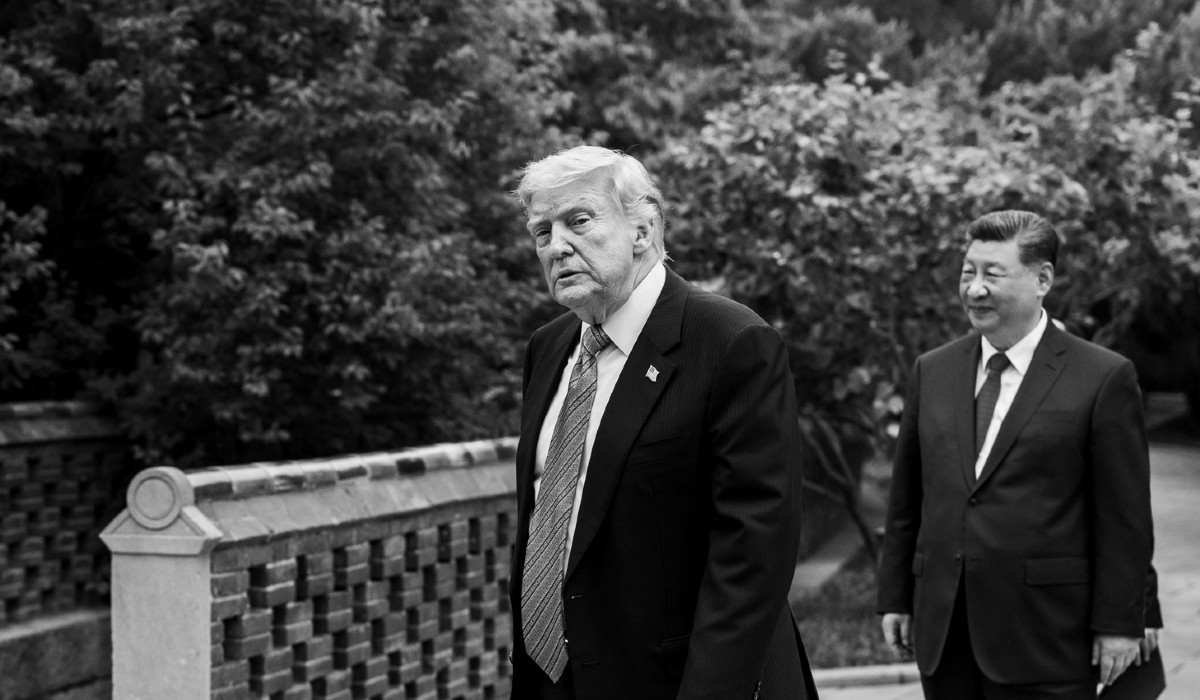
 Donald Trump, Xi Jinping. Photo: White House / Public Domain
Chris Bambery compares the problems facing the US in a multipolar world with those of the previous world empire, Britain, and looks at how both turned to military solutions that only worsened their predicament
In the wake of the US-Iran war and the visits of Donald Trump and then Vladimir Putin to Beijing, it is clear that China regards itself as a power on equal footing with the US and that the unipolar world which came into being with the end of the Cold War and the USSR is now long gone, replaced by a multipolar one.
But we should be careful at overstating the pace of US imperialism’s decline. It’s on par with China economically but the US has greater military and financial muscle.
If we look at the previous global power to the US, Britain, its process of decline began in 1870 when the US outstripped it economically and London accepted US dominance in the Western hemisphere, ruling out any attempt to use force against its rival.
Beginning in 1870, following the victory of the industrial North in the American Civil War, the US began to overtake Britain:
‘In 1870, American industry already enjoyed a 50 percent advantage in labor productivity over British industry; by the eve of the First World War, US manufacturing workers were twice as productive as their British counterparts. Worse, this decline was not only relative to the United States, but to Britain’s own recent past. After two decades of two percent growth, Britain’s annual GDP per capita growth slumped to scarcely more than one percent over 1873–99, and then crawled along at .84 percent per annum up to 1914. Total factor productivity – the efficiency with which Britain used economic inputs – growth fell by two thirds in the final decades of the 1871–1914 Belle Epoque.’
But if we were to set a date for Britain’s decline turning from being quantative to qualitive you might choose 1940 when its economy was mortgaged to the US to fund the war with Nazi Germany – or 1947 and Indian independence. But I will go with 1956 when Washington pulled the financial plug on Britain and France who, in league with Israel, had invaded Egypt to re-take the Suez Canal.
So, if we accept 1956 as when Britain ceased to be a top rank world power the process of decline lasted 86 years – that’s a considerable time. And faced with another power that had overtaken it economically at the beginning of the 20th century – Germany – Britain was still able to deploy is financial and naval power to defeat it in 1918.
The second factor in imperial decline, which is evident in today’s US, is that the declining super-power exerts its military power much more frequently to shore up its position in the world.
Britain did exactly the same in the 1880s and 1890s. After 1880, there was among statesmen in Europe and North America:
‘… a prevailing view of the world order which stressed struggle, change, competition, the use of force and the organization of national resources to enhance state power.’ [i]
With the rise of a unified Germany and a fast-industrialising Russia the European balance of power was dramatically transformed. One result was that Germany, and to a lesser extent Italy, attempted to challenge the two great colonial powers, Britain and France, by acquiring their own colonies. Only two areas of the globe were open to them to attempt this: Africa and the Pacific.
What was called the ‘Scramble for Africa,’ the European colonisation of the continent, saw the creation of 30 colonies and protectorates.
In that situation Saul David argues:
‘All of Britain’s many African wars, from the Zulu war of 1879 to the Boer War of 1899-1902, have to be seen in the context of this vicious European rivalry. They were no longer fought chiefly to extend British trade and influence, but rather to prevent other European powers from muscling into territories that Britain regarded as strategically vital for the safety of her steamer routes to the East, via Suez and the Cape.’ [ii]
In East Africa, German and French expansion created British anxiety over Egypt’s security, with the Nile valley gaining strategic importance. In an agreement with Germany reached in 1890 Britain secured a corridor between the Indian Ocean incorporating Zanzibar and Nyasaland (Malawi). This was followed by Britain taking as protectorates Uganda in 1894, and the rest of British East Africa (Kenya and Tanzania) a year later.
To both protect the Cape and to surround the Boer republics protectorates were created in Bechuanaland (Botswana) in 1885 and Cecil Rhodes’s British South Africa Company (1889) received a charter to occupy and administer at its own expense territory that was to eventually become Zambia and Zimbabwe.
Yet, while British Africa by 1911 totalled 2.8 million square miles with a population estimated at nearly 40 million, trade stood at just at £44 million (1909-13), of which the Union of South Africa provided some £30 million, and in total accounted for a mere 3.8 per cent of British overseas trade, and only 13 per cent of the Empire’s trade.[iii]
The wars Britain had fought were not for economic gain, as previously been the case, but to prevent rival powers acquiring territory.
Today’s US does not depend on Middle East oil but still wants to ensure that it or its Israeli ally dominate the Persian Gulf. That requires not just the defeat but the destruction of the Islamic republic of Iran. Victory for the US would also mean control of the oil on which its main rival China depends.
Of course, all of that went belly up.
The third thing that changed by around 1900 was that while Britain remained the largest naval power its fleet was not greater than its rivals combined. When Germany began building a battle fleet one response was to commence a naval race, the other was to concentrate the Royal Navy in home waters to meet the German threat.
The first step in the latter was for Britain to give up its position of splendid isolation – not becoming involved in European inter-state rivalries. In 1902 it entered a naval alliance with Japan. The latter took responsibility for policing the Pacific and South China Sea, allowing British warships to be deployed in the North Sea.
Two years later it entered into the 1904 Entente Cordiale with France, settling long standing rivalries. The British and French chiefs of staff began secret talks regarding a possible war with Germany and the British army agreed to sending an expeditionary force to fight the Germans. A naval agreement saw France take responsibility for the Mediterranean while the Royal Navy would protect the North Sea, the Channel and the Atlantic trade routes. Three years after that Britain extended this to include France’s ally, Russia.
Britain was now enmeshed within a Europe divided into two alliances at daggers drawn; France, Russia and Britain on the one hand, with Germany, Austria-Hungary and Italy on the other. When Austria-Hungary went to war with Russia’s ally Serbia in July 1914 that set off a chain reaction which brough Russia, then Germany, then France and then Britain into a world war.
No comparison is exact. Rather than reinforcing US imperialism’s existing system of international alliances Trump has seriously weakened them. That’s obvious with regard to NATO and the European states but it’s also the case on China which is rebuilding its links with Canada, Australia and India.
By destroying the Iranian state and leaving Israel in charge of the region, the US could then concentrate on East Asia. Instead, Trump is bogged down there and has had to remove missile defences and troops from South Korea.
Trump needs to find an off ramp but there is a problem. Any agreement with Tehran will require Israel ending its war in Lebanon, Iran will insist on that. Whether Trump can bring his Israeli ally to leash is a matter of considerable conjecture.
Alliances can strengthen a power, but they can also drag them into conflicts which can damage them. Britain won out in 1918 but at the price of it becoming a debtor state to the US, and the City of London being overtaken by Wall Street as the financial powerhouse.
Today China is exerting itself more because of Trump being bogged down with Iran. US military power has not been destroyed but its ability to project that power has been impaired.
Washington has a long way to go before it meets its Suez moment but it’s now having to treat its main imperialist rival as an equal. That’s a profound change.
[i] Paul Kennedy, The Rise and Fall of the Great Powers: Five hundred years of history of fluctuating economic muscle and military might, William Collins, 2017, P96
[ii] Saul David, Victoria’s Wars: The Rise of Empire, Penguin, 2007, P417
[iii] Andrew Porter, ‘Introduction: Britain and the Empire in the Nineteenth Century’, in Andrew Porter (editor), The Oxford History of the British Empire, Volume III: The Nineteenth Century, Oxford University Press, 1999, P4
Before you go
The ongoing genocide in Gaza, Starmer’s austerity and the danger of a resurgent far right demonstrate the urgent need for socialist organisation and ideas. Counterfire has been central to the Palestine revolt and we are committed to building mass, united movements of resistance. Become a member today and join the fightback.

Chris Bambery
Chris Bambery is an author, political activist and commentator, and a supporter of Rise, the radical left wing coalition in Scotland. His books include A People's History of Scotland and The Second World War: A Marxist Analysis.