
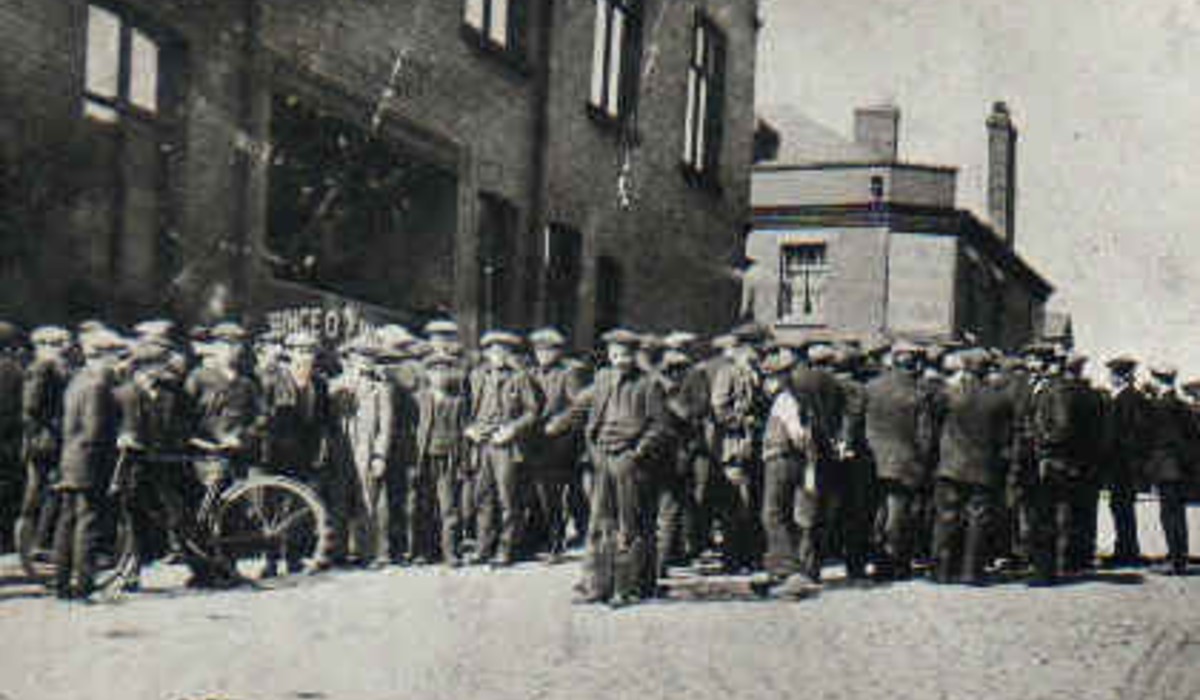
 Tyldesley miners outside the Miners Hall during the 1926 General Strike. Photo: Public Domain
On the centenary of the General Strike of 1926, John Westmoreland examines the background to the build up to the strike following the end of the First World War
It is a hundred years since British workers went out in the General Strike of 1926. It was a colossal battle between an imperial power and the trade unions. The heroism of the strikers needs to be acknowledged and celebrated for sure. But it is unlikely that the real story of 1926 will be told by the media, academia or indeed the TUC, for whom the General Strike left a stain that can never be expunged.
To appreciate the stranglehold that the TUC’s General Council had on the strike, it is worth having a look at Marxist thinking about trade union struggle and mass strikes in particular.
Friedrich Engels wrote that every strike has a revolutionary kernel at its heart. When workers are driven to strike they are protesting for their recognition as human beings who are more than an exploitable human cog in the capitalist machine. And this truth has been developed by Marxists since.
The mass strikes that were a central feature of the revolution in Russia in 1905 prompted Rosa Luxemburg to write her seminal work The Mass Strike, the Political Party and the Trade Unions. It is a book that everyone who is serious about engaging in working class struggle should read.
Luxemburg points to how mass strikes are historic phenomena, reflecting a crisis in capitalist rule and the potential for history to turn in a new direction. Mass strikes are not just defined by numbers but by how the experience changes the relations of production and the consciousness of the workers. When workers who have lived in submission rise up, they meet other workers from different sections of production, ethnicity and so on.
This increased awareness of the workers that they are part of a class with shared interests and goals, is forged into a fighting class. Increased confidence gained from the success of collective struggle helps workers shed what Marx called ‘the muck of ages’, the baggage of backward ideas and attitudes that come with a life limited by capitalist exploitation. In the process workers’ demands change. The economic demands for adequate pay and conditions tend to be superseded by political demands like more democracy and rights.
There was a crucial difference between the strikes across Russia in 1905 and the General Strike. In 1926 the General Strike was led by the trade union bureaucracy. It was called by them on 3 May, and called off by them nine days later. The workers never managed to influence the General Council and this limited their political development, but nevertheless their enthusiasm was remarkable and inspiring.
‘A country fit for heroes’
The high point of working class struggle after the end of the First World War was in 1919.
In the last year of the war revolutions happened in Russia and Germany, and brought the slaughter to an end. During the war trade union leaders had been co-opted into the Ministry of Labour and served the War Cabinet well, but their patriotism rode roughshod over workers’ demands for better pay.
The abandonment of workers’ demands by the bureaucracy allowed a space for worker-led militancy to develop. In 1919, over nineteen million strike days were lost to the bosses. The promise of a ‘country fit for heroes’ failed to appear, and workers’ faced inflation and unemployment. The rank and file action terrified the government, but they had come to realise that the trade union leaders were indispensable. Winston Churchill remarked that far from being too much trade unionism ‘there was not enough of it’. He wanted workers to be brought ‘into line by head office’.
The rank and file militancy didn’t develop into revolutionary action partly because of the strength of the bureaucracy, but also because they lacked a political leadership that understood the need to organise the best militants into a force that could act independently of the bureaucracy.
To maintain their control, the bureaucracy offered angry workers what looked like a way forward. The workers hit hardest by the aftermath of war were the railway workers, transport workers (including dockers) and the miners. The miners were to be at the centre of events up to 1926 and beyond. The mines had been run by the government during the war but had been returned to their pre-war owners. Conditions were awful, with long hours and low pay. The miners wanted nationalisation, a national wage and modernisation to include pithead baths and on-site medical support.
The Triple Alliance
The trade union leaders came up with the Triple Alliance of unions covering transport, railways and the mines. The Alliance had come about at the start of the war, so had a militant feel to it, but it gave the leaders control. If workers in one of the unions prepared to fight the leaders could fob them off by saying the others needed time to prepare.
The mine owners started a wage war on the miners. Coal exports to Germany had stopped since 1914 and redundancies were accompanied by demands for more work for less pay. Miners in the older parts of the coalfield working tighter seams, particularly in South Wales, were at the forefront of the attacks. After ongoing battles, the mine owners locked out the miners who asked for support from the transport and railway workers.
The betrayal of the miners, led by Jimmy Thomas of the National Union of Railwaymen, has gone down in history as Black Friday, 15 April 1921. The cave-in encouraged more attacks from the bosses.
The Post-war crisis in British Capitalism
British capitalism faced a number of problems in these years. Post-war conditions carried their own problems of returning soldiers and the need to slim down the standing army. The UK adopted the ‘Ten-Year Rule’ that assumed no war for the next decade and used the breathing space to invest in infrastructure such as the National Grid.
What were known as the ‘staple industries’ – ship-building, iron and steel, textiles and coal were declining in importance. Light engineering was on the rise. A North-South divide seemed to be happening with a de-industrializing north (and Wales) and an industrializing south. There were lots of exceptions to this trend, but in outline it was valid. This meant that the employers’ offensive hit areas that were already suffering from unemployment.
Churchill
In April 1925, the newly appointed Tory Chancellor Winston Churchill took Britain back onto the Gold Standard at its pre-war rate of 4.86 dollars to the pound. In the circumstances of British economic decline and restructuring this was ill-advised. John Maynard Keynes famously opposed this in his pamphlet The Economic Consequences of Mr. Churchill, arguing the rate was too high and would cause severe depression and unemployment. But for Churchill, a cunning and vicious class warrior, the pain would be worth it. Britain would be more competitive. Workers would just have to work harder for less.
Churchill slightly miscalculated that the trade union bureaucracy would take it on the chin and hold back the inevitable anger. The TUC had little choice but to threaten action. The miners’ plight had become a cause for all trade unionists to rally round. They were a symbol of the betrayed promise of a ‘country fit for heroes’ and also a weather vane of what would happen in other sections.
The TUC
The TUC began to show Baldwin that they wouldn’t be taken for granted. On 29 July 1925 Prime Minister, Stanley Baldwin, told the TUC that the government would not grant any subsidy to the industry, and that it must stand on its own economic foundations. This was a declaration of open class war. Anger had been building at the TUC and the Special Industrial Committee of the TUC had argued that the unions should refuse to handle coal, and this was accepted by the general council.
When the TUC met with Baldwin on 31 July, the government had decided to postpone the showdown until they could fight on more favourable ground. They informed the TUC that the mines would benefit from a government subsidy for a year while a government commission led by Sir Herbert Samuel investigated the coal industry.
This day, 31 July 1925, has been recorded in history as Red Friday, largely because of the anger that papers like the Daily Mail and Daily Express vented. It was a strategic move by Baldwin however, and not a victory for the trade unions.
Samuel was a Liberal, and no friend of the workers. He was an ardent Zionist from a family of bankers, and helped frame the Balfour Declaration. Everyone involved knew that Samuel would end up supporting the government’s position. Therefore, all sides had twelve months to prepare for the coming conflict.
Part Two to follow…
Before you go
The ongoing genocide in Gaza, Starmer’s austerity and the danger of a resurgent far right demonstrate the urgent need for socialist organisation and ideas. Counterfire has been central to the Palestine revolt and we are committed to building mass, united movements of resistance. Become a member today and join the fightback.

John Westmoreland
John is a history teacher and UCU rep. He is an active member of the People's Assembly and writes regularly for Counterfire.