
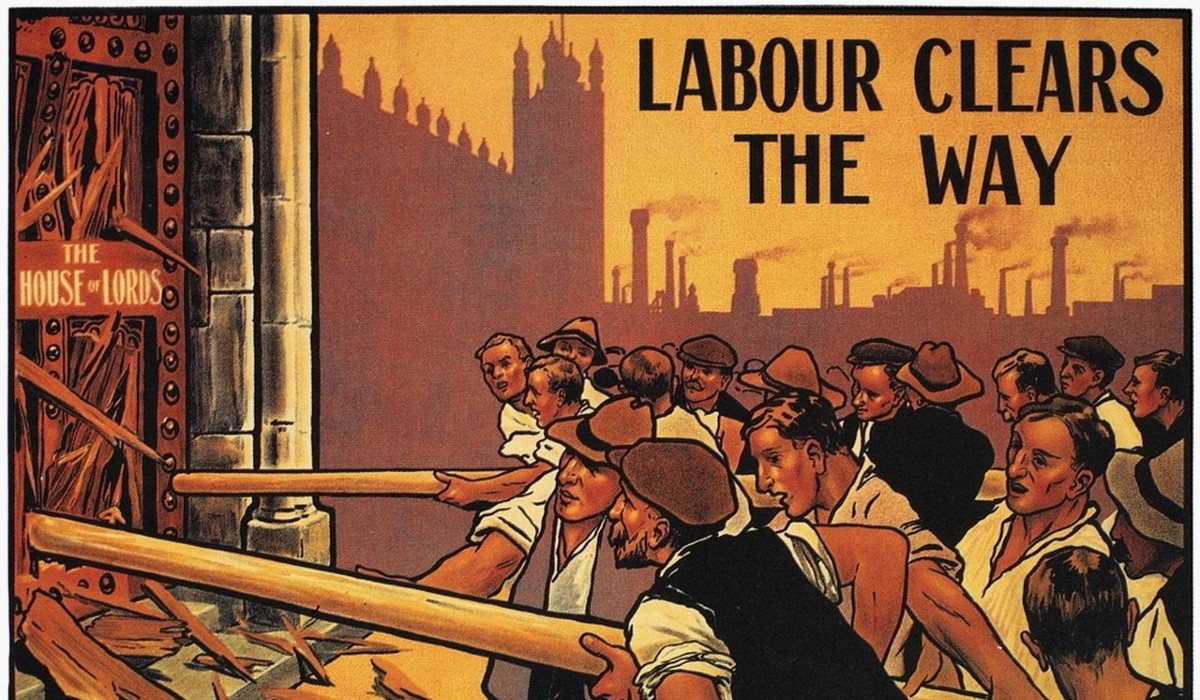
 Labour Party election poster 1909
Alex Snowdon looks at the limitations of reformism
Reformism has for generations been the dominant political current in the working class. It aims to win positive reforms, reflecting working-class interests and aspirations within the capitalist system. In Britain, the Labour Party has historically been the main expression of this current.
Reformism has deep roots. It is normal in capitalist society for working-class people to reject aspects of the ruling political order. That is hardly surprising in an exploitative, unequal society geared towards the interests of the wealthy, but it is also normal for most working-class people, most of the time, largely to accept capitalism as inevitable.
There are two major reasons for this. Firstly, the ruling ideas in any society are the ideas of the ruling class. Karl Marx argued that the ruling class controls not only the means of production, but the means of mental production. Consider how media companies owned by wealthy interests express ideas that prop up the status quo.
Secondly, this partial acceptance of capitalist society reflects people’s experiences. We tend to normalise the way things are. Disliking specific government policies is one thing. It requires a considerable leap to reach a total rejection of the existing social and economic order, with an alternative positive vision of a radically different society.
In a modern, liberal capitalist society, a degree of formal democracy masks the reality that economic power is concentrated in a tiny ruling-class elite, and is totally unaccountable. The limited democracy of parliament becomes the focus of efforts to change society for the better. Elections to parliament are therefore seen as crucial for winning reforms: get better people elected and things will improve for the mass of people.
The capitalist state – the police, armed forces, civil service and so on – remains largely impervious to democratic accountability. It appears politically neutral and benevolent, but is in fact an instrument of capitalist class rule.
Meanwhile, the economic power of the capitalist remains untouched. If a multinational corporation wishes to sack thousands of workers, the workers do not get a vote.
Marx recognised that, despite these limitations, the extension of the vote during his lifetime was an advance for the working class. Elections to parliament could at least offer an opening for the political expression of working-class interests. That would require independent working-class candidates and potentially a workers’ party.
In Britain, that party would not be formed until the early years of twentieth century. The Labour Party was part of the wider emergence, especially in Europe where capitalism was most developed, of social-democratic parties trying to reform capitalism.
Labour constituted an organisational break from the Liberals, reflecting the long-term expansion of the suffrage and a working-class desire for a political voice. It had close links with the trade unions, though it gave voice to the moderate union leaders rather than the workers’ movement’s more combative elements.
The Conservative Party embodies ruling-class interests. The Labour Party was established, though, to give some sort of expression, as the name implies, to the interests of workers. This is an expression, however, of workers’ existing ideas with all their contradictions, not workers’ objective interests.
Labour has therefore always been highly contradictory. Lenin called it ‘a bourgeois workers’ party’. It reflects (in distorted form) the aspirations of workers, with mostly working-class members and voters, but politically, it operates within a bourgeois (capitalist) framework.
Furthermore, Labour has always tried to balance between class and nation, with the ‘national interest’ defined by what works for the ruling class and the capitalist state. These pressures to conform to the British state, and bend to powerful interests, become enormous when Labour is in office. It invariably succumbs to the demands of capitalists and, in foreign policy, to Washington.
Labour has often promised a lot in opposition, but delivered little in office. In the post-war boom years, with Labour governments elected in 1945 and again in 1964, there were real reforms (if also disappointments and retreats). Capitalism had scope for allowing improvements to working-class people’s lives.
Every subsequent Labour government has delivered less than the one before. The economic growth and rising living standards of the 1950s and 1960s gave way to recurring economic crises from the 1970s onwards. Labour has narrowed its horizons over time.
Corbynism was an exception to the long-term trajectory of Labour moving rightwards. Starmer’s government is a new nadir. Labour is shedding support as a result. Socialists must organise independently of Labour and have a broader strategy than electoral politics alone.

Alex Snowdon
Alex Snowdon is a Counterfire activist in Newcastle. He is active in the Palestine Solidarity Campaign, Stop the War Coalition and the National Education Union. He is the author of A Short Guide to Israeli Apartheid (2022).