
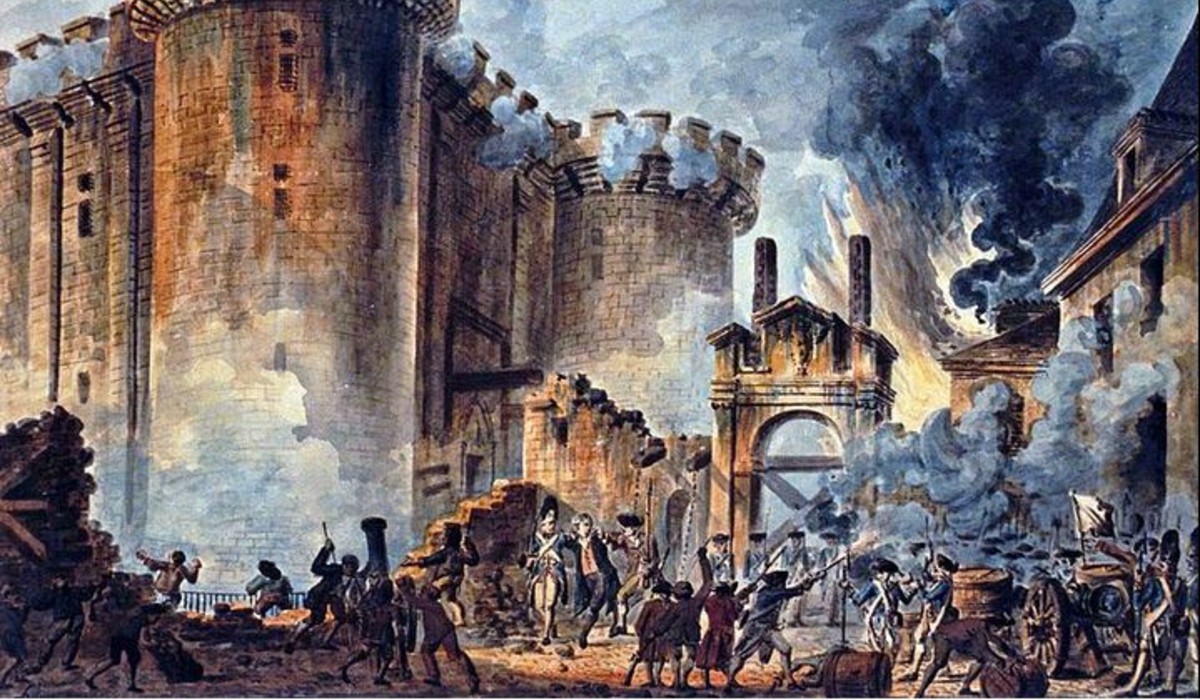
 Painting of the French Revolution. Photo: tonynetone / Flickr / CC BY 2.0
Capitalism was born in revolution, but as the working class grew, the capitalist class came to fear upheaval which would threaten its wealth. How then did countries like Germany and Italy become modern states? Chris Bambery examines the Marxist explanations for revolution from above
The English and French Revolutions were revolutions from below, driven by the masses. But the nineteenth century would see the rise of capitalist states in Italy, Japan and Germany in which the masses played no role, or a secondary one in the case of Italy. These we might call bourgeois revolutions from above, or passive revolutions.
That last term is to be found in the writings of the Italian Marxist, Antonio Gramsci, in the late 1920s and early 1930s, from inside a fascist jail, from which he would only be released to die.
His Prison Notebooks were just that, notebooks, where he set down ideas, not for publication, but for his later use. That did not happen, but they left us a valuable legacy, including that of his analysis of ‘passive revolution’.
The first mention of passive revolution in Gramsci’s Prison Notebooks comes in the winter of 1929-30. He borrows the term from Vincenzo Cuoco writing about the Neapolitan uprising against Napoleon: ‘The concept of passive revolution seems to me to be precise not only for Italy, but also for other countries that modernise the state by means of a series of reforms or national wars, without going through a political revolution of the radical-Jacobin type.’[1]
The French Revolution created a fear of further such disorders among both the absolutist elite and the bourgeoisie. Both were determined to prevent any repetition, The defeats inflicted on them by revolutionary France and then Napoleon, led states like Prussia and Piedmont in north Italy to introduce reforms, to overhaul the state itself, create a stronger military and a degree of state-led industrialisation.
After the Congress of Vienna in 1814-15, locked into the concert of great powers and increasingly menaced by an emerging working class, the absolutist states would step up that process with both Piedmont and Prussia seizing opportunities offered by great-power conflict to achieve national unification, with a degree of popular mobilisation in the former case (eventually easily contained) and none in the latter.
Something had changed from the days of the great French Revolution which began in 1789. A working class had since come into being and both the old rulers and the bourgeoisie were united in wanting it kept on the leash. Indeed, the bourgeoisie now looked to the old order to be prepared to repress it with their armies and secret police.
Gareth Stedman Jones argues that ‘if the definition of a bourgeois revolution is restricted to the successful installation of a legal and political framework in which the free development of capitalist property relations is assured, there is then no necessary reason why a “bourgeois revolution” need be the direct work of a bourgeoisie. Thus the triumph of the bourgeoisie should be seen as the global victory of form of property relations and a particular form of control over the means of production rather than as the conscious triumph of a class subject which possessed a distinctive and coherent view of the world.’[2]
Critics of Marxism love to argue that the great English and French Revolutions were not led by the bourgeoisie and neither did it form the governments which followed. It’s true that titled gentlemen generally made up the governments of Britain in the eighteenth and first half of the nineteenth century. In France, Robespierre and the Jacobins gave way, eventually, to Napoleon, a dictator, and then the restored Bourbons.
But look closer. Robert Walpole, Britain’s first prime minister, came from the gentry, not the aristocracy, and from East Anglia, the centre of capitalist agriculture in England in the early eighteenth century. Pitt the Elder was the son of a merchant and colonial administrator in India. Later, William Ewart Gladstone and Benjamin Disraeli were, respectively, the sons of a merchant and slaveowner and of a historian and literary critic.
The actual aristocrats were no longer living off serfs, or even rents in the main; their estates grew produce or raised livestock for the market. Many exploited the coal found on their estates or became property developers like the Duke of Westminster.
The Parisian society that the French novelist Honoré de Balzac satirised, in the period after Napoleon’s fall, is made up of both aristocrats and the ‘authority of talent’, self-made men who become bankers or industrialists. In Cousin Bette, Crevel tells Madame Hulot: ‘You’re deluding yourself, dear angel, if you imagine that it’s King Louis-Philippe that we’re ruled by, and he has no illusions himself on that score. He knows, as we all do, that above the Charter there stands the holy, venerable, solid, the adored, gracious, beautiful, noble, ever-young, almighty, Franc!’[3]
Returning to the objection that the bourgeoisie did not make these revolutions so they cannot be bourgeois revolutions, Isaac Deutscher provided a useful perspective: ‘When the Puritans denied the Crown the power of arbitrary taxation, when Cromwell secured for English shipowners a monopolistic position in England’s trading with foreign countries, and when the Jacobins abolished feudal prerogatives and privileges, they created, often unknowingly, the conditions in which manufacturers, merchants, and bankers were bound to gain economic predominance, and, in the long run, social and even political supremacy. Bourgeois revolution creates the conditions in which bourgeois property can flourish.’
Deutscher goes on to make the point: ‘Capitalist entrepreneurs, merchants, and bankers were not conspicuous among the leaders of the Puritans or the commanders of the Ironsides, in the Jacobin Club or at the head of the crowds that stormed the Bastille or invaded the Tuileries. Nor did they seize the reins of government during the revolution or for long time afterwards, either in England or in France.’[4]
In arguing this, Deutscher was drawing on the analysis of Karl Mark and Frederick Engels. In 1849, still involved in the revolutionary ferment which had broken out across Europe in the previous year, Marx looked back at the English and French Revolutions, and argued:
‘The revolutions of 1648 and 1789 were not English and French revolutions, they were revolutions of a European type. They did not represent the victory of a particular class of society over the old political order; they proclaimed the political order of the new European society. The bourgeoisie was victorious in these revolutions, but the victory of the bourgeoisie was at the same time the victory of a new social order, the victory of bourgeois ownership over feudal ownership, of nationality over provincialism, of competition over the guild, of the division of land over primogeniture, of the rule of the landowner over the domination of the owner by the land, of enlightenment over superstition, of the family over the family name, of industry over heroic idleness, of bourgeois law over medieval privileges.’[5]
Drawing on this analysis Neil Davidson adds: ‘In no bourgeois revolution did the revolutionaries ever seek to rally popular forces by proclaiming their intention to establish a new form of exploitative society … but did so by variously raising demands for religious freedom, representative democracy, national independence, and, ultimately, socialist reconstruction …’.[6] Bourgeois revolutions could not be, and did not need to be self-conscious revolutions in the same way working class proletarian revolution must be.
‘Revisionist’ historians of the French revolution dismiss the concept of bourgeois revolution, eager to point out that the revolution was neither made by the bourgeoisie nor did it bring them to government. Interestingly, in criticising Georges Lefebvre’s interpretation of the French Revolution as bourgeois, Alfred Cobban noted in 1964 that the spokesmen of the Revolution were not the industrial or commercial bourgeoisie, but in the main a class of declining state office holders, and lawyers.[7]
Regarding both German unification and the Meiji Restoration in Japan, Geoff Eley argues:
‘Each might be described as a “bourgeois revolution from above”, in the specific sense that in a concentrated space of time and through a radical process of political innovation it delivered the legal and political conditions for a society in which the capitalist mode of production could be dominant. This was achieved by quite far sighted and visionary interventions by the existing states (or at least by the political pragmatism of ‘modernising’ tendencies within them), but without the social turbulence and insurrectionary extravagance which marked the earlier Franco-British patterns.’[8]
Eley adds an important point: ‘In some ways – the sharpness of the rupture with the past, the definitive character of the new settlement, the commanding strength of capital in the new national economy – German unification was more specifically “bourgeois” in its effects than either the English or French Revolution had been, precisely because significant popular interventions failed to occur.’[9]
As we shall see, industrial capitalism had reached levels in Germany impossible to imagine at the time of either the English or French Revolutions. In the case of the France, absolutist France’s long wars with Britain had undermined its industrialisation, but Britain and Holland were the only two European capitalist powers at the time.
By 1871, Prussia was part of a Europe divided between capitalist powers – Britain, France and, though much weaker, Italy – while Tsarist Russia had begun to promote industrialisation after its defeat in the Crimean War in order to avoid a repeat.
Returning to who makes a bourgeois revolution, writing in 1904, Karl Kautsky argued the initial stages of the French Revolution were driven by the lower orders: ‘this overthrow of the system of government would not have been possible without the intervention of the lower classes: petty bourgeois, peasants, proletarians. They armed themselves, stormed the Bastille, burned down the castles of the nobility, abolished feudal burdens and began the self-administration of their communities.’[10]
The creation of the National Assembly led to the implementation of measures such as the eradication of the tax exemption of the privileged classes, of indirect taxes (taxes on salt and drinks), the tobacco monopoly, internal tariffs and the municipal octroi (municipal taxes on goods). National tariffs and the sale of church and municipal property boosted the state’s finances and its revenue was raised through a single direct tax on net income.
These greatly benefitted the bourgeoisie, but they did not want to go further. A constitutional monarchy suited them, as Kautsky explains: ‘The big bourgeoisie clung to the monarchy and the army as the last bulwark against the storm of the revolutionary people – the petty bourgeois and proletarians. And when Louis XVI attempted to flee abroad from Paris in order to draw on the help of foreign monarchs to prop up his tottering throne, his capture led to the first hostile encounter of the two classes in the revolution. Whereas the masses demanded that the king abdicate, the majority of the national assembly defended him. The extent to which this majority was conscious of its class interests in doing so is shown by what [Antonie] Barnave said back then: “The revolution must pause: one more step along the path of freedom and we will see the abolition of property”.’[11]
Barnave was one of a triumvirate of leaders of the Feuillants, the group which dominated the National Assembly in the summer of 1791. They effectively authorised the Champ de Mars massacre – the shooting down of republican protesters demanding the king abdicate after his failed flight to Varennes.[12] The massacre radicalised the revolution further.
The lower orders drove the establishment of the Republic, which the bourgeoisie disliked, but they had to wait on events. Victories in the war with absolutism opened the door to Thermidor, or defeat of the revolution. Here Kautsky points to the alliance the bourgeoisie made with a new officer corps, detached as it was from the people: ‘a new caste was created, separated from the people. This caste of officers had capitalist instincts and interests, taking the place of the old feudal officer corps.’[13]
Commentating on Kautsky’s writings on the French Revolution, Bertel Nygaard emphasises that the revolutionary bourgeoisie was not a group of ‘capitalist entrepreneurs tangled up in individual business interest, but a fraction of the class, the intelligentsia, whose position at a distance from particularistic business interests was precisely the feature enabling it to state and carry through the demands of the bourgeois class as a whole. Paradoxically, the Revolution was bourgeois-capitalist, in a sense, in spite of the capitalist bourgeois.’[14]
Writing in 1923, Leon Trotsky pointed out that the bourgeoisie had to ‘consciously study its life. To do this, it must know this life. Before the bourgeoisie came to power, it had fulfilled this task to a wide extent through its intellectuals. When the bourgeoisie was still an oppositional class, there were poets, painters, and writers already thinking for it.’[15]
This a point taken up by Neil Davidson who argues that the champions of bourgeois and nationalist ideology came from the ‘non-capitalist’ bourgeoisie, who were integral to the bourgeoisie as a whole, pointing to Gramsci’s later discussion of ‘organic intellectuals’. These were the lawyers, academics and, increasingly, army officers who were the outriders of the bourgeoisie: ‘First, precisely because they were not subject to competitive economic divisions within their class, these groups were often more able to express the common interests of the bourgeoisie as a whole than capitalists: they were tactful cousins smoothing over the tensions between the hostile band of warring brothers. Second, and conversely, they were also prepared to temporarily transgress capitalist property rights in order to better permanently enshrine them. Third, because these revolutionaries still belonged to a minority exploiting class, albeit one broader than their feudal predecessor, they needed to involve other social forces to overthrow the French absolutist state. The bourgeoisie should not be confused with the petty bourgeoisie, but the former did have a close relationship with the latter, which, from 1789 through 1830 and down until 1848 at least, invariably provided the foot soldiers for the struggle against feudal absolutism.’[16]
Robespierre and Danton were lawyers; Marat a physician, and scientist; Camille Desmoulins a lawyer turned journalist; Saint Just, a failed poet and novelist. Saint Just and Desmoulins hailed from Picardy; Robespierre from Artois; Marat was brought up in Geneva; Danton in Champagne. These figures came from areas of northern France or Switzerland where capitalist agriculture had taken root.
The anonymous author of the radical and popular Revolutions de Paris, published in the spring of 1791, argued that the bourgeoisie did not take part in the events of the revolution, prioritising their personal security and interests: ‘The bourgeoisie are not democrats. They are monarchists by instinct. Sheep likewise bleat for the authority of a master.’[17]
The author does say that the so-called ‘bonne bourgeoisie’, which included some lawyers, magistrates, intellectuals and merchants, behaved more honourably, but points out that it was the petty bourgeoisie which sided with the Revolution and put themselves on the side of the people.
A letter by the mayor of Paris, Jérôme Pétion, who had broken with the Jacobins shifting towards the Girondists, published an article in Le Patriote Francais on 10 February 1791, which received widespread attention with its appeal to the bourgeoisie to join with the people, bemoaning that the ‘bourgeoisie, that large and well-off class, is splitting itself off from the people. It is placing itself above it. It thinks of itself as the equal of the nobility. The nobility meanwhile disdains it and only waits a favorable opportunity to humiliate it.’[18]
Sylvia Marzagalli notes: ‘The French Revolution produced, indeed, a turn towards a capitalistic world in the sense that it freed property from collective rights and complex jurisdictional webs, and put the working class under stricter control. The Revolution ultimately gave political rights to a new social category of landed proprietors, in which non-nobles were numerous.’[19]
Marx was clear that the road to capitalism in France was opened by non-bourgeois ‘heroes’:
‘Camille Desmoulins, Danton, Robespierre, Saint-Just, Napoleon, the heroes as well as the parties and the masses of the old French Revolution, performed the task of their time in Roman costume and with Roman phrases, the task of unchaining and setting up modern bourgeois society. The first knocked the feudal basis to pieces and mowed off the feudal heads which had grown on it. The last [Napoleon] created inside France the conditions under which free competition could first be developed, parcelled landed property, exploited and unchained the industrial productive forces of the nation, and beyond the French borders everywhere swept the feudal institutions away, so far as was necessary to furnish bourgeois society in France with a suitable up-to-date environment on the European Continent.’[20]
The French Revolution, then, led to ‘the abolition of seigneurialism, the creation of legal equality and guaranteed property rights, and the unification of France into a single economic market – all of which were central to capitalist development.’[21]
The Bourbon restoration did not abolish the legal framework for capitalism. The French Revolution ‘set the stage’ for the later progress and triumph of capitalism as we know it.[22] Henry Heller explains what he means by setting the stage: ‘The initial success of the bourgeoisie did not mean that France was a fully developed capitalist economy led by a fully conscious and self-confident capitalist class. It meant only that the bourgeoisie had developed enough economic as well as political strength to get rid of the ancien régime. It would take an extended process over the next 25 years for it to mature as a class while further developing its economic underpinnings.’[23]
As Colin Mooers points out: ‘capital was forced to follow the paths open to it. This was by no means a smooth or linear process; factory production often grew up alongside merchant capitalist enterprises which still retained many of their pre-capitalist characteristics; artisanal producers and handicraft workers continued to grow in numbers alongside and increasingly as part of the modern proletariat.’[24]Mooers regards the growth of French industrial capitalism during the 1860s as the long-term result of the institutional and social changes resulting from the Revolution.
Napoleon made some important changes which benefitted the bourgeoisie. The creation of the Bank of France in 1800 provided a stable source of credit for businesses and helped to regulate the money supply. The introduction of the franc as the national currency in 1803 further facilitated economic transactions and promoted financial stability.
The abolition of feudal privileges during the French Revolution opened up new opportunities for economic advancement. The Napoleonic Code, introduced in 1804, provided a legal framework for property rights and commercial transactions, aiding economic activity. The expansion of education and the growth of a middle class also contributed to the modernisation of the French economy.
Napoleon’s Minister of the Interior, the chemist Jean-Antoine Chaptal, a friend of James Watt and an admirer of Adam Smith, introduced a mix of laissez-faire and statist policies to promote industrialisation. Chaptal was particularly keen to develop a layer of engineers: ‘By 1802, the state engineering corps, reformed and opened to new men by the mores of meritocracy, saw that a direct relationship to entrepreneurs had become essential. Engineers shifted their roles toward commerce and industry, abandoning their traditional hauteur in favor of active engagement in industrial life. From a tentative beginning after 1795, a new cadre took center stage in an effort to develop the technology that they considered essential to France’s industrial takeoff. These men were scientifically trained bureaucrats educated in the new schools established by the various revolutionary governments. Many of them were engineers whose reformed training made them increasingly aware of entrepreneurial interests. By the 1830s and 1840s, their work had paid off.’[25]
The Revolutionary and Napoleonic catchphrase, la carrière ouverte aux talents (the career open to talent) meant that positions in the expanding French civil service and military would be filled by those who were most qualified to carry out the tasks required of them.
The Revolution did away with the system whereby high positions in the state’s service were bought and sold among a narrow layer of those rich enough to purchase them. It did retain others corps, however, such as the Corps des Mines, nowthe foremost technical Grand Corps of the French State, and the Corps des Ingénieurs des Ponts, des Eaux et des Forêts (Corps of the Engineers of Bridges, Waters and Forests), which gave the state control over the elite of the engineering profession.
This system lasted down to today: ‘In its later stages, the Revolution created a coherent system by which entry to these corps, and in general to the highest levels of state service, was by competitive examination; and a system of elite state schools—the ancestors of the present-day elite grandes écoles, which French political, business and academic elites still attend in preference to the university system, which has open admissions. And throughout the Revolution and the Napoleonic period, the prestige of elite state servants was maintained through perks, pay, and constant praise in the pages of state-controlled periodicals and in the curriculum of the educational system.’[26]
Napoleon wanted to match Britain and that required industrialisation. He believed the key to technological innovation was education, mixing theoretical knowledge and practical experience. The results were lasting: ‘in the industrial center of the department of the Somme, the workshops involved in chemical dyeing increased from twenty-two in 1799 to thirty-four in 1806, and total production of machine-spun cotton goods rose steadily year by year until the recession of 1808. In the department of the Aube, textile manufacturers who had long resisted mechanization bought their first advanced machines during the Consulate and did so with government support. Mechanization revived the Champagne cotton textile industry and enabled entrepreneurs from the Aube not only to increase production but to improve textile quality.’[27]
Between 1789 and 1814 the number of large-scale mechanised cotton-mills in France increased from six to 272.[28] Heller writes of the arms industry: ‘The stage was set for a future transformation of this industry—key to the development of nineteenth century industrial capitalism—under the auspices of these maîtres de forges who now operated these means of production as their private property.’ Steel production nearly doubled between 1789 and 1801.[29]
Chaptal was also the initiator of the most important institution for the dissemination of industrial ideas, the Société d’encouragement pour l’industrie nationale (Society for Encouraging National Industry), founded in 1802, which brought together bankers, landlords, scientists, industrialists and senior officials. Chaptal held the position of chairman of the institution until his death in 1832.
Jim Wolfreys has argued that while ‘the Revolution itself may not have transformed the economy overnight, it did create the environment in which change was possible, eventually allowing France to become a major industrial power … The survival of rented property long after the Revolution – in 1892 it made up 47 per cent of agricultural land – is identified as a major factor in the imposition of inefficient practices on rural France. But the Revolution nevertheless paved the way for the replacement of polyculture by removing the burden of seigneurial tithes on peasant farmers who could then risk greater specialization. Similarly, the creation of a uniform legal framework and currency, a system of weights and measures, and the removal of feudal obstacles to internal free trade facilitated the development of a national market … in the absence of radical upheavals, it is by no means certain that these changes would have inevitably occurred piecemeal over time.’[30]
It has become commonplace to diminish the significance of all this by comparing it to contemporary British industrialisation: ‘the existence of a capitalist England, then Britain, changed the context in which subsequent transitions took place. Where Britain does appear as a comparator, however, is in relation to how well emergent capitalist economies like France perform. Unless they are doing so at British levels then the implication is that they are somehow not “really” fully-fledged capitalisms at all.’
France faced some three decades of ‘revolutionary and military mobilisation, war and occupation, to which France was subject, but Britain largely spared.’ In those circumstances, France could not replicate British industrialisation.[31]
The restoration of the Bourbons did not mark a reversion to absolutism. Louis XVIII ruled alongside an elected Chamber of Deputies. The Charter of 1814, which was the policy document of the monarchy, was aimed at allowing Louis XVIII to balance between the liberal and conservative elements in French society. It retained key gains of the revolution: equality before the law; civil liberties; freedom of conscience, worship and expression; freedom from arbitrary arrest and trial; that political opinions and actions prior to 1814 must not be investigated; taxation according to wealth and not status, and equality of opportunities in employment.[32]
Louis XVIII could be compared to Britain’s Charles II as a monarch who balanced Restoration with the changes brought by revolution. When Louis XVIII’s successor, Charles X, did try to carry out a coup d’etat to restore royal power, he was overthrown by the 1830 revolution; similarly the ‘Glorious Revolution’ in Britain had seen the end of James II.
The restored French monarchy lasted less than two decades before 1830. This was a year of European revolution and everything seemed possible. But each revolution in turn was defeated, for reasons to which we shall return.
Marx and Engels were heavily involved in the German revolution of 1848, which massively influenced their thinking. Both drew important lessons from the failure of the 1848-9 revolution in Germany. It had thrown up the first-ever elected parliament for all of Germany, divided as the country was into a patchwork of kingdoms and statelets. The monarchs and dukes were on the back foot. The parliament meeting in Frankfurt had to strike the decisive blow to finish them off and unify Germany into a republic.
It did not happen because liberals like the Cologne banker, Gottfried Ludolf Camphausen, were more concerned with acting legally within the existing order. Marx, writing in the Neue Rheinische Zeitung, demanded that this democratically elected body act in a revolutionary way, taking ‘decisive’ action, breaking with the law of absolutism – in his words, to act as a dictatorship – by which he meant imposing the rule of the new, revolutionary class over the old.
He wrote: ‘Every provisional state set up after a revolution requires a dictatorship, and an energetic dictatorship at that. From the beginning we taxed Camphausen with not acting dictatorially, with not immediately smashing and eliminating the remnants of the old institutions. So while Herr Camphausen lulled himself with constitutional dreams, the defeated party strengthened its positions in the bureaucracy and the army – indeed here and there even ventured on open struggle.’[33]
While the liberals used words, the old order used bullets and would crush the revolution. The democrats in the Frankfurt assembly had written a lovely constitution for the King of Prussia but were shocked when he refused to ratify it.
The old, real state now confronted the new, fictitious state of the Frankfurt parliament. The liberals simply quit rather than face this challenge. That put the parliament in the hands of the radical democrats. In many parts of Germany, workers, artisans, and peasants rose up, and took up arms to defend the republic and the constitution. Engels returned to fight on the barricades. But each local rising was left in isolation to be defeated by the regular Prussian army.
Marx and Engels drew an important conclusion from this. The German liberals had not driven the revolution to the necessary conclusion because they feared the response of the masses, who they feared more than the King of Prussia and co. For both men, the bourgeoisie would not make any more bourgeois revolutions. That task fell to the new working class.
But within their lifetime, new capitalist states would emerge in the United States, Germany and Italy where popular revolutions had not occurred.
After the French Revolution and the 1848 wave of revolutions, a section of the old ruling classes set out to restructure the state and economy, often in order to compete militarily with those states that had already made the transition to capitalism, or in the case of the United States, to win a civil war which the North was not winning.
Abraham Lincoln was a hesitant revolutionary (though one praised much by Marx); Otto von Bismarck in Germany, Camillo Benso, Count of Cavour in Italy, and the Samurai who led the Meiji Restoration in Japan, were highly unlikely revolutionaries. But make revolutions they did.
In conclusion, I want to return to the writings of Antonio Gramsci. The first mention of passive revolution in Gramsci’s Prison Notebooks comes in the winter of 1929-30. The French Revolution created a fear of further such disorders among both the absolutist elite and the bourgeoisie. Both were determined to prevent any repetition, The defeats inflicted on them by Revolutionary France and then Napoleon led states like Prussia and Piedmont to introduce reforms, to overhaul the state itself, create a stronger military and a degree of state-led industrialisation.
After the Congress of Vienna, locked into the concert of great powers and increasingly menaced by an emerging working class, these absolutist states would step that process up with both Piedmont and Prussia seizing opportunities offered by great-power conflict to achieve unification, with a degree of popular mobilisation in the former case (eventually easily contained) and none in the latter.
Gramsci argued that the Risorgimento included elements of revolution but also the maintenance of many of the old power structures. In many ways the state took the lead in renewing Italian society.
Returning to this, Gramsci wrote: ‘Restoration becomes the first policy whereby social struggles find sufficiently elastic frameworks to allow the bourgeoisie to gain power without dramatic upheavals, without the French machinery of terror. The old feudal classes are demoted from their dominant position to a “governing” one, but are not eliminated, nor is there any attempt to liquidate them as an organic whole; instead of a class they become a ‘caste’ with specific cultural and psychological characteristics but no longer with predominant economic functions.’[34]
The process of passive revolution was described by Gramsci as being ‘not so much a question of freeing the advanced economic forces from antiquated legal and political fetters but rather of creating the general conditions that would enable these economic forces to come into existence and grow on the model of other countries.’[35]
This analysis applies to how Germany was unified in 1870 and to the Meiji Restoration in Japan, which laid the foundations for the first, non-Western industrial power.
Before you go
The ongoing genocide in Gaza, Starmer’s austerity and the danger of a resurgent far right demonstrate the urgent need for socialist organisation and ideas. Counterfire has been central to the Palestine revolt and we are committed to building mass, united movements of resistance. Become a member today and join the fightback.
[1] Antonio Gramsci: Prison Notebooks: Volume 1, ed. Joseph A. Buttigieg (New York: Columbia University Press, 1992), p.234.
[2] Gareth Stedman Jones, ‘Society and politics at the beginning of the world economy’, Cambridge Journal of Economics 1, No. 1, (1977), pp.77–92; p.86.
[3] Honoré De Balzac, Cousin Bette, trans. James Waring (London: J.M. Dent, 1897):https://www.gutenberg.org/files/1749/1749-h/1749-h.htm
[4] Isaac Deutscher, ‘The Unfinished Revolution’, New Left Review 1/43, (May-June 1967) https://newleftreview.org/issues/i43/articles/isaac-deutscher-the-unfinished-revolution-1917-67
[5] ibid.
[6] Neil Davidson, How Revolutionary were the Bourgeois Revolutions? (Chicago: Haymarket Books, 2012), p.510.
[7] Alfred Cobban, The Social Interpretation of the French Revolution, (Cambridge: Cambridge University Press, 1964), p.67.
[8] Geoff Eley, ‘The British Model and German Road: Rethinking the Course of German History Before 1914’ in David Blackbourn and Geoff Eley (eds), The Peculiarities Of German History: Bourgeois Society and Politics in Nineteenth-Century Germany, (Oxford: Oxford University Press, 1984), p.84.
[9] ibid. p.85.
[10] Karl Kautsky, ‘Republic and social democracy in France’, in Ben Lewis (ed.), Karl Kautsky on Democracy and Republicanism, (Leiden: Brill, 2020), p.166.
[11] ibid. pp.167-8.
[12] Brian W. Refford, ‘The Feuillants’, in Gregory Fremont-Barne (editor), The Encyclopedia of the Age of Political Revolutions and New Ideologies, 1760-1815 (London, Bloomsbury, 2007), p.238.
[13] Karl Kautsky, ‘Republic and social democracy in France’, p.169.
[14] Bertel Nygaard, ‘A modern outlook reviewing its history: Karl Kautsky and the French Revolution’, (2006), p.21: published online: https://pure.au.dk/ws/portalfiles/portal/2455820/Kautsky_article.pdf.
[15] Leon Trotsky, ‘Habits and Custom’, in Problems of Everyday Life, (London: Pathfinder, 2009), p.32 https://www.marxists.org/archive/trotsky/women/life/23_07_11.htm
[16] Neil Davidson, How Revolutionary were the Bourgeois Revolutions, p.564.
[17] Henry Heller, The French Revolution and Historical Materialism: Selected Essays, (Chicago: Haymarket Books, 2018), p.144.
[18] Henry Heller, ‘Marx, the French Revolution, and the Spectre of the Bourgeoisie’, Science and Society 74, No. 2, 2010, p.202.
[19] Sylvia Marzagalli, ‘Economic and Demographic Developments’, in Davis Andress, ed., The Oxford Handbook of the French Revolution, (Oxford: Oxford University Press, 2015, p.17.
[20] Karl Marx, The Eighteenth Brumaire of Louis Bonaparte, in Karl Marx and Frederick Engels, Collected Works, Vol.11, (London: Lawrence and Wishart 1978), pp.103-4.
[21] Colin Mooers, The Making of Bourgeois Europe: Absolutism, Revolution, and the Rise of Capitalism in England, France and Germany, (London: Verso, 1991), p.95.
[22] Henry Heller, The Bourgeois Revolution in France 1789-1815 (New York and Oxford: Berghahn Books, 2006), p.103.
[23] Henry Heller, The Bourgeois Revolution in France, p.25
[24] Colin Mooers, The Making of Bourgeois Europe: Absolutism, Revolution, and the Rise of Capitalism, pp.95-6.
[25] Jeff Horn and Margaret C. Jacob, ‘Jean-Antoine Chaptal and the Cultural Roots of French Industrialization’, Technology and Culture 39, No.4 (1998), pp.671-98; p.673.
[26] David A. Bell, ‘Class, consciousness, and the fall of the bourgeois revolution’, Critical Review 16 (2004), pp.323-351; p.340.
[27] Jeff Horn and Margaret C. Jacob, ‘Jean-Antoine Chaptal and the Cultural Roots of French Industrialization, p.695.
[28] Jeff Horn, The Path Not Taken: French Industrialization in the Age of Revolution, 1750-1830, (Cambridge, Mass: Massachusetts Institute of Technology Press, 2006), p.223.
[29] Henry Heller, The Bourgeois Revolution in France 1789-1815, p.103 and p.85.
[30] Jim Wolfreys, ‘Twilight Revolution: François Furet and the Manufacture of Consent’, in Mike Haynes and Jim Wolfrey, eds., History and Revolution: Refuting Revisionism, (London: Verso, 2007), pp.50-70; pp.59-61.
[31] Neil Davidson, ‘Capitalist outcomes, ideal types, historical realities’, Historical Materialism 27:3 (2019), p.242: https://eprints.gla.ac.uk/172151/7/172151.pdf.
[32] Volker Sellin, ‘Restorations and Constitutions’, in Kelly L. Grotke and Markus J. Prutsch, Constitutionalism, Legitimacy, and Power: Nineteenth-Century Experiences, (Oxford: Oxford University Press, 2014), pp.87-90.
[33] Hal Draper, Karl Marx’s Theory of Revolution volume III: The “Dictatorship of the Proletariat (New York: Monthly Review Press, 1986), p.63.
[34] Antonio Gramsci, Selections from the Prison Notebooks, trans. and ed. Quentin Hoare and Graham Nowell-Smith, (London: Lawrence and Wishart, 1971), p.115.
[35] Antonio Gramsci, Prison Notebooks, Vol 3, ed. Joseph Buttigieg, (New York: Columbia University Press, 2011), p.60.

Chris Bambery
Chris Bambery is an author, political activist and commentator, and a supporter of Rise, the radical left wing coalition in Scotland. His books include A People's History of Scotland and The Second World War: A Marxist Analysis.