
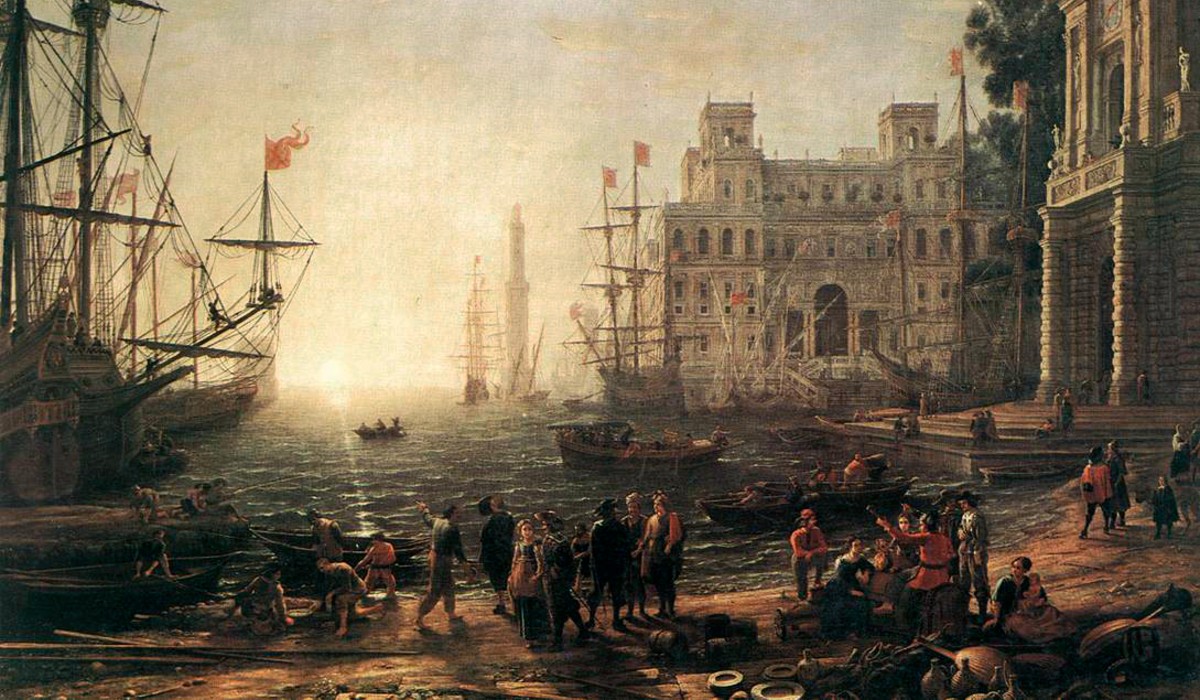
 17th century merchant trading. Painting by Claude Lorrain, 1637
Alex Snowdon traces the early development of capitalism and the struggle it generates against it
Exploitative and deeply unequal class societies have existed for thousands of years. Capitalism, though, is only a few hundred years old. Capitalism first emerged in western Europe, developing out of an earlier type of class society known as feudalism.
Tracing the early development of capitalism helps us understand this massive world-historic shift. Examining this history also focuses our attention on the distinctive elements in capitalism: what makes it different from feudalism and other pre-capitalist class societies.
Marx devoted some attention to explaining the transition from feudalism to capitalism. This transition remains the most recent shift from one mode of production to another.
Let’s make a quick contrast between medieval feudalism and modern-day capitalism. In the first scenario, we have an overwhelmingly rural, agricultural society. Most people live in villages and work on the land. The mass of peasants work for feudal lords, who possess power as well as wealth.
Land is the dominant source of wealth. The feudal ruling class exploit the peasants and use the surplus (the profits) generated primarily for conspicuous consumption and the raising of armies, rather than re-investing it in new technology or the development of productive forces.
In the second scenario, in our world today, we have a mainly urban society transformed by successive waves of industrialisation. Most people work in industry and services, providing the wealth for an exploitative capitalist class.
Money is everywhere. Everything is a commodity. What drives the system forward is no longer ruling-class consumption, but the endless drive to accumulate capital.
Much else follows from this economic and social transformation. Political institutions like parliament and the modern state developed alongside capitalism. The nation-state became much stronger, with the world clearly divided into nations.
There was a transformation in ideas and attitudes. Feudalism encouraged extremely fixed ideas: a peasant could not aspire to be anything but a peasant. Religion was the main ideological force that buttressed these conservative ideas.
Capitalism ushered in a greater sense of social mobility and fluidity. There was greater emphasis on democratic and political rights. However, it has also evolved a set of ideas designed to justify massive inequality and unaccountable economic power. The media and the education system are more influential than religion in reinforcing its dominant ideas.
The feudal ruling class was contradictory. It was hugely wasteful, devoting surplus wealth to grand consumption (from extravagant castles to lavish entertainments) and also military expenditure to defend its land and wealth. However, it did also invest, at least modestly, in new agricultural technology. Feudalism was not entirely stagnant.
It was the developments within feudalism that laid the basis for a new economic and social order: capitalism.
Feudal lords had a surplus of goods that, increasingly, they would exchange for other goods from outside their own area. Networks of trade developed. A social layer of merchants, profiting from trade, emerged. There was growth in towns, which served as centres of trade but also as sites for specialised handicraft production.
Merchants took some of the surplus previously held by feudal lords, while handicraft production created new wealth for the artisans responsible. These two social groups developed distinct material interests over time.
The towns began to develop their own dynamic, with relatively rapid progress in productive technology and a greater emphasis on trade. This also led to money becoming more important.
Some of the small-scale urban producers expanded their operations. They found a workforce among the people who had moved from the countryside to the towns, who became early wage labourers. A system of commodity production developed, built around trade, money, and the work of those who possessed nothing but their labour power.
The growth of this market economy was fuelled by advances in the forms of production: by new technology and improvements in productivity. This could be a violent and destabilising process, with land enclosures in the countryside pushing agricultural labourers towards the towns. This created an embryonic class of wage labourers. Colonial conquest was another factor in acquiring wealth for the earliest capitalists.
In Capital, Marx viewed the emergence of capitalism as the inter-relation between four elements: growth of trade, the use of waged labour, the removal of the peasantry from the land, and the accumulation of capital.
The antagonism between capitalist and worker became the central one in society. As the new capitalist mode of production developed, it brought about an acceleration of productivity unimaginable under feudalism.
Yet the spoils of this growth has always been concentrated among the capitalists at the expense of workers. This inevitably generated constant struggle between capitalists and the workers they exploit.
Before you go
The ongoing genocide in Gaza, Starmer’s austerity and the danger of a resurgent far right demonstrate the urgent need for socialist organisation and ideas. Counterfire has been central to the Palestine revolt and we are committed to building mass, united movements of resistance. Become a member today and join the fightback.

Alex Snowdon
Alex Snowdon is a Counterfire activist in Newcastle. He is active in the Palestine Solidarity Campaign, Stop the War Coalition and the National Education Union. He is the author of A Short Guide to Israeli Apartheid (2022).