
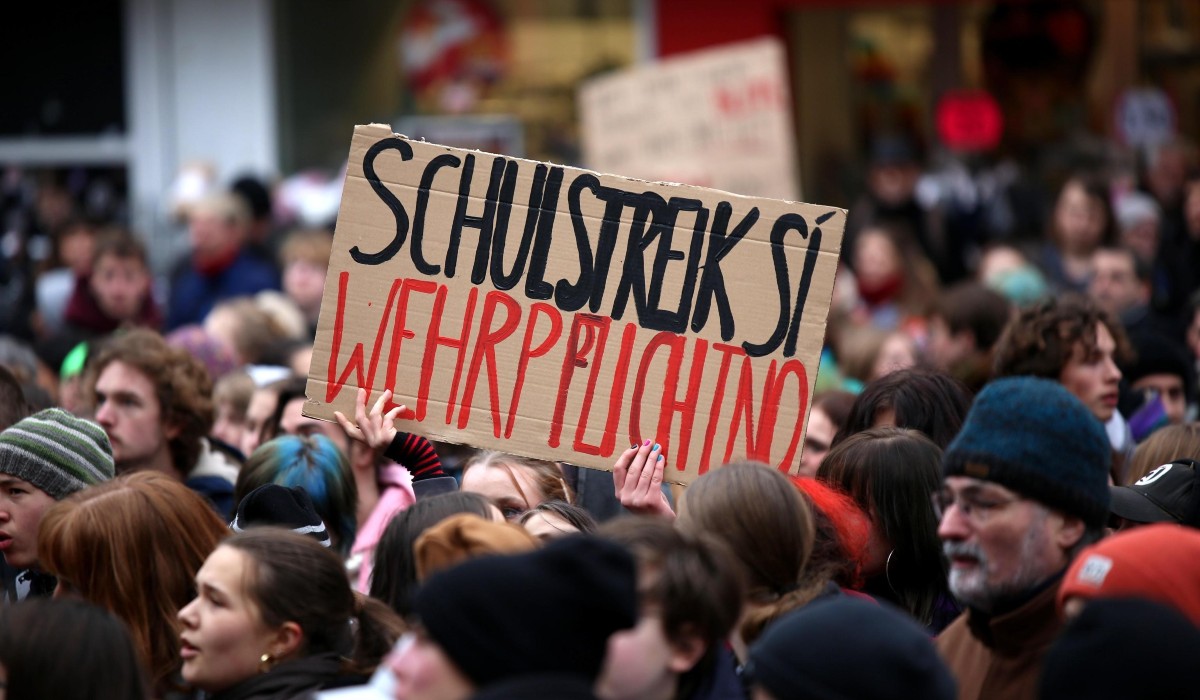
 School strike against conscription in Kassel, Germany, December 2025. Photo: Dezentrale Kassel / CC BY-NC-SA 4.0
The reintroduction of conscription is picking up pace across the continent and must be resisted, writes Terina Hine
Europe is in the grip of a military frenzy. Countries across the continent are spending billions on boosting supplies of weapons and attempting to integrate disconnected military infrastructure. But it’s not just about guns and tanks. In order to have an effective fighting force, we are told Europe must plug large gaps in its military personnel.
During the Cold War, NATO had large conscripted armies to rely on. Since then, not so much, but things look set to change as the introduction of compulsory and voluntary military service is becoming a fashion followed by increasing numbers of European countries. A fashion that is rapidly heading this way.
Starmer’s agreement to send British ‘peacekeeping’ troops to Ukraine, with permission to shoot Russians as necessary, has been met with cries of despair by the right wing and armed forces. What boots, they ask, have we to put on Ukrainian ground?
Just last year, in a bid to deal with the crisis of recruitment and retention in the armed forces, the government promised £1.3bn of additional funding; apparently that’s not enough. The youth of today are just too interested in scrolling on social media to become cannon fodder. As it seems are their European counterparts.
The solution? Denmark, Estonia, Latvia, Lithuania, Norway and Sweden have all introduced compulsory conscription in the last decade, most in the last few years. Croatia will be joining their ranks in 2026 with mandatory military service for all men aged between eighteen and thirty.
Elsewhere, governments have looked to voluntary schemes to boost recruitment. In December last year, the Belgium government wrote to all seventeen-year olds inviting them to volunteer for the army and earn €2,000 per month. A similar scheme was introduced in the Netherlands in 2023.
Poland has plans to introduce universal military training for every adult male and expand its voluntary forces. Bulgaria has a voluntary scheme for citizens up to the age of forty and Romania has plans to adopt a similar scheme this year.
France is introducing voluntary ‘national service’ for eighteen to nineteen-year olds this year. The young recruits will be paid €800 per month to participate in a ten-month military-training programme.
Germany is also moving towards a voluntary scheme, with an option to make it compulsory if national security demands it, or if there are not enough reservist volunteers. From July 2027, it will be mandatory for all German men aged eighteen to complete a survey on their suitability for service and undergo a medical examination. The initiative will enable the military to call on those needed as and when required. In December, German youth took to the streets to protest the plans and schools went on strike in ninety German cities: 63% of 18-29 year olds oppose the scheme.
Here in the UK, after Rishi Sunk caused a national outcry in 2023 by proposing mandatory military service for young people, the government has been a little more circumspect. However, in the run-up to Christmas, they announced plans to boost armed-forces recruitment by introducing a ‘gap-year’ programme for school leavers. The plan is to give ‘gappies’ the chance to spend a year in the armed forces, as if it were equivalent to travelling the world with your mates or working at a beach-bar in Australia.
Recruiting to the armed forces in the 2020s is no easy task. Consequently, there are real concerns voluntary conscription models are part of a slippery slope towards mandatory military service.
Traditional solutions in the UK have been to recruit children from the most deprived areas of the country. The UK has the only professional army in NATO which recruits children. According to the latest MoD figures, a third of new recruits are aged eighteen or under, 10% of those who signed up between September 2024 and March 2025 were only sixteen.
Research conducted by the Child Rights International Network (CRIN) show a direct correlation between economic deprivation and the rate of childhood recruitment: the more deprived an area, the younger the recruits. In the most deprived areas, the recruitment of sixteen and seventeen-year olds was found to be 57% higher than in the least deprived.
If Britain does send troops to fight the Russians in Ukraine, it appears many will be child soldiers, and most will be from our poorest communities. Unless of course, Britain joins the expanding European compulsory conscription club. Both must be resisted.
The International Peace Conference in London on 20 June could not be at a more important time. Do what you can to build it and attend.
Before you go
The ongoing genocide in Gaza, Starmer’s austerity and the danger of a resurgent far right demonstrate the urgent need for socialist organisation and ideas. Counterfire has been central to the Palestine revolt and we are committed to building mass, united movements of resistance. Become a member today and join the fightback.
