
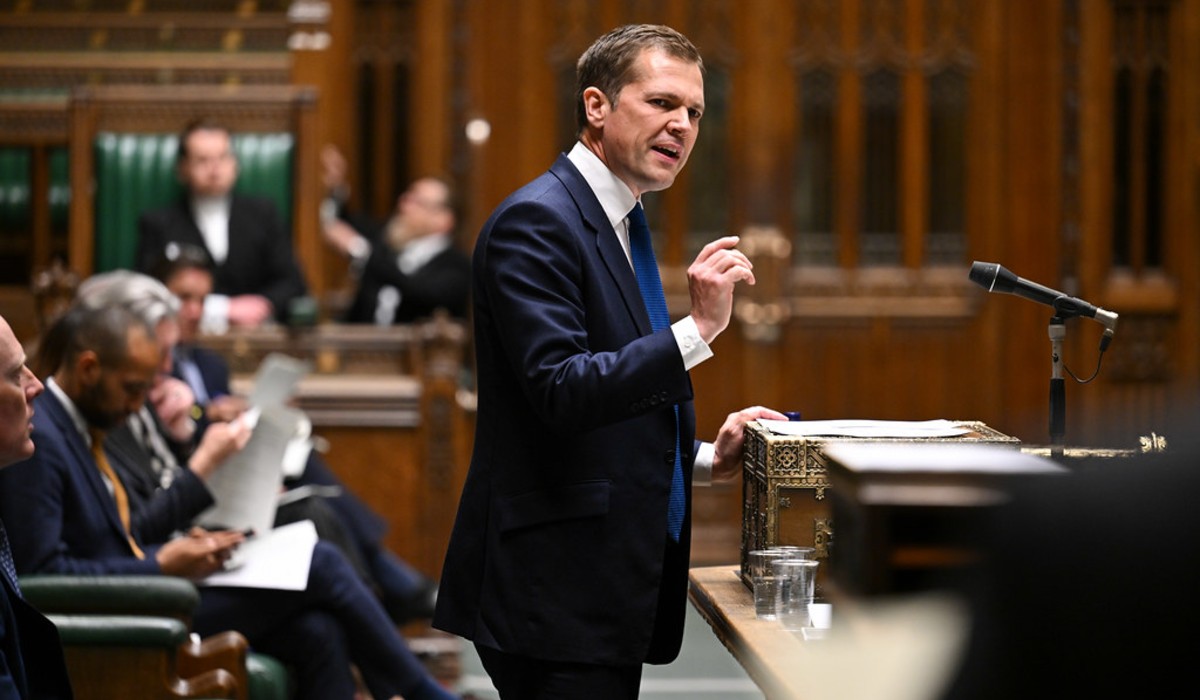
 Robert Jenrick. Photo: House of Commons Flickr / CC BY-NC-ND 2.0
The latest high profile Tory defection opens up a realignment on the right which contains real challenges to the left, argues John Rees
Just over a year ago, then Tory MP Robert Jenrick was runner up in the contest to become leader of the party. In the MPs’ section of the ballot he got one less vote than the winner, Kemi Badenoch. Now Jenrick is out of his job as shadow justice secretary and in Nigel Farage’s Reform after his party leader accused him of plotting against her and kicked him out of the party. Farage has previously called Jenrick ‘a fraud’.
Mainstream media commentators have been in a frenzy over the circular backstabbing, unsure whether it’s all more House of Cards or Game of Thrones. But, step back, and the drama is the least of it. Jenrick is the 23rd former Tory MP to join Reform. Some 13 leaders of Reform, including Farage and seven current council leaders, are former Tories.
Whatever the short-term effectiveness of Badenoch’s decision to push Jenrick before he jumped, the real meaning of his defection is that it is a marker of how far the split in the right has gone. Reform has been leading the Tories in the polls for many months, and though it seems to have lost some traction in the wake of the Guardian’s revelations about Farage’s schoolboy fascism, that lead is still substantial.
If the eclipse of the Tory Party as the main electoral standard bearer of the right continues it will be the reversal of a 300-year-old primacy. No other western political party has sustained itself so effectively for so long, negotiating the rise of universal suffrage and the welfare state. The Tories managed to do this by being the effective representative of big business in coalition with a substantial section of the middle class and a minority of conservative working class voters.
Ultimately it is the logic of Margaret Thatcher’s neo-liberal, market driven politics which has undone that coalition. Indeed, the legacy of Thatcherism may be that it has destroyed the modern Tory Party and won the modern Labour Party. It did this by creating an ever-deepening privatisation of the economy, a voracious appetite for gobbling up public services, the weakening of the unions, and the destruction of the public service ethos in politics.
That logic propelled Conservatism so far to the right that it prepared the conditions for its own fragmentation and the emergence of Reform. The fact that Labour – at least from the Blair era onwards – followed suit has helped to create a discontented layer of workers to which far-right populists can appeal, using them as a battering ram against an undifferentiated Tory-Labour establishment.
A fragmented right is not a less dangerous right, however. It unleashes an even more virulent populist inflation of chauvinism and xenophobia, relatively unfettered by traditional establishment concerns for social order. Worse still it opens the prospect of alignment between the extra-parliamentary extreme right of Tommy Robinson and the now openly fascist rebranded UKIP, and the parliamentary right under Farage and Jenrick, whose own far right instincts have become ever more marked in recent years.
Before you go
The ongoing genocide in Gaza, Starmer’s austerity and the danger of a resurgent far right demonstrate the urgent need for socialist organisation and ideas. Counterfire has been central to the Palestine revolt and we are committed to building mass, united movements of resistance. Become a member today and join the fightback.

John Rees
John Rees is a writer, broadcaster and activist, and is one of the organisers of the People’s Assembly. His books include ‘The Algebra of Revolution’, ‘Imperialism and Resistance’, ‘Timelines, A Political History of the Modern World’, ‘The People Demand, A Short History of the Arab Revolutions’ (with Joseph Daher), ‘A People’s History of London’ (with Lindsey German) and The Leveller Revolution. He is co-founder of the Stop the War Coalition.