
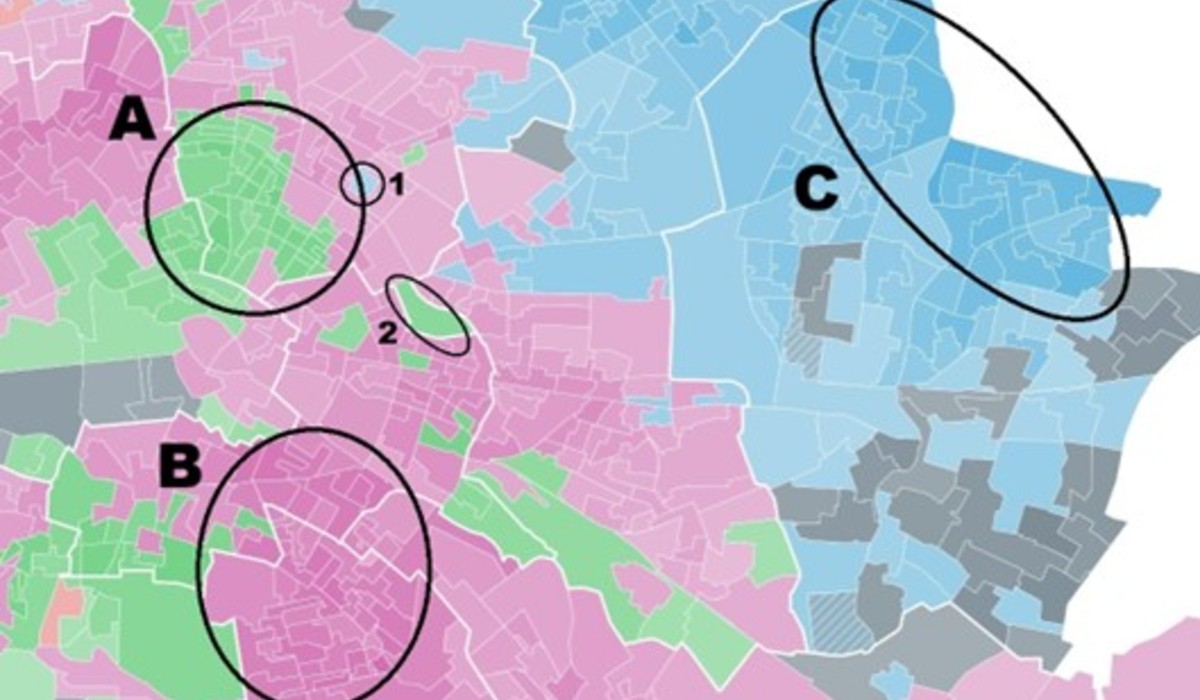
 Electoral map of part of Berlin, Bundestag election, February 2025.
Robert Dale examines the political scene in Germany with an eye to trends in UK politics
Amidst all the fuss about election winners and losers, some of the most interesting things tend to get overlooked. Even if we are sceptical about elections changing anything – and I certainly am – they can still tell us a lot about what is going on in politics and society.
In this piece, I’m going to pick apart the German party landscape. It’s the one I know best, and it has a couple of quirks that reveal the patterns of party and class particularly clearly. Fundamentally, though, I think it is a picture that reappears in one form or another across the Western economies.
Proportional Representation
Two features of the German voting system make the focus particularly sharp: (1) proportional representation (PR) and (2) published results at polling station level. Under a party list system, voters generally feel freer to vote for the party they like best. Tactical voting is not a big issue.
And conversely, PR allows parties to form and thrive around comparatively narrow interests. So they are free to pursue policies that only really appeal to a smallish group. For a long time the hard free-market Free Democrats owned a significant slice of the business vote, and between 5 and 10 per cent sufficed to play kingmaker.
Polling Station Results
Election results at polling station level allow us to pinpoint quite precisely how different groups are voting. Maps like the one of Berlin at the top of this piece are available for all German elections. Each division on the map represents the results of one or two polling stations (so one or two thousand voters). Three parts of town stand out straight away:
First, Prenzlauer Berg (Circle A), heavily gentrified in the 1990s/2000s and now pretty affluent. Its population skews hard to the graduate professions, new economy start-ups, consultants managers, doctors, teachers. The Greens poll very well here, getting around 40 per cent.
Recently gentrifying Neukölln North and Kreuzberg East (B) is a trendy place to live for students, ‘creatives’ and young professionals. They tend to be feeling the pinch (housing!) but are often expecting to be moving on and up. The area also has a large Turkish/Arab population. The Left Party do very well here, again around 40 per cent.
And so we come to the very large and now neglected housing estates of Marzahn and Hellersdorf (C). Currently pretty much the bottom rung of the ‘housing ladder’. These used to be a Left Party stronghold on the outskirts of the city. Now the ‘far right’ AfD polls 40 per cent there.
You can repeat that analysis across the city and across the country, and find roughly the same thing. The middle classes backing the Greens; students and young graduates supporting the Left Party; (manual) workers voting for the far right AfD.
Because the divisions are so small, you can pick out a great deal of detail. For example, two tower blocks where the AfD did especially well (1 on the map). Or a swanky new-build development whose affluent owners mostly vote Green (2).
I’ll now look a little closer at each of those three parties, to see what else we can say about their voters, and how their policies and actions relate to their base. For the moment I’m leaving out the social democrats (SPD, equivalent of Labour) and the Christian democrats. There’s not so much interesting to say about them at present. The SPD is happy if anyone votes for them at all. And I’m also skating over certain regional differences.
The Greens
The Greens have pretty much cornered the liberal middle classes. Green voters earn more than those of any other party, and fly more. Yeah, I know, the irony… They are enthusiastic about war in Ukraine, about superficial Diversity, Equity and Inclusion (DEI) activities, about reducing the use of fossil fuels. Their representatives in the 2021–2025 coalition government delivered on all that. These days they are doing very well for themselves in prosperous rural areas, taking votes from the Christian Democrat Union (CDU) and entering conservative regional coalitions.
The party speaks very fervently for immigrants and refugees, but in government went along with the European Union’s repressive turn. The ‘green’ policies they push often subsidise the middle classes at workers’ expense (solar roofs, electric cars).
In the abstract, the Greens are big on human rights. Especially as a pretext for war (not just Ukraine, also Kosovo 1999). Originally fervently anti-Nato, they dropped that in the late 1990s. A poll in 2025 found that three quarters of Green voters wanted to continue sending weapons to Ukraine, while the figure for AfD voters was just 11 per cent. And from leaders to voters, the German Greens are no friends of Palestine.
Green leaders have also gained quite a reputation for coming down on critics like a ton of bricks. In the most notorious case, someone had their house raided by police at 6am – for calling the Green economics minister a ‘dimwit’ online.
The material concerns of ordinary people don’t really feature. In government the Greens were quite blasé about fuel hikes and the cost of their ‘climate measures’. They quickly became ‘Most Hated Party’ in working class communities, and there were several instances of senior Greens being quite literally run out of town. In government, you could say, they did pretty much the same as their Social Democrat Party (SPD) partners – but at least the social democrats pretended they were a little bit sorry.
The Left Party
The Left Party’s voters are young and educated. Essentially they represent a subset of the Greens’ middle class social base. A bit less established, a bit edgier. Like the Green voters, they are concentrated in the ‘better’ (but not best) parts of the more ‘dynamic’ cities and in nice little university towns. Soy latte land.
They are enthusiastic about equality in the sense of identity politics, and talk a lot about ‘social justice’ – in a very abstract way. Climate and housing too. More than anything, they are motivated by opposition to the far right. The Left Party’s unexpected comeback at the last election in February 2025 was fueled by a wave of very large demonstrations against the AfD.
Before that election the Left Party had lost members over its failure to oppose Germany’s Ukraine warmongering and then its abstention from the Palestine struggle. Unlike the Greens today, it still contains some good honest leftists (the Greens did too, once upon a time). But it is not connecting with workers in any meaningful form.
The AfD
Like it or not, the party for which workers are voting in numbers is the Alternative for Germany, or AfD, which is most prominently known for its anti-immigration policies and statements. It is currently polling around 40 per cent among manual and clerical workers, more in the regions most ravaged by deindustrialisation.
The relevant trade unions are certainly having to get their heads round a significant proportion of their members voting for the AfD. They aren’t talking about it much in public, though. One full-time organiser in eastern Germany told me that when he looks for the leading militants in a plant, it is not unusual to find them to be AfD voters (though not members).
In the recent works council elections many thousands of workers who had voted for the AfD in parliamentary elections gave their support to the traditional unions, which did well enough. The small yellow unions made a little progress in the big (and threatened) car plants, but nothing to write home about.
The AfD is a conundrum. Its leadership and policies don’t match its base. Many of its leaders and members of parliament make highly alarming statements. Racist, reactionary, and not a few sympathetic to Nazis old and new. The AfD’s policies are thoroughly neo-liberal and anti-worker (for those who read manifestos).
Yet for all the hard right talk, there is no sign of the AfD building the kind of street-fighting force that has historically characterised fascism. Some of their leaders are, however, closely connected with the (small) open neo-nazi scene.
Apart from the many more and less open anti-migration references, its campaign posters are populist. It was the only party to campaign on fuel poverty for example. Many of its posters simply suggest that it is time for a big change: ‘AfD now’ or ‘We are the alternative’.
So are workers voting for the AfD explicitly for its fascist fringes? Or because they want to see deportations come what may? Many on the German left seem to think that they are and they do, and that colours the action that is put forward.
My reading, for what it’s worth, would be that most of those who are voting AfD are not terribly close or connected to the party itself. And not terribly interested in policy documents. Really, they have simply had enough, and are expressing that. If those who lord over us are saying ‘The one thing you must never ever do is vote for that lot, as that would make our heads explode’, I can see the temptation…
That is not the consensus on the German left, however. There’s a lot of demonisation of AfD voters, and virtually no contact. The underlying assumption is that every AfD voter is as unpleasant as the party’s worst leading figure (that would be Björn Höcke).
On the basis of a widely shared belief that the AfD is a proper fascist party, there are serious initiatives to physically prevent its conferences, tear down its posters and smash up its election stands. For a long time I took that view myself. Calls for the state to ban the party get a great deal of traction, especially in the Green/Left Party milieu.
Is that going to work? I have my doubts on that. But fear and loathing is certainly electorally helpful for the Greens, the Left Party and the SPD. Recent elections have seen comparatively high turnout, without much enthusiasm for any of the mainstream parties. A lot of negative voting, simply to keep the other party out. In that situation, the Greens, the Left Party and the SPD are telling voters ‘if you don‘t vote for us you’ll be getting fascism’.
One test will come in September, when there are regional elections in two eastern states. The AfD is expected to do very well, and has absolute majorities in its sights. Altogether I see many unanswered questions when it comes to the nature of the far right parties, and in particular how to relate to the workers voting for them.
We should not kid ourselves that the harshest line is automatically the safest one. And we will not know whether our chosen course of action was right or wrong until long after the dust has settled.
Distilling it down
To close, I’d like to come back to the essence of the Green project in Germany. I could put it like this: firmly centred in the liberal middle classes; no problem with profiteering and privatisation; enthusiastic about profit-bearing climate policy; signed up to Nato; strong on DEI speech policing but weak on the (material) causes of discrimination; vocal supporters of certain progressive causes, until they get into government; happy enough to administer austerity and see workers impoverished; not squeamish about clamping down on free speech.
Kinda sounds like very many governments in the 2000s and 2010s, doesn’t it? In Germany the Schröder, Merkel and Scholz governments all fitted that bill in some way or other. The same could be said of Blair and Brown, Cameron and Clegg, and Starmer. Nicola Sturgeon’s SNP. Macron, Obama, Biden. German cynics – alluding to the name of the former East German ruling party – called this the ‘neoliberal unity party’. Time it met the same fate as the East German ‘unity party’.
Robert Dale lives in the Berlin region, where he has been active in socialist politics since the 1980s.
Before you go
The ongoing genocide in Gaza, Starmer’s austerity and the danger of a resurgent far right demonstrate the urgent need for socialist organisation and ideas. Counterfire has been central to the Palestine revolt and we are committed to building mass, united movements of resistance. Become a member today and join the fightback.
