
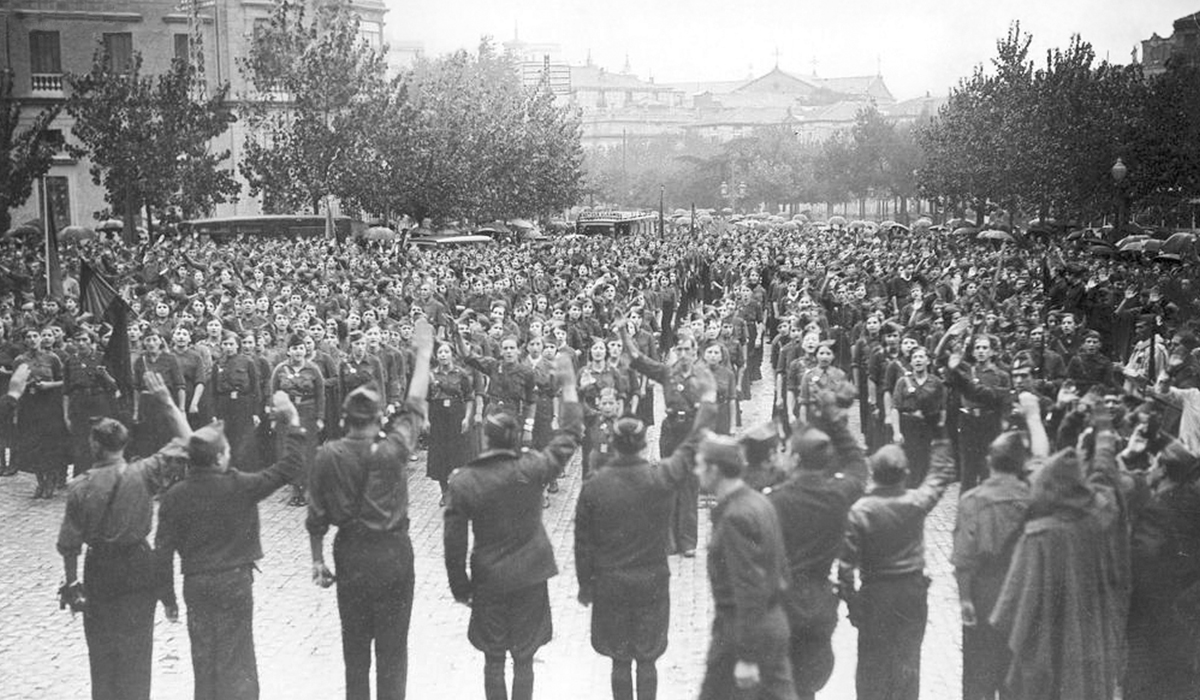
 Falangistas in Zaragoza, 1936. Photo: Narodowe Archiwum Cyfrowe / CC BY 3.0
Academic history denies that Franco’s fascism, but the violence and antisemitism of his war in, and then rule over, Spain tells the story, argues Chris Bambery
Fifty years ago, on 20 November 1975, Generalissimo Francisco Franco died, after his family finally agreed to turn off the life-support machine keeping him alive.
Over thirty years before, his fascist comrades, Hitler and Mussolini, in the former case had committed suicide and in the latter had been shot after being captured by the resistance. Both dictators had supplied men and arms which helped ensure a fascist victory in the 1936-9 Spanish Civil War. Franco would rule as a dictator until his death with the blood of hundreds of thousands on his hands but in the 1950s was rehabiliated by the West as a crucial ally in the Cold War.
The Civil War began with a military coup against a centre-left government elected in early 1936 under the banner of the Popular Front. The generals who launched the rebellion hoped for an immediate victory, a coup d’état, but this did not transpire. Workers rose up in the cities such as Madrid, Barcelona and Valencia, defeating the uprising and in Barcelona taking control.
Now that the generals were faced with a prolonged war, they relied on terror to purify Spain from the evils they believed polluted its Catholic and national spirit. The fascist party, known as the Falange (‘phalanx’ in English), had been growing in the months before the rebellion began, as Spain polarised. Having rallied to the military, party numbers mushroomed and provided the executioners operating in territory taken by the Nationalists, as rebel forces called themselves.
On the other side, the Republic was led by an alliance of liberals, socialists, and other leftists, including the communists, but also Catalan and Basque nationalists (the latter were Catholic and moderate but joined the Republican government, with much hesitation, when it granted the Basque Country autonomy). That alliance was an uneasy one from the outset.
In the opening months, there was great violence on both sides, although it was much greater in the Nationalist zone. In the Republican zone, anarchists and leftists executed rightists, burnt churches (the Catholic Church unreservedly supported the rebellion), and rounded up those they considered fascists. The difference was that the Republican government abhorred this, and did everything it could to stop it, eventually succeeding. In the Nationalist zones, by contrast, the military authorities encouraged mass executions.
Terror was the strategy
Franco led the intial uprising in Spanish Morocco and Hitler then provided planes to transport him to the mainland. He began a slow advance towards Madrid carrying out massacres on the way. At Badajoz, after the city was captured, some 4000 people were shot.
General Mola had planned the military uprising and commanded the fascist forces in the north of Spain. Large areas of northern Spain supported the uprising and joined in without very much resistance. That did not stop him ordering his men to implement terror, killing anyone suspected of having voted for the government or for being vegetarians, naturists or champions of Esperanto. Teachers were another target. From the beginning, Mola saw the civil war as a crusade against the ‘Jewish-Masonic-Bolshevik’ conspiracy, telling Italian fascist officers fighting alongside him that he would welcome the wholesale destruction of the industrial working class. Like many veterans of the long and bitter colonial war in Morocco, Mola, like Franco, viewed the working class in the same colonial way he viewed Moroccans.
Mola declared the fascist strategy early in the war, on 19 July 1936, when he said in a speech: ‘It is necessary to spread terror. We have to create the impression of mastery eliminating without scruples of hesitation all those who do not think as we do.’[1]
Franco, in a speech following his 19 May 1939 victory parade through captured Madrid, justified the continued need for repression by pointing to the continuing and necessary struggle against the Jews, stating: ‘The Victory would be wasted if we did not stay on the alert and maintain the concerns of the heroic days, if we left eternal dissidents, the embittered, the egoists, the defenders of liberal economics free to act … Let us have no illusions: we cannot extinguish in one day the Jewish spirit that facilitated the alliance of big capital with Marxism, that knows all about deals with the anti-Spanish revolution. That spirit still flutters in many hearts.’[2]
General Gonzalo Queipo de Llano y Sierra took control of the uprising in Seville, elbowing his way to the top. He would become famous for his rants on the radio promising death to a long list of those supposedly conspiring to destroy Spain. That list would include US President Roosevelt, supposedly controlled by Jews. His forces, aided by squads of Falangists, carried out mass killings in the towns and villages of the south, where landless labourers backed the Republic. Aristocrats joined in with glee. Queipo himself loved killing, and raped and sexually assaulted female prisoners. He also despised those who rose above him, Franco above all, ensuring he would be sidelined as the dictator gathered power into his hands. Franco was selected as Il Caudillo, The Leader, in order to fight a long and brutal war.
A fascist regime
Barcelona fell to fascism in January 1939. Some 500,000 refugees crossed into France , where many were placed in internment camps. General Alvarez Arenas entered the city leading a conquering army, telling his propaganda chief: ‘This is a city that has sinned greatly, and it must be sanctified.’
A Francoist poster declared: ‘Spain has arrived!’[3] Franco described Catalan as ‘la lengua de perros’ (the language of dogs). Posters appeared saying ‘Speak Castilian, the language of Empire.’[4]
The public use of the language was banned, Catalan books, newspapers and journals were banned and burnt in the streets. Education had to be in Spanish (Castilian) and half of the city’s teachers fired. Catalan christian names were banned.
Military tribunals began systematically rooting through the city and the prison camps looking for leftists, Catalan nationalists, freemasons and all those deemed enemies of the New Order. Some 1600 executions were carried out on the beach at the Camp de la Bota in the Poblenou district.
In 1940, the Gestapo arrested the Catalan President, Luis Companys, and extradited him to Franco’s tender mercies. He was tortured, tried by a military tribunal and shot; the only democratically elected head of state to be executed during World War II. All of this left scars which remain today.
It is estimated that around 500,000 people had been killed in the fighting, and countless more had succumbed to malnutrition, starvation, and war-engendered disease, making it the deadliest conflict that Western Europe had experienced since the end of First World War.
During the Civil War itself, 100,000 people were executed by the Nationalists; after the war ended in spring 1939, another 50,000 were put to death. Martial law remained in place in Franco’s Spain until 1948, and former Republicans were subjected to various forms of discrimination and punishment.
The dictatorship used a wide array of savage tactics to dehumanise, persecute, terrorise, and silence the enemy, including forced exile, labour camps, torture, and rape. Their goal was to eradicate all of Spain’s supposed enemies, actors in the ‘Judeo-Masonic-Bolshevik’ conspiracy: leftists of all shades, Republicans, liberals and Catalan and Basque nationalists. The Catalans were denounced by the Falange as being ‘Judeus-Catalanes’.
It’s often said Franco was not a fascist. That may be, but he a shared the genocidal impulse of Hitler and the Nazis. The fascist party, the Falange, would be incorporated into the National Movement under him, along with monarchists of different hues, but they were central to the terror, and central to the regime, until it became clear Germany was going to be defeated. Nonetheless, the Falange remained the force Franco would turn to whenever he felt threatened, right up to the end.
Antisemitism
During the Civil War, the Francoists spread the pernicious myth of a ‘Jewish-Masonic-Bolshevik’ conspiracy, drawing on old Catholic traditions, stretching back to the expulsion of Muslims and Jews in 1492, when the last Muslim kingdom of Grenada was conquered. Spain’s reactionary propogandists quickly picked up and spread the current version issuing from Berlin.
The Falange mushroomed in size before the military uprising, recruiting the monarchist youth en masse, and then did again once the civil war got underway and it was given a free hand to kill en masse.
The entire Spanish right, from open fascists to the officer corps, the Catholic hierarchy and most of the priesthood, and the monarchists, were infected by Nazi ideas and by Nazi methods. When World War II began, Franco would declare Spain neutral but after Hitler’s occupation of Scandinavia, the Low Countries and France, changed that to ‘non-belligerence’, supporting Germany and Italy in every way short of joining in the fighting.
The truth was that after the civil war, Spain was in no position to join the war and Hitler could not afford to supply it with the material that would have required, or accede to Franco’s price, swathes of North Africa. However, when Hitler invaded Russia, Franco did send 40,000 men to fight there, the fascist Blue Division. He supplied the Third Reich with raw materials and weaponry till the end, and Hitler’s U-boats docked in Spanish ports to be refuelled, repaired and to be supplied with weather charts and information on British shipping. The Germans in turn ran a huge propaganda operation in Spain, targeting Jewry.
After France fell to Hitler, Franco occupied Tangiers, until then a French possession. The Falange ran amok, attacking its Jewish population and forcing them to flee. The regime also tried to stop Jewish refugees (including Spanish-speaking Sephardic Jews, the descendants of those expelled from the Kingdom of Spain in 1492, many of whom had Spanish passports) entering Spain and, when they relented to a degree, allowed those with papers only the right to cross the country to a port from which they could depart. Those without papers were interned.
All the time, the press and radio were issuing antisemitic statements given to them by the German embassy or lifted from Tsarist-era antisemitic tract The Protocols of the Elders of Zion. Post-war Holocaust denial was the rule of the day.
After the Second World War, Franco had to try to tone down the public statements attacking Jews and Freemasons, as the dictatorship tried to draw a curtain over its enthusiastic support for Hitler and, as the Cold War gathered strength, became an ally of the United States. But it was a façade. Franco couldn’t stop making hideous statements and wrote articles, and even scripted a film, under a pseudonym, attacking Jews and Freemasons. Old fascists couldn’t change their spots.
The executions continued to the very end of Franco’s rule. Two months before he died, five members of ETA, the Basque guerilla group, and another left-wing group were shot.
Franco still casts a dark shadow over Spain and the transition to parliamentary democracy which eventually followed his death. The end of military dictatorship left too much of the fascist state intact.
[1] Paul Preston, Architects of Terror: Paranoia, Conspiracy and Anti-Semitism in Franco’s Spain (London: Harper Collins, 2023), p.212.
[2] ibid. pp.27-8.
[3] Chris Bambery and George Kerevan, Catalonia Reborn: How Catalonia took on the Corrupt Spanish State and the Legacy of Franco, (Edinburgh, Luath Press, 2018), p.87.
[4] ibid. p.88.
Before you go
The ongoing genocide in Gaza, Starmer’s austerity and the danger of a resurgent far right demonstrate the urgent need for socialist organisation and ideas. Counterfire has been central to the Palestine revolt and we are committed to building mass, united movements of resistance. Become a member today and join the fightback.

Chris Bambery
Chris Bambery is an author, political activist and commentator, and a supporter of Rise, the radical left wing coalition in Scotland. His books include A People's History of Scotland and The Second World War: A Marxist Analysis.