
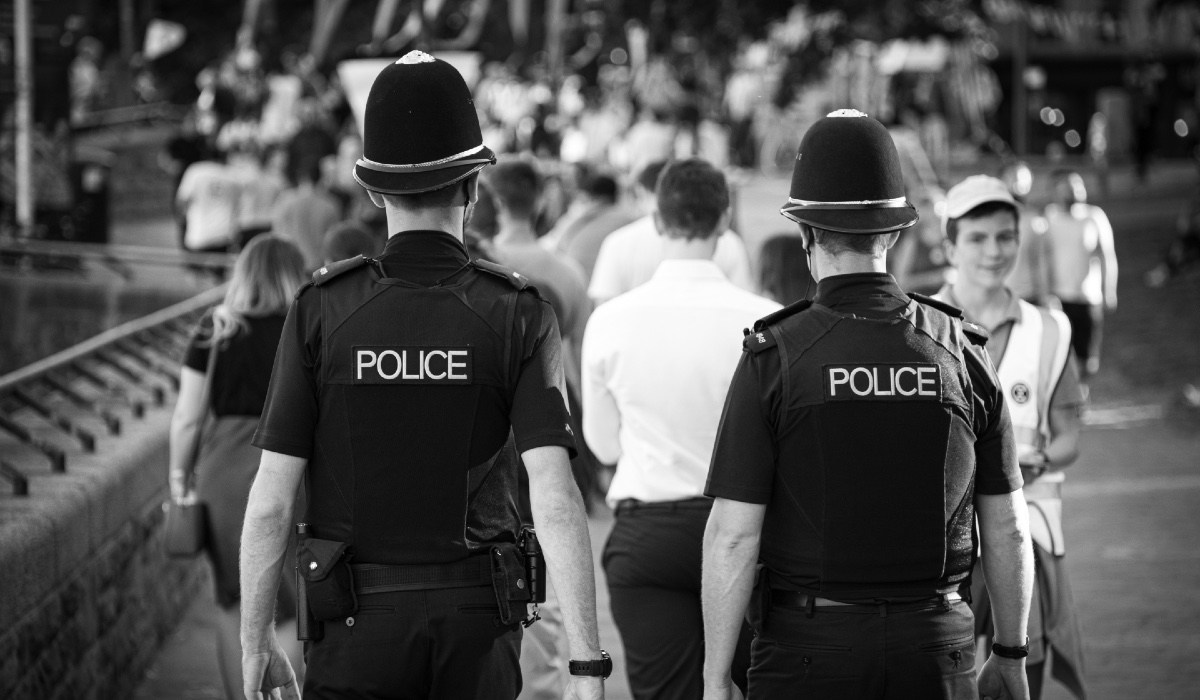
 Police at an Extinction Rebellion Protest in Bristol in 2019. Photo: KSAG Photography/Flickr
As the undercover hearings continue, James Simpson explains why the fight for the truth is facing obstacles from within the process itself
Monday 3 November saw the return of the Undercover Policing Inquiry (UCPI) from a half-term break. The day, however, underlined much of what is wrong with the process, and underscores the battles core participants and activists have to ensure it remains useful.
The UCPI is investigating the historical abuses of undercover officers (UCOs) of the Special Demonstration Squad (SDS) and its successor, the National Public Order Intelligence Unit (NPOIU). It was first announced in 2015 by then Home Secretary Teresa May. This was in response to revelations that multiple UCOs had deceived women into long-term sexual relationships whilst deployed, and some had been tasked with infiltrating family justice campaigns such as the one that followed the racist murder of Stephen Lawrence in 1993.
The day was split in two hearings. An evidential hearing from ‘Ellie’, one of the many women deceived into a long-term relationship by SDS officer James Thomson beginning in 2001 and only really coming to an end in 2018 when it became clear that the UCPI would be revealing his true identity. This was followed by a procedural hearing into whether SDS officer, cover name Dave Hagan, was fit enough to give the hearing evidence due to reported concerns over his mental health.
‘Ellie’: putting the humanity into an inhumane process
‘Ellie’, as she is known to the UCPI, returned to give the second half of her evidence via video link from Australia. As with many of the women deceived into relationships, this was clearly an emotionally challenging thing to do. One that she met with the utmost dignity and bravery. Thomson, whom had been tasked with infiltrating animal-rights groups, entered into the second (known) sexual relationship of his four-year deployment, with ‘Ellie’ in early 2001. This ended when he feigned having to leave the country for family reasons in the first months of 2002. From this point on, he and ‘Ellie’ maintained regular, if sporadic, contact for fifteen years. Meeting up for dates when they could, even after ‘Ellie’ emigrated to Australia.
Thomson’s emails were often sexually explicit. Also, they revealed a concerning pattern that makes even clearer the courage ‘Ellie’ has had in giving evidence. Thomson’s cover employment was in the film and television industry. His cover name, James Scraven, even can be found in the credits for 1998 wartime period drama Coming Home. However, his email exchanges revealed that, over the years, he became more forthright in showing images of a ‘new’ career in security. Pictures were sent with soldiers and armaments in Northern Iraq. Messages were sent from his trips to Libya, Afghanistan, and whilst providing security at the Commonwealth Games.
Whilst more detail of Thomson will follow (after more evidence is heard from him and his victims this and next week), the power imbalance confronting ‘Ellie’ is further highlighted in what we have learnt of his career following his unmasking in 2018. Thomson, following his SDS deployment, became a Close Protection Officer for, amongst others Tony Blair, and had a highly successful and globe-trotting career in the shadows between policing and intelligence.
‘Ellie’ detailed how she is unable to drive anywhere without checking the boot of her car first. How she has checked her antipodean home for bugs. How she out-of-the-blue received a text message that revealed Thomson had knowledge of whom she had appointed as her lawyer to aid with the process of the UCPI. The pressure on these women, not only to relive past traumas, but to do so, against agents of the state, is enormous. Yet time and again, women like ‘Ellie’ are forced into doing so by the belief that this is their only available avenue for any modicum of justice or understanding.
Mitting closes ranks in the face of enormous pressure
The ‘Dave Hagan’ question presented Mitting with an enormous challenge. ‘Hagan’, as detailed in Spycops – undercover and unaccountable, is a hugely problematic figure. His deployment, ostensibly targeting the Movement for Justice campaign, resulted in his reporting extensively on the family justice campaigns of Stephen Lawrence, Ricky Reel and Michael Tachie-Menson. He is said to have had his undercover intelligence fed into then Commissioner, Paul Condon’s, evidence that was submitted to the seminal Macpherson Report. This was a report detailing the structural racism and corruption that prevented proper investigation into Stephen Lawrence’s murder. A report that reverberates through British society and policing today.
Hagan has managed to answer questions for the Ellison review of the Macpherson Report, where he was described as ‘a spy in the camp’ of the Lawrence family at the time. He also was able to be interviewed by Operation Herne. An external police-force investigation of the Metropolitan Police Service (MPS) use of the SDS concluded a decade ago. Furthermore, his witness testimony, said to be a detailed 77-page summary of his deployment, was turned into the UCPI in 2023. However, on 14 July 2025, an application was made to Lord Mitting that ‘Hagan’ was too unwell with Post Traumatic Stress Disorder to be able to give evidence to the hearing. This was announced, to the bemusement of many, on 24 September. The second half of today’s evidence was to give the legal teams of those affected an opportunity to state their case and attempt to overturn this decision.
Doctor SDS Sicknote?
Imran Kahn KC, representing Baroness Doreen Lawrence and Suresh Grover, introduced the core arguments. The diagnosis of Hagan by Doctor Noreen Tehrani was questioned severely. It was put to the chair that she did not have the relevant expertise to make such a diagnosis. Tehrani’s background in stress-related disorders in relation to occupational health, it was suggested, did not make her sufficiently expert to ascertain whether Hagan could give evidence, particularly in relation to the Vulnerable Witness Provision Measures often used in civil and criminal courts.
Furthermore, in correlation to the provisions that vulnerable witnesses can be afforded when giving testimony, no evidence of any stress testing against these had been presented to any of the legal teams. Nor had any relevant evidence of any use of Hagan’s previous medical interactions seemingly been used or at least shared. He is said to have been first diagnosed with PTSD in either 2001 or 2003 (even this date is disputed). Yet no legal team outside of Hagan’s own has seen any even digested report from his medical records, be that from his GP or from Metropolitan Special Branch psychologists Mary Piper and Ian Palmer. Both saw UCOs in Special Branch as a matter of course and had sessions with Hagan. Palmer is said to have been keen to share his notes.
Kahn also questioned the independence of Tehrani. She is said to have had multiple contracts with police forces across the country. It was intimated that a large part of her business is in a mutually beneficial relationship with the police in this country. That could be seen to be a conflict of interest, Kahn suggested, when the concerns of Hagan and the MPS are best served by not having such a controversial officer subjected to further scrutiny.
Crucial testimony needs to be tested
Family justice campaigns into the racist killings and botched investigations are a feature of this phase of the UCPI. Before Christmas, spying on justice campaigns for Stephen Lawrence, Ricky Reel, Cherry Groce, Joy Gardener and Michael Tachie-Menson will all be under the microscope. Hagan’s deployment touches on most of them. His 77-page witness testimony is hotly disputed by all challenging the ruling today.
It has been raised, logically and patiently, time and again today, that, without further scrutiny, then the words of Hagan’s witness statement cannot be properly tested. That without core participants being able to raise questions, and hear answers, then where is the litmus test for these words? And this also includes what is not in the statement. Sukhdev Reel, mother of Ricky, murdered in 1998, recounts an event when Hagan offered her a lift home from an event where she had been campaigning on behalf of her murdered son. This event is not included in Hagan’s witness statement. Without taking the stand and being questioned, where now does this grieving mother find the answer to why this happened?
This strand runs through all of the hearing. Stephen Lawrence’s friend, and witness to his murder, Duwayne Brooks OBE, demands answers as to why there was reporting from Hagan on him bringing a civil case against the MPS.
‘MWS’, a family member of Michael Tachie-Menson, wants to interrogate allegations in Hagan’s witness statement about Alex Olowayde, an anti-racist campaigner of the Movement for Justice, and his involvement in family justice campaigning. It is felt that Hagan was questioning the family’s own agency and ability in decision making and campaign direction. This is something ‘MWS’ and the family wholeheartedly dispute.
Peter Francis, whistleblowing SDS officer, is called a liar repeatedly throughout the statement. Francis will take the stand for his own evidence at the start of December. He too has had a long-standing diagnosis of PTSD related to his time in the SDS. Due to the nature of his evidence, the onus is on him to give evidence rather than avoid it, regardless of any underlying diagnosis.
Mitting a very predictable response and the duality of the UCPI experience
After a lengthy period of all the legal teams giving their rationale as to why Hagan should be put on the stand, it took no time at all for Lord Mitting to proffer his response. No. No, he would not be revisiting his original decision. Although labouring to repeat that Hagan’s evidence is paramount, he would not be able to give evidence to the UCPI due to the severity of his mental-health condition. That he ‘unhesitatingly’ accepted Tehrani’s diagnosis and rationale. That any revisiting of his medical conditions by any other party would likely exacerbate them, whilst contravening his Article 2 and 8 rights under the European Court of Human Rights (Right to Life and Right to Respect for Private and Family Life [!]). And that all in all, it was too risky for the Hagan’s mental health to open this question up again.
One small off ramp from the unremittently awful image the UCPI was creating for itself may have been presented by the legal team of Neville Lawrence, father of Stephen. In the statement delivered endorsing the positions of Imran Kahn KC and others outlined above, the legal counsel acting on his behalf, briefly opened up the question of written questions being presented to Hagan in lieu of oral evidence being impossible. This mere thirty second interlude contained within ninety minutes of discussion was latched on to by Mitting eagerly.
Even so, and with such a low bar being set, Hagan’s legal team, have been given a fortnight to consider whether the man who in 2023 could write a 77-page witness statement is, in 2025, fit enough to answer a handful of written questions in 2025. It could be suggested the answer will be found in the damage-limitation exercise the MPS is constructing around their former officer, rather than the questioned records of Doctor Tehrani or any other medical professional.
This day neatly shows the power imbalances that undermine the UCPI so regularly. The bravest and most harrowing testimony, given by ‘Ellie’ this morning, followed by the procedural closing of ranks shortly afterwards. ‘Ellie’ was forced by the need to find answers and some explanation to take the stand to relive the abuses of a man who clearly has gone on to wield much relative power and societal influence. The stress and strain is bore by the victim in order to try and have a voice and fight back against the intrusions of her state sponsored abuser.
Hagan’s evidence on the other hand is clearly a risk to being damaging to the state if he was allowed to give hearing evidence and blundered in the witness box. A state that used a police force to spy routinely on black and minority groups in their hours of grief to limit its own reputational damage. Now the Inquiry has seen an aloof and hasty Mitting cover himself in contradiction as he tries to weasel the MPS’s way out of one of its most controversial and revealing moments in recent domestic policing history.
Mitting himself inadvertently summed up the position nicely when thanking ‘Ellie’ on completing her evidence. As he expressed his gratitude, he remarked how oral evidence is so important in bringing the written statements to life and illuminating and informing the UCPI and himself. A few hours later, and having been given every reason not to, he was brazenly contradicting his own words. One gets the feeling that when the families spied on by Hagan come to give evidence in the coming weeks, he may have a fair few very public and very uncomfortable moments to contend with now.
The Undercover Policing Inquiry continues at the International Resolution and Disputes Centre every week until Christmas (before returning in 2026!). Evidential hearings are public and can be attended. For further information on how, go to Undercover Policing Inquiry: Official Website. For more information and analysis please support and visit the sites and social media of Police Spies Out of Lives, Campaign Opposing Police Surveillance and the Undercover Research Group.
Before you go
The ongoing genocide in Gaza, Starmer’s austerity and the danger of a resurgent far right demonstrate the urgent need for socialist organisation and ideas. Counterfire has been central to the Palestine revolt and we are committed to building mass, united movements of resistance. Become a member today and join the fightback.
