
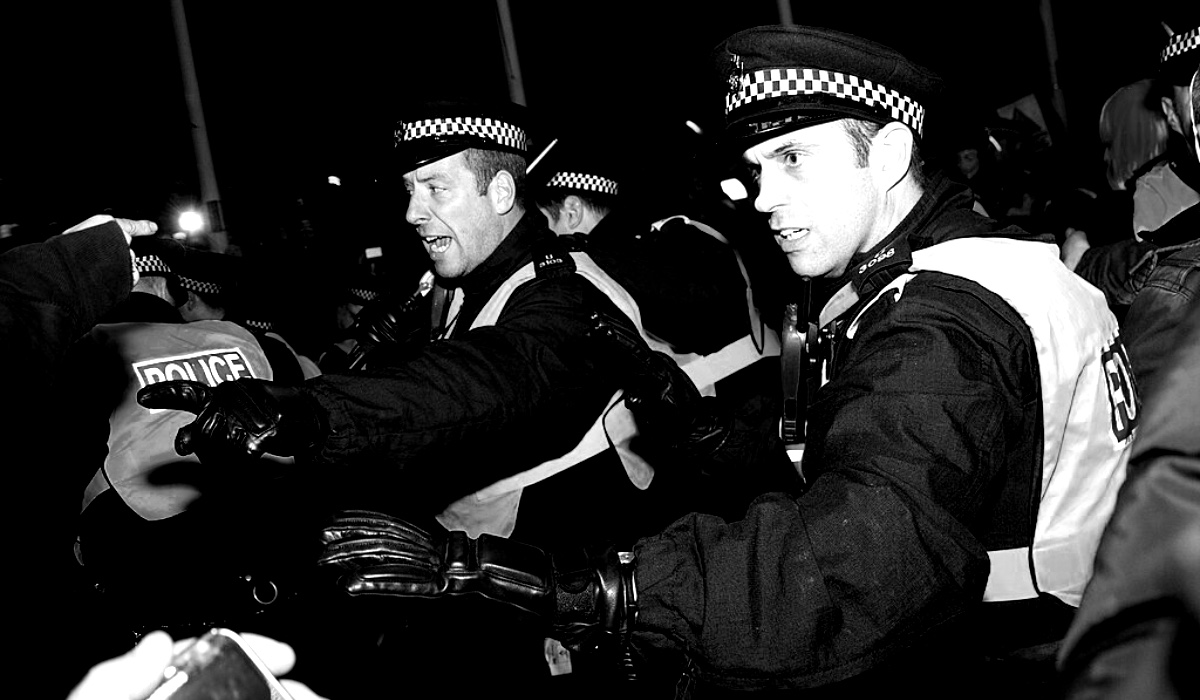
 Met Police at an anti-austerity protest in London, 2013. Photo: Andy Thornley, CC BY 2.0
 Tranche 3 (T3) of the Skycops Inquiry re-opened this week and will investigate the actions of the Special Demonstration Squad (SDS) from 1993 to its disbandment in 2008 reports James Simpson
Former Commander of The Metropolitan Police Special Branch Dennis ‘Ben’ Gunn left jaws on the floor as he attempted to defend the indefensible and blame the untouchable whilst giving hearing evidence at The Undercover Policing Inquiry (UCPI) this Monday 20 October.
The UCPI into the Spycops scandal rolled on with a ghost from Christmases past. One of the most senior officers to date to give evidence. Allowed to do so out of sync – his evidence chronologically pertains to events investigated last year – and with special parameters to disbar follow up questioning from the legal teams of other core participants; nevertheless, caused a stir around the conference hall at the International Resolution and Dispute Centre by St Paul’s Cathedral in central London.
Blame game changes sides
In a vitriolic, hyperbole ridden appearance, where Gunn, more than once, proclaimed that his appearance on a BBC documentary in the early years of the new millennium was all that prevented the toppling of the government of the day, went in two footed on the Home Office, MI5 and current Commissioner of the Metropolitan Police Service (MPS) Mark Rowley. And who were the noble bastions of the flame of freedom this octogenarian was going into bat for? None other than the white knights of the Special Demonstration Squad (SDS), in their brave quest to flounce about London preventing the subversive intent of peace campaigners, anti-fascists and animal-rights activists.
Gunn repeatedly bemoaned the way the UCPI, and public at large portrayed these brave serving police officers. As they broke the law with impunity, deceived women into long-term relationships, used dead children’s identities for their cover names, reported on the relatives of murdered ethnic minorities and the plethora of other supremely justifiable actions SDS officers got up to under his watch. All in the name of distorting the power dynamics and social relations between the people and their much better-informed masters.
Amnesia is a cruel and convenient crux to bear
Of course, there was the usual splattering of selective short-term memory loss that seems to be rampant in SDS officers. Probably nothing to do with their overbearing weight of their conscience.
SDS officer John Dines gets arrested twice in his deployment once in Hereford and again in London protesting the introduction of the Poll Tax. The latter was ‘for being involved in assaults on uniformed police officers’ which, it is arranged, he skips bail from, as he is found to be in possession of, and arrested under, a third identity (second false one) …Gunn has limited memory of the one arrest at the Poll Tax protest. Decide Dines skipping bail was the ‘lesser of two evils’ due to his unsanctioned use of a second dead child’s identity, Wayne Cadogan. The arrest he does not remember in Hereford, involved Dines being part of an action with a group of animal-rights activists. This ended in the bringing of a formal complaint against their unlawful arrest by West Mercia Police Force. A complaint that he was allowed to pursue, with Gunn’s knowledge and blessing, albeit down the memory hole now, in his sanctioned cover name of John Barker.
SDS officer Stefan Scutt, breaks down and is arrested in York, sleeping rough, and spilling the secret beans of the SDS to the police force detaining him…. Gunn cannot remember the drive to York and back to retrieve the situation. Nor asking the force there to release Scutt and destroy their records. Nor the circumstances that lead to him being medically retired on a full pension… Of course, we have all driven the full length of the country to ask a police force to release an undercover officer (UCO) and destroy any records about him in many a fugue state. However, this normally meant there was a rave somewhere along the timeline. Gunn was not asked about whether he packed his glow sticks for the Scutt retrieval mission.
Gunn has no memory of any contemporary knowledge of any intimate sexual relationships any SDS officers at the time deceptively entered into. Despite that accounting for parts of John Dines, Andy Coles, Trevor Morris, ‘Matt Rayner’, and Bob Lambert’s deployments. All of which did deceive women into relationships whilst undercover. The latter of which fathered a child. Nor does he recall any SDS interference in the 1988 trials of Geoff Sheppard and Andrew Clarke, for planting incendiary devices in branches of Debenhams, despite Lambert reporting on it, having had clear involvement in the plot (not to mention him likely having planted one such device during the action in the Debenhams in Harrow (see Robert Lambert in the 1980s: Frankenstein’s monster grows up).
Much of this oversight is attributed to Gunn’s attention being drawn by the Lockerbie bombing which he mentions on numerous occasions, although the inference he intended is unclear.
Animal wrongs
‘On 9 June 1988 — or was it 6 June, I can’t remember, but it was June 1988, Margaret Thatcher was discussing with her Principal Private Secretary Robin Butler about the threats posed to this country by animal extremists. Margaret Thatcher was glowing in her praise as to how the police were dealing with the threat by animal extremists. Margaret Thatcher then offered a suggestion to Robin Butler, had the police considered undercover operations? Happily, we were able to tell the Home Office, who were also involved in the tripartite chat, that we had been doing it for 25 years.’
This takes some unpicking. Thatcher, old friend of Bicester Hunt Master Colonel Peter Farquharson, targeted by the group of hunt saboteurs Bob Lambert infiltrated, can well be considered coy enough to make sure in meetings like this to not surmise on something illicit that she fully well knows has happened. In the next meeting, she probably remarked, ‘you know it would have been a jolly good idea to imbed spies in mining communities and the National Union of Mineworkers during the strike…is that something with which we could look into in the future?’
There is no element of surprise in the unit’s existence nor from Thatcher or from the Home Office noted in the statement. In fact, Gunn explains that the Home Office was well aware of the SDS, partly funding its activity for over half of its known lifespan. He discusses meetings on SDS funding with, Peter Phelan, Deputy Assistant Commissioner of the MPS, and John Chilcott, then a senior Home Office civil servant. The same Chilcott that would be just the chap when it came time for the public inquiry into the Iraq War. Previously, UCOs that infiltrated left-wing groups have said that their reporting was shared with government departments. Mark Kennedy bragged his reporting on actions surrounding the G8 summit in Gleneagles was read by Prime Minister Tony Blair. SDS officers Roger Pearce and Trevor Morris have intimated non-specifically that their reporting was shared with government departments. This was the first time that such a senior figure has detailed specific examples that SDS deployments were, at least some of the time, being influenced by the Home Office and Downing Street. This will have raised an eyebrow from the black family-justice campaigns spied on by the SDS. Particularly the one following the murder of Stephen Lawrence, that strongly insinuated this exact directorship from the Home Office during their opening Tranche 3 statements (see Gloves off at the Undercover Policing Inquiry).
The quotation also insinuates that the animal-rights movement was spied on for much longer than the five years or so of SDS infiltration that we know of to date through the UCPI and the work of the activists spied upon. Even given an older gentleman clearly possessed with a great deal of self-importance, and given to hyperbole, there is quite the difference between five and twenty-five years, which, if true and accurate, would mean animal-rights groups were being spied on in some way, before the SDS had even been formed in 1968.
The return of a few bad apples and where the finger of guilt lies
Gunn, if his appearance at the UCPI is any indication, is an angry man. Angry at the Inquiry. Angry at the Home Office. Angry at the apologies by MPS Commissioner Mark Rowley. Angry at the security services. Angry at the previous police investigation into the Spycops scandal. Angry at ‘animal extremists’. Angry at Ken Livingstone. Angry at all the subversive misfits that dared dream of a better world or democratic freedoms.
However, SDS officers, not so much. The UCPI ’doesn’t understand’ the nature of their work. It has misrepresented the SDS by highlighting a few bad apples, when, the vast majority of SDS UCOs protected this green and pleasant land, from the commies, the anarchists and the outsiders that didn’t think it was right for cats to be experimented on to make more appealingly fragrant deodorant. Even his own apologies to the women deceived into long-term sexual relationships are shrouded in this lack of understanding about the positions UCOs in the SDS could find themselves in. Overall, the Metropolitan Special Branch and SDS, especially Dennis Gunn, knew what was best for us all.
Except when they didn’t. Except when the shots were being called by the Home Office or MI5. Gunn prevaricates quite a lot on this. When asked directly about the Home Office directing deployments, he says they would sometimes ‘offer advice’. However, he had earlier stated; ‘[In] The matters of the SDS, it was a highly sensitive and secret operation [Restriction Order] and it was on behest of the Government and the Home Office that we performed such duties.’
Gunn also says that ‘Racial violence was endemic within society. As far as we were concerned, we were tasked as Special Branch to provide intelligence to our uniformed colleagues, to the Security Service, to others, to deal with extremism in whatever form it reared. And if it was racial issues, then it was against those that we targeted.’
Aside from the fact that he means racist violence, Gunn’s time as a commander in the Metropolitan Police Special Branch overlapped with the murders of Roland Adams and Trevor Monerville. Black men whose families were spied on by SDS officers and gave moving testimony in Tranche 2 last year. Are the extremists that he speaks of here communities coming together to fight for justice? Is he indicating that the security services had particular interest in this type of campaign? This again will echo throughout Tranche 3 of the Inquiry when the spying on the families and justice campaigns and campaigners for Stephen Lawrence, Ricky Reel, Michael Menson and Cherry Groce will be investigated further.
In total, the transcript of his hearing testimony mentions the Home Office eighty-two times and the Security Service thirty times.
Legitimate sharing of intelligence and illegitimate reporting of his own words
McLibel. The longest civil trial in UK history. Based upon a leaflet handed out by environmentalists concerning why they thought McDonalds was bad. Bad for workers, the environment, your diet, animal welfare and was aggressively marketed at children. Things taken as read now was enough to get the legal bigwigs at McDonalds in a massive froth then. The leaflet detailing this, called ‘What’s Wrong with McDonalds?’ was partly written by Bob Lambert. John Dines was a defendant in the writ (before his name was dropped) brought by McDonalds. Sid Nicholson, a former MPS Chief Superintendent was one of a number of private spies and former MPS officers that McDonalds employed to monitor the activists of London Greenpeace alongside SDS officers. Particularly Helen Steel and Dave Morris, the co-defendants in the trial. Dines deceived Steel into a long-term sexual relationship. So, what was Gunn’s take on information sharing between the MPS and corporate interests, like McDonalds, at a time when The Economic League still ran blacklists throughout the UK public and private sectors?
‘A … It was good practice for police in possession of intelligence about threats to industry, commerce and whatever, to share that information with those potentially affected.
Q. Presumably
A. — shops
Q. — wider than just McDonald’s?
A. Oh, absolutely. McDonald’s was just one of a number of organisations.’
In the context of blacklisting, and particularly the exclusion of Blacklist Support Group chair and blacklisted construction worker Dave Smith, these words must stand out, especially in light of his exclusion from the list of people giving hearing evidence in Tranche 3 (see Spycops – undercover and unaccountable).
One last fly in the ointment for Gunn was the use of one of his own historical witness statements into undercover policing against him. Operation Herne was an internal police investigation conducted by an external force into the SDS more than a decade ago. It has been used, much to the chagrin of former SDS officers, to highlight discrepancies between what they would say to an internal investigation against what they would like to admit to a public inquiry. Gunn was livid about this. Repeatedly questioning the ethics of its use. For him, this may be the biggest injustice of the whole Spycops saga. Or so it would seem from Monday’s performance. For instance, in Operation Herne, he gave witness testimony that he was unaware of the practice of using dead children’s identities for the cover aliases of SDS officers. A decade later, when that position became untenable in the gaze of a public inquiry, his remorse at the upset this caused affected families, is overshadowed somewhat by his incandescence at the use of his own words against him.
And that in a nutshell is the former Commander Metropolitan Police Special Branch, Dennis Gunn. A man who repeatedly liked to say how his choices were often like ‘being caught between a rock and a hard place’ once again caught in that metaphorical stupor, and coming out swinging at some of those above, but mainly at those below. A very senior officer that has drawn back quite a bit more of the curtain hiding the UCPI final reports and analysis. A disappearing shroud that reveals, little by little, more of the words, ‘political policing’.The inquiry into Spycops continues in Central London and online. Visit the Undercover Policing Inquiry website for more information on forthcoming hearings, past evidence and how to attend at Undercover Policing Inquiry: Official Website. And look out for the campaign websites and social media of Police Spies Out of Lives, Campaign Opposing Police Surveillance, and the Undercover Research Group for more research, reports and analysis.
Before you go
The ongoing genocide in Gaza, Starmer’s austerity and the danger of a resurgent far right demonstrate the urgent need for socialist organisation and ideas. Counterfire has been central to the Palestine revolt and we are committed to building mass, united movements of resistance. Become a member today and join the fightback.
