
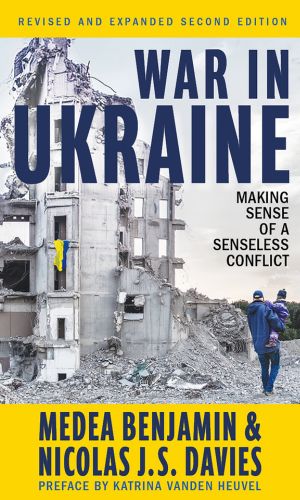
 Medea Benjamin and Nicolas J.S. Davies, War in Ukraine: Making Sense of a Senseless Conflict. Second Edition (O/R Books 2025), 252pp.
The second edition of War in Ukraine emphasises once more how Nato’s responsibility in the war’s origins and continuance must be acknowledged for it to end, argues Paul Buhle
The war in Ukraine needs to end before it diverts still more of the world’s resources into the coffers of military might rather than toward solutions to nuclear proliferation and global warming. The war needs to end because it is a distraction, in the worst way, from the ongoing intensification in the further division of wealth pretty much everywhere. Washington has not been helping, to put it mildly.
The ongoing, unwinnable war prompted a badly confused Joe Biden, near the end of his failing presidential campaign, to reference a recent Nato meeting where his personal leadership guided Nato allies and thereby all the good forces on the planet. It was a moment of extreme confusion for a stumbling candidate unable to separate hubris from reality.
Arguably, he cost Democrats the election, as wars have cost other Democrats past elections. The Ukraine war itself, more than a year later, drags on with no end in sight. Or are we talking about Ukraine and Gaza? Would an elected Kamala Harris have been able to end either one? Her insistence on being entirely in line with Biden, Ukraine, and Israel alike still raises painful doubts about the Democratic Party at large.
The Russians continue, at any rate, to bomb and take further territory from a country ruled by martial law, with zero civil liberties and a population that has in large part fled, down a quarter since 1991. The West, aka Nato, aka the US State Department, apparently seeks goals as unlikely to be achieved as Putin declaration a while back that Ukraine is not really a separate country from Russia, thus suitable for wholesale conquest.
The horror can’t last forever, of course. But happily, from a Western point of view held for more than twenty years, Putin’s Russia, aka the Russian Menace, is in terrible shape and destined to collapse, prevented from collapse only by the super-authoritarian government. Or maybe not?
Two large display pages in the 31 August issue of the New York Times (‘Russia Distracts Its Citizens from War with Nonstop Festival’) depicts something startlingly different: Moscow in festival mode, seemingly with good reasons to celebrate. Russians, at least a large class of urban Russians, appear to be living better than ever. New subway lines grow up overnight. Slick and efficient, electric-powered buses appear as if by magic. The streets are clean and safe. The payout to war volunteers may not be as large as enrolees for Ice operations, but seems to be sufficient to maintain troop levels. People seen on the Moscow streets appear to be happy, despite the war’s continuation and the occasional blackouts from Ukrainian bombs.
As Mad Magazine used to ask, ‘WHA….?’
Nato’s hubris
How did all this happen and did it need to happen at all? We turn to the second edition of War in Ukraine. The editors note, ‘We wrote the first edition in record time, two months, without knowing how the war would evolve or how it would end, but with the knowledge that the consequences … will likely be with us for decades’ (p.9). They are obviously hoping, somewhat wistfully, that another edition will never be necessary.
We need to go back to the roots of the conflict, which could take us back across the twentieth century, but more briefly takes us to 1991 and the dissolution of the Soviet Union. The many newly-independent regions, mostly run by small cliques willing or eager to gain money and power from international investor-allies, found themselves in conflicts over borders and resources. Although the writers of this book do not say so, the pre-1914 world of uncertain nationalities, frequently shifting borders, and large folk-culture areas indifferent to any specific national state, had come back to life. However, with more to sell and more buyers with more guns to buy and to use.
Looked at from another standpoint, as the authors say, Nato and the Warsaw Pact in effect had actually agreed, until 1990, to maintain a quiet border. Then the Warsaw Pact dissolved. Logically, Nato had finished its mission. Instead, it actually ‘looked for new missions and new justification for its continued existence in the post-Cold War world’ (p.135).
The authors point to the Balkan wars as the first turning point. The talk in 1990 of actually disbanding Nato, with the Russian threat gone, had dissolved most amazingly into American plans and dreams of expanding the alliance. Secretary of State James Baker had assured the Russians only yesterday, so to speak, that ‘not an inch of NATO’s jurisdiction will spread in an Eastern direction’ (p.130). President George H W Bush seemed to send off conflicting signals. Bill Clinton, the first Democratic president since Jimmy Carter, warmed to the prospect of a fresh expansion, rebutting familiar Republican charges that Democrats were weak on national defence.
And yet, for a few years, things seemed to remain fluid or at least contested at the highest levels. In 1996, ‘fifty prominent foreign policy experts urged President Clinton to stop NATO expansion eastward, calling it a policy error “of historic proportions”’ (p.132). Nato moved ahead anyway, adding Poland, the Czech Republic, and Hungary, altogether moving right up to the Russian border. In a Times op-ed of 1997, Cold War savant George Kennan repeated the warning note, noting that Russian leaders would not be assuaged by US promises of no hostile intent.
Still, under the bumbling feet of Boris Yeltsin, losing population and losing resources to financial barons inside and increasingly outside of Russia, the shattered state was in no shape to respond. Derided internationally as a third-rate power and in no apparent mood for recovery, Russia took the blows. Then came Putin, arriving as a reformer and promising much for a country on its back foot. And then came a different Putin, Menace to the World.
Paths not taken
The section of War in Ukraine most difficult to digest is the indelicate dance of how the conflict might have been prevented or stopped a half dozen times before the 2022 invasion. The writers do not justify the invasion, which they rightly regard as tragic and dreadful. In the same breath, they insist that it was far from inevitable, and that the Russian leadership looked repeatedly for some way out.
Biden’s 2024 State of the Union address remains notable, to some insiders, for his announcement that Victoria Nuland had retired. Architect of the overthrow of the Honduran government in 2009, under the guiding hand of State Department Secretary Hillary Clinton, the neoconservative Nuland had always been a hardliner. It is no surprise, then, that she played a central role in events of 2014-15 and successive developments. A regional conflict that Nuland likened to the Second World War, it might easily have been halted early on. Or at least some diplomats on both sides thought so, even as events moved out of control.
A twenty-first century succession of corrupt presidents of the Ukraine had helped lead the way to disaster. So did the rise of a new right in the Ukraine, around a very real, avowedly pro-fascist Azov Battalion, never a viable electoral force but supplying the shock troops for internal conflict. All this was destined to awaken Russian memories of the Second World War. Zelenskyy’s election, many thought, might actually bring an end to the conflict.
The two Minsk Accords had earlier seemed to mark a path to something better. By 2022, when each side had made gains and losses, and after a considerable expanse of military outlay, one could still believe that each sought a better bargaining position for a deal to settle up. General Mark Milley compared the situation to Europe in 1914: there was no point of going on with a war but the war went on anyway, accompanied by vast, and at least for Europe, destruction unprecedented since the 1940s. Biden disagreed with Milley and so did Congress. A vast new supply of arms seemed more in line with Nuland’s worldview: now was the time for a sort of showdown with Russia, fought within Ukraine.
Pentagon documents later leaked nevertheless suggested that the Ukraine’s Spring Offensive of 2023 was not going to be decisive in pushing the Russians into surrendering their demand for control of two provinces and the Crimean peninsula. A former spokesman for Zelenskyy noted that no more than 20% of Ukrainians embraced the anti-Russian nationalism expressed so fervently by the politicians in charge. Peace proposals came from all across the world, and continue to come, some of the most eloquent from Africa, Latin America and the Papacy. To no avail.
The authors repeat, in conclusion, their earlier insistence (p.127) that without Nato’s expansion eastward, Russia would not have invaded Ukraine. Although we cannot absolutely either prove or disprove this claim, what we can say, with the authors, is that the continuation of the conflict blocks escape routes from ecological destruction and threatens to breach the nuclear threshold.
‘At least in the short term, an invasion by Russia designed to deter NATO actually united, strengthened and further expanded it. But wars have a way of becoming unpopular very quickly’ (p.145). We may wonder. And worry. The authors conclude, in sum, that Nato, urged on by Biden and the State Department, made a bad situation worse. With that conclusion, the reviewer agrees wholeheartedly.
The second edition of War in Ukraine is available from O/R Books.
Paul Buhle is an aged radical who published the magazine RadicalAmerica for the new left, wrote the authorised biography of CLR James, and has edited twenty historical graphic novels.
Before you go
The ongoing genocide in Gaza, Starmer’s austerity and the danger of a resurgent far right demonstrate the urgent need for socialist organisation and ideas. Counterfire has been central to the Palestine revolt and we are committed to building mass, united movements of resistance. Become a member today and join the fightback.
