
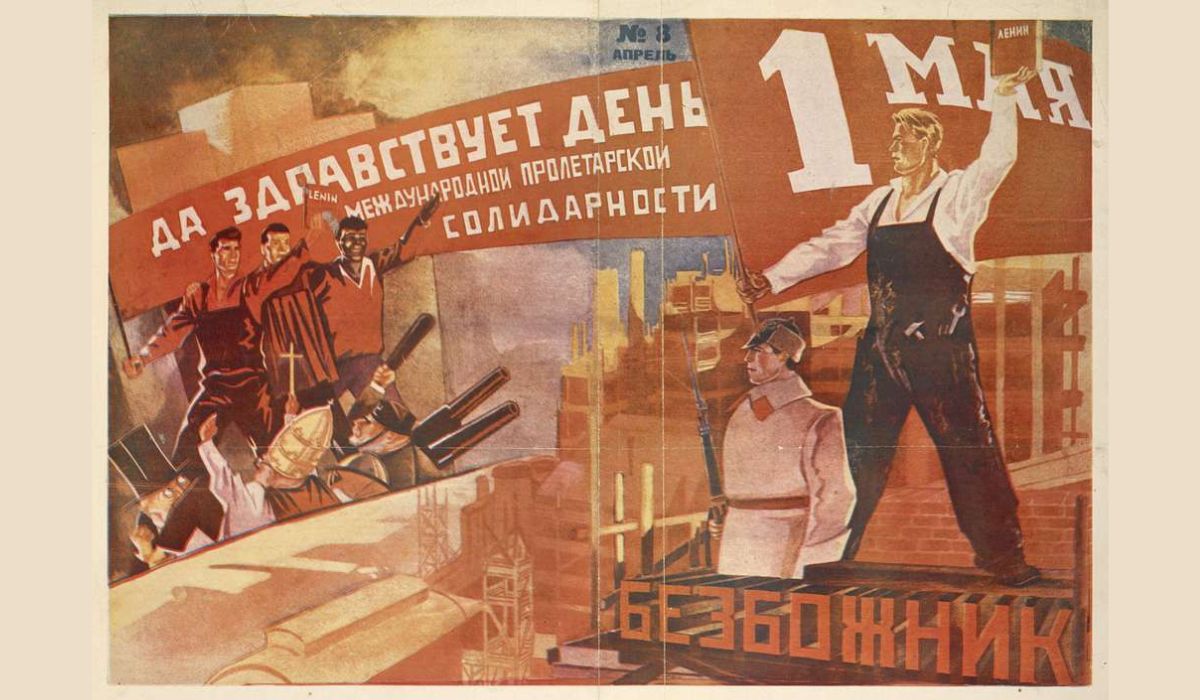
 Bezbozhnik u stanka - Long live the Day of International Proletarian Solidarity. Source: New York Public Library - Wikicommons / cropped from original / public domain
In the latest in his series on socialist ideas, Alex Snowdon discusses why Marx was, before all else, a revolutionary
The experience of revolution shaped Karl Marx’s life and ideas. The French Revolution, the revolutionary uprisings of 1848-49 and the Paris Commune of 1871 were huge factors in his political development.
Marx was, before all else, a revolutionary. He was not merely a critic or analyst of capitalism. He was committed to the revolutionary overthrow of capitalism by the working class. His deep work in analysing the system’s laws and mechanics, published in three volumes of Capital, was geared towards ending capitalism.
The French Revolution (1789-94) shaped the outlook of radicals belonging to Marx’s generation. Marx, born in 1818, grew up in a Europe influenced by the radical, egalitarian ideals of the revolution. However, it was also a climate shaped by the lack of fulfilment of those ideals.
This was true at the formal political level. In France, democratic ideals had given way to varying degrees of authoritarianism after the rise of Napoleon in the 1790s. Elsewhere, there was little democracy or real political liberty.
At a deeper level, there was little to celebrate in the social misery of early industrial capitalism – the long working hours, poverty, overcrowded slums and rampant disease described eloquently by Marx’s collaborator Engels in The Condition of the Working Class in England. The French revolution and the industrial revolution were the twin revolutions that conditioned Marx’s development.
The massive Peterloo demonstration in 1819, brutally repressed by the British state, expressed the working-class yearning for democracy and liberty. This mattered so much to workers because political rights, they realised, were crucial to advancing their material interests.
This was also a feature of Chartism, the world’s first working-class mass political party, in the late 1830s and 1840s. One Chartist orator spoke of the vote as ‘a knife and fork, a bread and cheese question’, meaning that political and democratic rights mattered in order to improve standards of living.
Marx’s understanding of revolution and social change was built on this fusion of the democratic and the social. A democratic revolution would be an advance, but insufficient. What really mattered was transforming economic and social conditions.
The bourgeois revolutions, above all the English revolution in the 1640s and the French revolution, had been led by political forces that expressed the growing dominance of capitalism. These forces desired political forms, including a very limited degree of democracy and some political freedoms (for example, freedom of the press and freedom of association), that better suited the new economic and social conditions.
They expressed the interests of an emerging ruling class and the new middle class. They chafed against the old order inherited from the age of feudalism, but they had little interest in satisfying the needs and aspirations of working-class people.
This could be seen in the uprisings of 1848. Middle-class elements like doctors, lawyers and professors were dominant in these revolutionary movements. They asserted their own interests, and those of the industrialists and financiers, but were frightened of awakening popular revolt from below. This made them timid and cowardly.
Marx and Engels were active participants in the 1848-49 uprisings (on its most radical wing) and wrote about them as journalists. Once the dust had settled, though, Marx analysed the contradictions. He identified that the once-revolutionary bourgeois class had become a barrier to further social progress.
Marx concluded that socialists must constantly champion independent working-class interests in the context of any democratic struggle. More than that, the goal should be to turn democratic struggle into a social revolution seeking to end poverty and inequality.
Turning the democratic revolution into a social revolution is what Marx dubbed permanent revolution.
A key discovery for Marx was the agent of this transformation: the working class. As industrial capitalism grew, workers were concentrated into factories and other workplaces, with their conditions under attack as exploitation was increased. Workers would be the gravediggers of capitalism.
In 1871, workers in Paris rose up and took control of their own workplaces and communities. The Paris Commune was crushed after a little over two months, but Marx glimpsed in it the possibilities of working-class revolution.
Crucially, he concluded that the existing capitalist state, with its coercive instruments like the army and the police, must be abolished and replaced with popular, democratic forms. Only workers, acting collectively, could do that.
Finally, Marx observed how socialist revolution (even more than in the French Revolution or 1848-49) could transform the ideas, challenge the prejudices and broaden the horizons of those taking part. In changing their conditions, people changed themselves and their ideas.
Before you go
The ongoing genocide in Gaza, Starmer’s austerity and the danger of a resurgent far right demonstrate the urgent need for socialist organisation and ideas. Counterfire has been central to the Palestine revolt and we are committed to building mass, united movements of resistance. Become a member today and join the fightback.

Alex Snowdon
Alex Snowdon is a Counterfire activist in Newcastle. He is active in the Palestine Solidarity Campaign, Stop the War Coalition and the National Education Union. He is the author of A Short Guide to Israeli Apartheid (2022).