
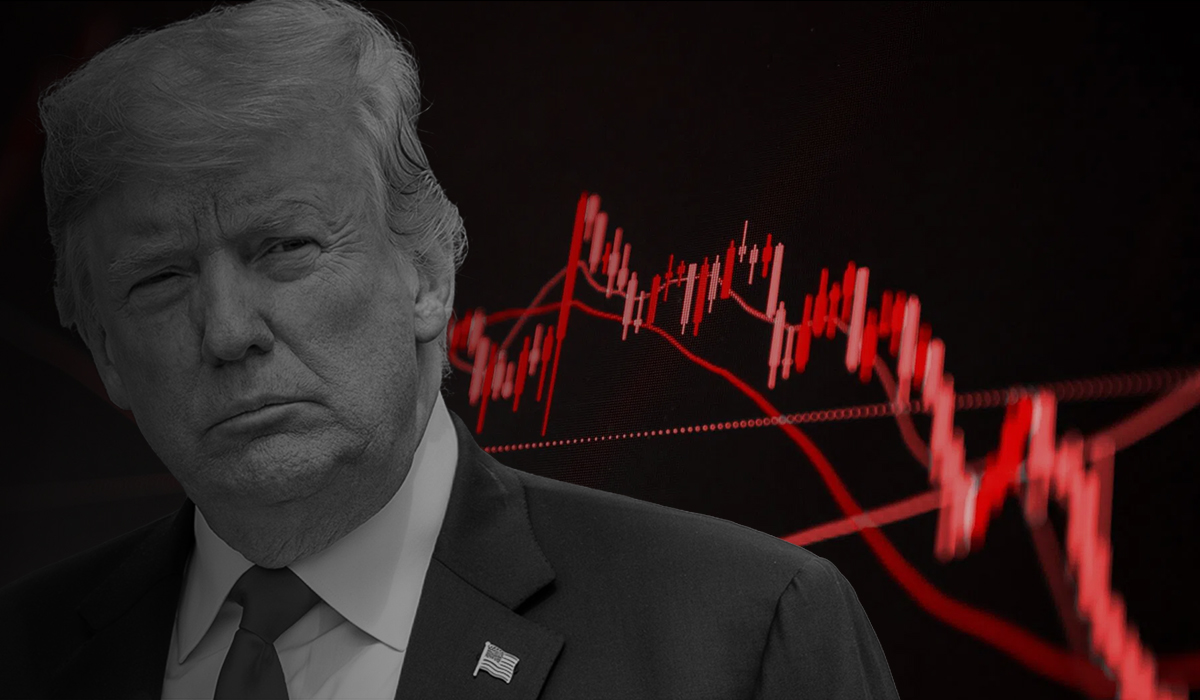
Trump’s twin track of tariffs and deportations to restore American ‘greatness’ are in contradiction with each other, and are damaging the US economy, argues John Clarke
As he pursues his mission to ‘Make America Great Again,’ Donald Trump has embraced an approach that has come to be known as ‘America First.’ His administration has jettisoned a concept of US world leadership that has held sway since the days immediately following the Second World War. Trump isn’t interested in the role of cornerstone of a global order but rather he seeks to use the waning but still formidable economic strength of the US and its huge military superiority to obtain the greatest possible immediate benefits in matters of trade and geopolitical rivalry.
An MSNBC opinion article that was published in June attempted to come to terms with ‘Trumponomics’ and assess the economic strategy that the Trump administration is implementing. Pointing, with some justification, to the erratic and unpredictable conduct to which Trump is prone, the article nonetheless identified some of the key elements that are shaping this administration’s actions.
MSNBC notes that:
‘So far this year, Trump has enacted tariffs on nearly every country on the planet; started major trade wars with China, Canada and Mexico; and launched an enormous deportation campaign with still-unfolding consequences for industries such as farming, construction and hospitality. The Republican megabill that includes most of his domestic agenda would slash taxes for the wealthy and cut benefits for the poor, while massively increasing the national debt.’
Trump’s political approaches are very much based on notions of a US ‘greatness’ that has been undermined by hostile forces which must be defeated. Immigrants are to be rounded up and deported, liberal political rivals and meddling federal bureaucracies to be subdued and a regime of centralised executive power is to be established.
In matters of trade, the central proposition is that the US has been cheated by both rivals and avowed allies alike. The remedy is an aggressive turn to protectionism and tariff measures that will tilt the balance of trade and force competitors to establish manufacturing facilities in the US. The restoration of unrivalled manufacturing dominance is a central element of Trumponomics and the broader America First strategy.
Raid on Hyundai factory
The economic dangers involved in Trump’s drive against migrant workers were highlighted by an immigration raid that was conducted last week on a major Hyundai facility in Georgia. According to National Public Radio, ‘U.S. Immigration and Customs Enforcement agents arrested 475 people, most of them South Korean nationals, in a raid Thursday at a massive electric vehicle battery plant under construction in Ellabell, Ga., near Savannah. The plant is a joint venture between Hyundai Motor Group and LG Energy Solution.’
It appears that roughly 300 of those arrested were Koreans and the government of that country, an ally and major trading partner of the US, was taken by surprise and deeply shocked by the raid. South Korean President, Lee Jae Myung, stressed ‘that the rights and interests of South Korean nationals and the business operations of South Korean companies investing in the United States must not be infringed upon.’ Following negotiations, the Trump administration agreed to release the detained Koreans and a plane has been chartered to bring them home.
In assessing the significance of the raid, Steven Schrank, special agent in charge of homeland security investigations for Georgia and Alabama, declared that: ‘We are sending a clear and unequivocal message that those who exploit our workforce, undermine our economy and violate federal laws will be held accountable.’ He stressed, moreover, that the operation was the result of months of careful planning.
For his part, Trump came out clearly in support of the action that was taken by his immigration enforcers, stating that: ‘I would say that they were illegal aliens, and Ice was just doing its job.’ It appears that the investigation that led to the raid found that some of the detained workers ‘had expired visas or had entered on a visa waiver that prohibited them from working’ but the bigger question is the political choice that was made to conduct such a high-profile and large-scale operation at this facility.
A statement issued by Hyundai in March, noted that it was engaged in a ‘$12.6 billion investment in Georgia and the largest economic development project in the state’s history.’ There would be, moreover, ‘an additional $21 billion investment from 2025 to 2028 to drive U.S. manufacturing growth.’
Given the scale of Hyundai’s investments and the degree to which they conform to Trump’s avowed aim of having foreign rivals establish manufacturing facilities in the US, it seems quite remarkable that this carefully prepared and massive enforcement operation was undertaken. Certainly, a more discreet resolution of the matter was entirely possible and it seems that xenophobic zeal is overriding sound judgement, when it comes to Trump’s economic agenda.
The Hyundai raid, moreover, is only a particularly sharp expression of the degree to which the administration’s conduct is problematic from the standpoint of major capitalist interests. Workers without legal status have long been a major part of the US workforce and a ruthless and repressive immigration system has worked to keep them as vulnerable as possible. Trump, however, threatens to take things to a level that cuts into the profits of some of the most exploitative employers.
In June, CNN Business quoted ‘Rebecca Shi, the CEO of American Business Immigration Coalition, a group representing employers with immigrants.’ She complained that recent ‘immigration enforcement raids on businesses nationwide are creating serious challenges for local economies, communities, and industries that depend on immigrant labor to operate and prosper.’
The concerns of Shi and the interests she speaks for are hardly surprising, given that undocumented ‘immigrants make up 4% to 5% of the total US workforce, but 15% to 20% or more in industries such as crop production, food processing and construction, according to Goldman Sachs.’
Economic downturn
On 5 September, Al Jazeera reported that the ‘United States labour market has begun to stall as employers face economic uncertainty due to tariffs imposed by US President Donald Trump and an immigration crackdown that has softened the labour pool.’ The massive US economy was only able to add 22,000 jobs in August and the unemployment rate rose to 4.3%. ‘So far this year, employers have cut more than 892,000 jobs, the highest total since 2020.’
Responding to this news, Skanda Amarnath, executive director of Employ America and a former Federal Reserve economist, spoke of another ‘poor jobs report thanks to tariffs. With the benefit of revisions, it’s increasingly clear that tariffs are weighing on hiring and jobs. Manufacturing jobs are falling sharply, and so are other trade-sensitive sectors like mining and wholesale trade.’
It is clear that the Trumponomics component of the present US administration’s America First approach is running into very major problems. The crude effort to expel the undocumented workers who play such a key role in the functioning of the US economy is producing disruptive effects and economic shocks. The trade-war approach is generating global instability and a dangerous risk of economic slump and it is most certainly not bringing the economic benefits to the US that Trump has predicted.
Having said this, however, it is important to stress that we are dealing with very much more than the failed approaches of a single presidential administration. Trump, after all, is responding to a decline in the hegemonic power of the US and its reduced ability to maintain its leading role within the global order.
It must also be stressed that Trump returned to the White House on the basis of the failures of the Biden administration. That political regime was touted in terms of a restoration of responsible US world leadership and, both domestically and internationally, it failed on its own terms. Biden was unable to save the decades-long role the US has played and simply provided a warm-up act for Trump’s second term.
Now back in power, a more determined and focused Trump regime tries to offer its reactionary solutions to the travails of a declining United States. It is a very dangerous administration that needs to be challenged and defeated but the hopes and assumptions on which its bid to restore US ‘greatness’ are based are proving to be extremely dubious. As a response to the decline of US imperialism, the America First turn is going very badly.
Before you go
The ongoing genocide in Gaza, Starmer’s austerity and the danger of a resurgent far right demonstrate the urgent need for socialist organisation and ideas. Counterfire has been central to the Palestine revolt and we are committed to building mass, united movements of resistance. Become a member today and join the fightback.

John Clarke
John Clarke became an organiser with the Ontario Coalition Against Poverty when it was formed in 1990 and has been involved in mobilising poor communities under attack ever since.