
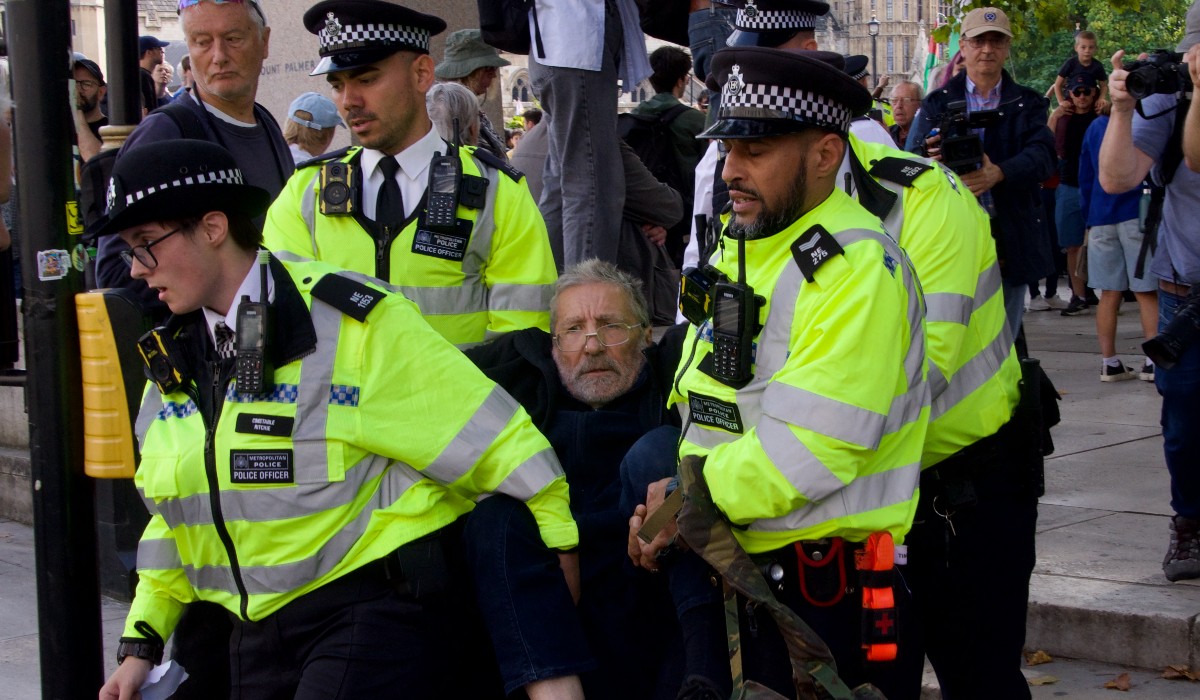
 State oppression in Parliament Square, September 2025. Photo: Indigo Nolan/ Flickr / CC BY 4.0
Lindsey German on the Palestine clampdown and real-time polarisation in UK politics
It’s hard not to see the contrast. Israel’s president Isaac Herzog will be welcomed by government ministers this week on a visit to London. This man signed a missile to be used in bombing Gaza, has supported every one of the genocidal acts of the IDF there, and presides over the illegal settlement of the West Bank and the repression of the people there. He will be treated as an important head of state instead of the war criminal that he is who should be arrested.
The treatment of thousands of Palestine protesters at the weekend was very different. Over 800 were arrested in Parliament Square for holding signs supporting the now proscribed Palestine Action. Police imposed conditions on the 30th mass demonstration organised by the Palestine Coalition which included a ban on drums and pots and pans – one which was widely observed in its breach.
If the intention of the now departed Home Secretary Yvette Cooper when she proscribed Palestine Action was to make the Metropolitan Police look foolish then she has exceeded beyond her wildest dreams. I saw police from as far away as Wales and Humberside brought to London to help arrest people sitting peacefully on the grass, many of them my age or older, simply for carrying a sign. Among those arrested was Sally Groves, one of the main organisers of the famous Trico equal pay strike in 1976. Even the police must ask themselves whether this is the best use of their time and resources.
The repression on Saturday failed. There were in total 1,500 in the square waiting to be arrested. The police said at around 9pm that they were concluding their operation, although it obviously continued for several hours. They did not enforce the ban on percussion and pots and pans. At the same time, they did crack down on Defend our Juries organisers last week, arresting some of them in dawn raids, holding them and then charging them under terrorism laws. They have strict bail conditions which restrict their civil liberties.
In addition, the extensive police powers to limit or ban demonstrations are growing, with new laws aimed at banning marches near synagogues. The Palestine movement has never targeted synagogues or Jewish religious buildings. Our protest is not against Jews – many of whom attend our demonstrations as part of the Jewish bloc – but against the Israeli government. Yet we have been barred from marching through central London to the Israeli embassy and from the BBC for this reason. This is at a time when the police allow aggressive demos outside hotels housing asylum seekers. This is the real two-tier policing.
As Israel becomes ever more isolated internationally, protest is widening and deepening. Every demo we organise has first time protesters and first-time stewards on it. We are seeing flotillas sailing the Mediterranean to Gaza, sent off by huge solidarity demos at ports. Massive protests take place across the world. BDS is biting ever deeper. Celebrities are speaking out, as Hugh Bonneville did at the premiere of Downton Abbey. All of this and more is needed, including industrial action to stop arms going to Israel.
Solidarity is central to the movement for Gaza. I was on both protests in London. We discussed with Defend our Juries and agreed a solidarity delegation following our march which was announced from the stage and thousands joined us. The Palestine movement is one movement. There are many different organisations and different tactics. The mass demonstrations are vital – they have made headlines around the world and the marches in London are some of the largest and most diverse in the world. They also generate huge levels of local activity of various sorts. But we will not be divided. The police and media tried to contrast our demo with the Defend our Juries action, saying that there were few arrests on ours unlike that in Parliament Square. But that was entirely the decision of the police and government – they did not have to arrest totally peaceful participants on a protest, including an ex-serviceman, octogenarians, and people in wheelchairs.
An injury to one is an injury to all, which is why we show solidarity to all those arrested. We will be marching against Herzog on Thursday, which is the best way to defend our right to protest.
Labour’s right turn can be resisted
The cabinet reshuffle shows how weak Keir Starmer is. It has been led from the right and puts some of the worst right wingers in central roles. Shabana Mahmood is likely to be even more draconian on ‘stopping the boats’ than Cooper was. There are fears that the already weak bill on employment rights will be further watered down, now Angela Rayner has gone. There will be more attacks on welfare, as they make the poorest pay for the cost of the crisis. Rayner’s departure has allowed the right to seize more control, and the new cabinet is generally regarded as a shift to the right.
While it’s hard to imagine how much further in this direction Labour can go and still remain in any sense a social democratic party, the whole aim of this government is to out-Reform Farage’s party. Starmer and co don’t seem to realise it isn’t working since they are also some of the most cloth-eared politicians I have ever seen. The Reform conference was an echo of Trump’s rallies, and showed a highly confident Farage, who knows that he is setting the agenda and winning the argument. There is no serious opposition from Labour to Farage, just mimicry or claims that it can be more efficient in stopping migration. Mahmood has already talked about housing asylum seekers in barracks.
Any government that ramps up racism in the name of confronting far-right racism is shooting itself not just in the foot but in the head. At the same time, its wilful refusal to confront the cost-of-living crisis, the housing emergency or any of the other issues facing working-class people, is losing votes to both left and right from Labour. The reshuffle is also causing divisions with sections of the left in Labour. The Norwich MP Clive Lewis is positioning himself for a future challenge. Manchester mayor Andy Burnham has attacked it for being London-centric and we can be sure that there will be a centre-left challenge for the deputy leader post. Even Starmer must be aware that the election of Zack Polanski as Green leader signifies a shift to the left there which will attract former Labour voters, and that the Jeremy Corbyn/Zarah Sultana project is waiting in the wings.
At the moment however the dominant political narrative in Britain is to the right. Starmer’s government is accommodating to that over racism, foreign policy, and workers’ rights. We need a left alternative, and the Your Party development is much too slow, creating a vacuum which will eventually be filled by other forces. The importance of struggles – that over Gaza, against the far right, for strike solidarity with the London tube workers this week – is crucial in providing a counterweight to the politics of scapegoating and genocide.
This week: a lot happening. I’m off to the TUC on Tuesday for the Stop the War fringe meeting, then to Bristol on Wednesday for a Counterfire meeting on the Spycops scandal. Thursday I will be protesting against Herzog at a place tba. All of these will be harder because of the tube strike, but I fully support the RMT members taking action. They are some of the best-organised workers in London and do an amazing job running our transport system safely. If they win, we all win. On Saturday 13th I will be at the counter-protest against the Tommy Robinson demo, which I hope everyone who can will join to stop the scapegoating.
Before you go
The ongoing genocide in Gaza, Starmer’s austerity and the danger of a resurgent far right demonstrate the urgent need for socialist organisation and ideas. Counterfire has been central to the Palestine revolt and we are committed to building mass, united movements of resistance. Become a member today and join the fightback.

Lindsey German
As national convenor of the Stop the War Coalition, Lindsey was a key organiser of the largest demonstration, and one of the largest mass movements, in British history.
Her books include ‘Material Girls: Women, Men and Work’, ‘Sex, Class and Socialism’, ‘A People’s History of London’ (with John Rees) and ‘How a Century of War Changed the Lives of Women’.