
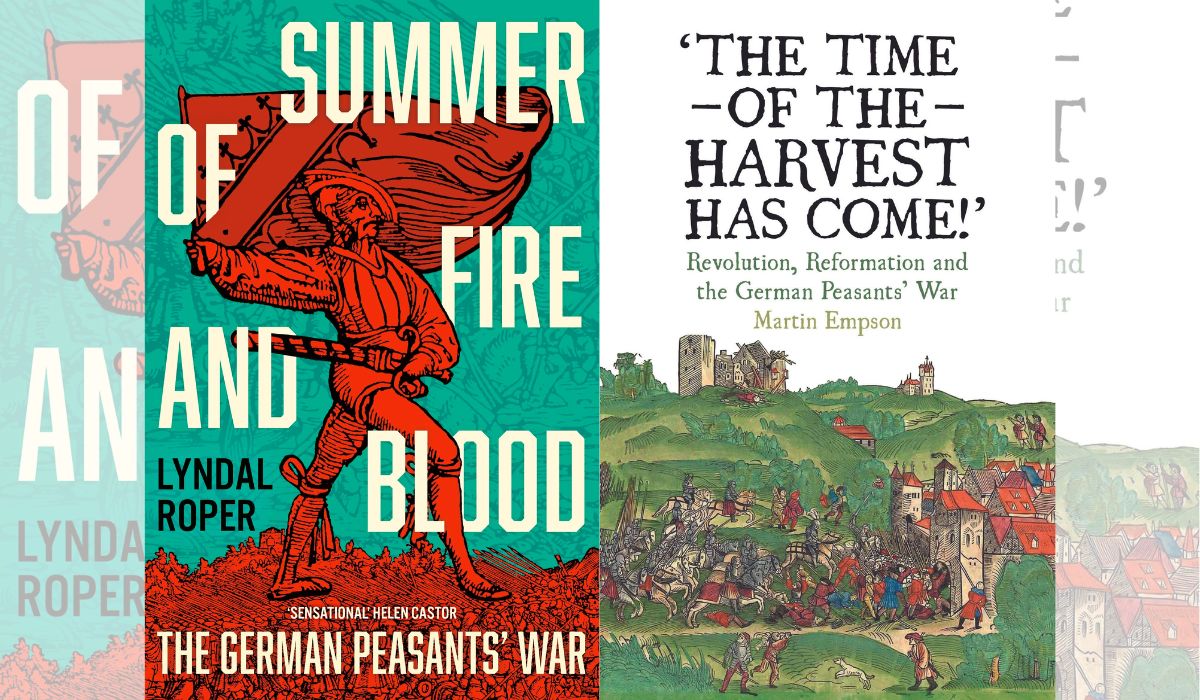
 Lyndal Roper, Summer of Fire and Blood: the German Peasants’ War (Basic Books 2025), 544pp. / Martin Empson, ‘The Time of the Harvest Has Come!’ Revolution, Reformation and the German Peasants’ War (Bookmarks 2025), 245pp.
Two recent books on the sixteenth-century German Peasants’ War reveal the importance of this episode in the history of class struggle and revolution, finds Dominic Alexander
The German Peasants’ War of 1524-5 can be assessed from two directions. From one vantage point, it was the last of the great medieval peasant revolts; from another, it was an early, albeit defeated, bourgeois revolution. Lyndal Roper’s comprehensive study, Summer of Fire and Blood, firmly rejects the latter interpretation, but rather situates the events firmly within their context of the opening act of the Reformation, which would convulse Europe for the next two centuries. Martin Empson in ‘The Time of the Harvest Has Come!’ covers the same ground, but does give careful consideration to the question of the War’s place in the history of bourgeois revolution.
In rejecting particularly East German socialist traditions about the war, Roper also downplays the role of the best-known revolutionary leader, Thomas Müntzer, choosing instead to highlight the range and importance of other preachers and leaders of the rebels in their increasingly radical demands over the course of 1524-5. Müntzer has been well treated recently in Andrew Drummond, The Dreadful History and Judgement of God on Thomas Müntzer, and Roper does admit that he ‘remains the theologian who articulated social justice like no other’ (p.326), so he can’t be dispensed with entirely, however interesting other figures might be. Even so, in her concluding section, Roper insists that ‘if we have lost Müntzer as a revolutionary hero, we have gained a far wider sense of the Reformation as a dynamic and variegated movement’ (p.384). It is quite possible to agree with the second half of this judgement without endorsing the first, which is broadly the view of Empson’s less grudging appraisal of Müntzer.
The Peasants’ War was not an unheralded convulsion, but had been anticipated by decades of smaller-scale peasant risings important enough that we would be discussing them even without the events of 1524-5. Significantly, these revolts were also imbricated with religion, beginning in 1476 in Niklashausen in Franconia where a shepherd drummer had a vision of the Virgin Mary telling him: ‘Say to all the people that my son wishes and orders that all tolls, levies, forced labour, exactions, payments and aids required of the prelates, princes and nobles be abolished completely and at once’ (Roper, p.10). Thus began the movement of the Drummer of Niklashausen, whose visions soon also told him that ‘fields and woods must be held in common’. This episode ended with peasants being massacred, and the Drummer being burnt as a heretic, but it contained the main elements that would reappear in the 1520s.
Elsewhere, peasants were engaged in rent strikes, refusing labour services and feudal exactions, and forming leagues bound by oaths, again all to be repeated later. These widespread actions coalesced into the ‘Bundschuh’ revolts, so-called because the peasant shoe of that name was used as a banner symbol, punning on the word for a union, ‘bund’ (p.12). In 1502, A Bundschuh conspiracy was led by a peasant soldier called Joss Fritz, who reappeared again in 1513 and then once again in 1517. In 1517, he led a large revolt in Breisgau, where peasants used a flag of Christ, Mary and John the Baptist, called for woods and rivers to be common land, and for there to be no lords but the pope and the emperor (p.13).
In this last demand, they echoed the revolutionary demands of the peasants in England in 1381, who called for the abolition of all authorities save the king and one archbishop. Martin Empson points out that Fritz’s 1517 attempted revolt depended upon a layer of organisers beneath him travelling between villages and towns in the Rhineland (Empson, p.22). The scale of peasant organisation lying behind mass revolts is often underestimated or dismissed, but is on good display here. Fritz himself reappeared a final time during the Peasants’ War.
Causes of the revolt
The Peasants’ War that began in 1524 was, however, on a whole different order of scale both in numbers and geographical breadth than these earlier revolts, and while those do give an indication of peasant communities’ capability for organised mobilisation, the rapid spread of Martin Luther’s new theology gave a new ideological coherence and force to the risings. Luther’s attacks on the worldliness and corruption of the Church aligned with existing resentments and anti-clericalism, as many parts of Germany were ruled by ecclesiastical lords. Together with the democratising implications of Luther’s early radical pronouncements, rapidly taken up by popular preachers, conflicts over feudal impositions rapidly cross-fertilised with religious agitation to produce a revolutionary programme across wide swathes of the realm. Again, some of the Lutheran demands were anticipated in the earlier movements. For example, a demand attributed to the 1502 revolt was that peasants should control the appointment of clerics and priests for their localities, and there were plans to sack monasteries, as they did in 1524-5 (Empson, p.21).
The risings were alleged to have begun with a dispute over an apparently trivial, but clearly infuriating, demand of labour service. This was a countess’s demand, on a village near the Swiss border, that peasant women collect snail shells for court women to use as spools, ‘emblematic of the collapse of reasonable relations between lords and peasants’ (Roper, p.28). These peasants rose up in June, but nearby in May, peasants had also risen against the monastery of St Blasien. Once the peasants had drawn up their list of grievances, the snails did not feature, but a range of issues around feudal exactions and common resources did: ‘It was an indictment of an entire system’ (Roper, p.29).
Roper sees the revolt against feudal obligations as in a sense paradoxical, as ‘peasants were well off and their legal situation was secure’, at least in some areas like Thuringia. Certainly the rebellions were concentrated in the most commercialised areas, Franconia, Thuringia and Alsace, rather than in eastern regions where lordship was stronger. Nonetheless, Roper concedes that there had been poor harvests leading up to the revolt, and that ‘peasants felt [conditions] were worse because they were becoming less submissive’ (Roper, p.50).
The picture would thus be that the commercialisation of the economy offered peasants new economic opportunities such that feudal obligations were more visibly limiting than before. However, Empson points out that the commercialisation of agriculture was an opportunity for lords and a minority of wealthier peasants, but landless peasants found their wages squeezed, and lords were endeavouring to reassert their feudal powers (Empson, pp.10-11,15). Far from the peasantry being largely prosperous, poverty was rife. In Saxony, between a quarter and a half of the rural population was immiserated, and in Thuringia two thirds were landless (Empson, p.40).
Roper occasionally seems oddly dismissive of the peasants’ anger at feudal dues: ‘The dues that serfs had to pay and the symbols of their bodily subjections – the best hen, some eggs, a coin – may have been humiliating, but they were scarcely oppressive taken singly’ (Roper, p.52). On the contrary, one would think that however trivial they might seem, they were clearly an unjust burden to people whose margins would have always been quite narrow. Moreover, it must be borne in mind just how heavy were the various layers of exactions on peasant production overall, as Roper notes a little later. ‘Taken together, the dues owed to the lord could be crippling: on some monastic estates in the southwest, it has been estimated that the monastery got between 20 and even up to 40 per cent of the crop’ (Roper, p.55). Claims that rising prosperity lie behind revolts have often been made by historians, but, as in this case, are never really convincing.
The gemeinde and the Reformation
The developing late feudal economy, with its premonitions of capitalism, may have provided much of the contradictory tinder for the Peasants’ War, but increasing divisions between rich and poor peasants had not yet drained the peasant community of vitality. Roper rightly gives the village assembly, the gemeinde, considerable prominence in her account of the risings. The gemeinde managed the collective concerns of a village, including upkeep of the local church, and was generally independent of the lords. It was sometimes monopolised by the richer peasants, but kinship ties ‘would have undercut wealth consciousness’ (Roper, p.42).
It hadn’t, therefore, yet become an instrument of class domination, although the exclusion of women did make it a patriarchal one. Nonetheless, it was the key node of organisation through which the risings were organised, and neighbouring communities were drawn into the revolts through appeals directly to their gemeinde. Crucially also, towns still had gemeinde organisations, which were usually far more democratic in nature than the governing town councils. It was through the former that rebels often appealed to townsfolk to join in the rebellion, which they frequently did, in opposition to patrician-dominated councils.
The peasant demand that they should have the power to appoint and dismiss their community’s priests would have centred on the gemeinde also, of course. This demand, above all others, exposed the revolutionary democratic implications of the Reformation Martin Luther had begun in Wittenberg. After Luther had had to flee into hiding, his ally Andreas Karlstadt oversaw radical changes in Wittenberg religious practice. Communion in both kinds was given to the laity, the liturgy was spoken in German rather than Latin, images were removed from churches, and plans were drawn up to use the wealth of the monasteries as sources of support for the poor. Across Germany, as Luther’s ideas spread, monks and nuns began abandoning their vows in droves.
This radicalism was suddenly reversed by Luther in 1522 on his return to Wittenberg, as he reversed iconoclasm and restored the Latin mass, but he was unable to contain the radicalism that he had already unleashed. Early on, he had written a tract called On the Freedom of the Christian, which claimed that a ‘Christian is an utterly free man, lord of all, subject to none’, a notion whose social implications were enthusiastically taken up as justifications for revolt by the peasants, who also embraced the tenets of the justification by faith alone, and the priesthood of all believers. Luther rapidly resiled from his emphasis on freedom, which ‘ceased to feature in his theology’ after 1522 (Roper, p.69).
Luther also fell out with his former friend and ally, Karlstadt. Karlstadt’s trajectory became increasingly radical after this estrangement, condemned by Luther as a fellow traveller with Thomas Müntzer, although Karlstadt actually reacted with horror to the latter’s call for insurrection (Roper, p.73). The vast majority were unaware of such growing differences between the major Protestant theologians, allowing Luther’s early emphasis on Christian freedom to knit together the revolt against serfdom with religious revolution in an uncomplicated way.
Popular preachers took up the Reformation message themselves, with ‘well over two hundred preachers’ involved in the War sporting a great range of different views (Roper, p.67), some very radical like those of the ex-monk Heinrich Pfeiffer, a key ally of Müntzer. Radical preachers in towns helped to bring urban populations into alliance with the peasants, as in Waldshut when an evangelical faction around Balthasar Hubmaier took control of the town. In Augsburg, the council’s attempt to expel a radical preacher, Heinz Schilling, provoked a weavers’ uprising (Roper, p.84).
The experience of the revolt led to further radicalisation among many, not least the preachers themselves, although some, like Karlstadt, recoiled. Roper notes two ‘orthodox evangelicals’, Christoph Schlappeler and Sebastian Lotzer, who were radicalised into becoming revolutionaries in the course of a few months in the winter of 1525 in Memmingen, when rebellious peasants streamed into the town, and the two helped draw up the Twelve Articles focusing the myriad issues of discontent into a set of demands put to the rulers of the region (Roper, pp.114-16). By this point, the peasants in the region were organised into a series of armies, but the Twelve Articles synthesised the grievances of townspeople and miners alongside the peasants, all couched in religious language, of course. The air was full of social revolution, and people’s ideas change rapidly during such times. What can be said of preachers like Lotzer and Schlappeler was also true of figures like Müntzer, whose often mystical ideas similarly developed into revolutionary ones in the course of 1524-5.
Antisemitism
It is unsurprising that in all this turmoil, given the prevalence of antisemitic violence in medieval Germany, such ideas would also appeared during the Peasants’ War, but what is also notable is how minor a role these appear to have had. There had been demands for the expulsion of the Jews in Alsace in 1493, bound up with the issue of peasant indebtedness (Roper, p.13), and this reappeared in 1524 in the same region, alongside anticlericalism, since monasteries and Jews both acted as moneylenders (Roper, p.85). Some Jews were expelled from larger towns in Alsace during the War (Empson, p.71), however, while antisemitism had been pervasive in Germany, and appears in a few articles in peasants’ lists of demands, ‘many lists of articles do not refer to the Jews at all’, notably the Twelve Articles. Clearly Jews were not seen as a ‘significant threat or high priority’ to the rebels (Empson, p.79). Roper concludes also that while the potential for violent antisemitism was high, ‘for the most part antisemitism centred on usury and property … did not turn into violence against people’ (Roper, 297). The appearance of such ideas, the ‘muck of ages’ as Marx’ put it, is less remarkable than the absence of violent retribution against the secular and ecclesiastical lords.
As the revolts snowballed in early 1525, lordly authority simply collapsed in the face of the massed actions of peasant communities. Hundreds in the lower layers of the ruling class, knights, town councillors and officials went over the peasants (Roper, p.124). Bands of peasants began by marching from village to village, recruiting and growing into armies along the way. They sacked and plundered monasteries in particular, but huge numbers of castles were also taken.
‘Marching was, in a sense, the war … only by constant movement could they continue to supply their armies from castles and monasteries that had not yet been looted’. They avoided stealing or looting from local people to avoid alienating those they needed as allies, and also because that would have violated their essential ethic of ‘brotherhood’, which they sought to impose on the lords (Roper, p.214). Indeed, lords were addressed as ‘brothers’ in letters demanding their support for the demands of the revolt, but this of course, was a revolutionary act in itself, asserting the equality of serfs with their lords.
There was evidently considerable bitterness towards monasteries and convents, probably because of their perceived hypocrisy in standing for Christian renunciation, and yet, as institutions, being deeply implicated in the exploitation and oppression of the peasants, while also holding vast reserves of food and drink. Convents were sacked at an even higher rate than male monasteries (Roper, pp.291-3). Richer orders were targeted more than poorer ones, and since convents were more likely to be aristocratic, this might explain the difference. Certainly convents could display marked class contempt towards the rebels (Roper, p.367).
Yet in all this, while nobles, monks and nuns were regularly humiliated and roughed up, there were, with one exception, no massacres or other such outrages. The ethic of brotherhood was clearly taken very seriously by the peasant armies. The one massacre they perpetrated was at a castle outside the town of Weinsberg, where 24 knights were killed and ‘unchristian wanton acts’ perpetrated against the aristocratic ladies of the castle. This followed the castle owner, a Count Ludwig, massacring a group of peasants, and was also once the ruling class had already begun its violent reprisals against the revolution. The leader of the peasant violence was a former soldier and property owner, who was ‘disavowed’ by the other peasant armies (Roper, pp.202-5).
Given that our sources are overwhelmingly hostile to the peasants, and routinely accuse them of boorish, gluttonous and drunken behaviour when raiding aristocratic stashes of food and drink, it is remarkable that there is not more evidence of deplorable acts committed by the rebels. Roper notes that despite rumours that the peasants planned to rape nuns, ‘there is no evidence that they in fact did so’ (Roper, p.310).
There was no such restraint when it came to the violence of the ruling class. Once the lords had recovered enough to gather their forces, many of them foreign mercenaries, their military superiority over the peasant armies was devastating. Men, women and children were slaughtered in vast numbers, women were raped and villages destroyed by fire (Roper, pp.327-8). The movement was systematically crushed over the period of several months, with Müntzer making the celebrated last stand of the peasant armies at Mühlhausen in Thuringia.
Perhaps as many as 80-100,000 people were killed, or 10-15% of military age men in the regions central to the War (Roper, p.355). Serfdom and feudal obligations were re-imposed, but many of the areas that suffered the most became sites where the heirs of the radical side of the early Reformation, the Anabaptists, would later thrive. Martin Luther, by contrast, supported the most extreme repressive violence in his pamphlet ‘Against the Murderous, Thieving Hordes of Peasants’, in which he wrote, ‘Let whoever can stab, strangle, and kill them like mad dogs’. The individual who did the most to spark the revolution acted as a bloodthirsty cheerleader for its brutal liquidation, and mainstream Protestantism would develop to become an ideology of German absolutism.
Women and the revolution
Revolutions tend to crowd out popular expression of support for oppressions of varying kinds, as people unite around opposition to ruling-class exploitation. In this respect, the surprisingly muted expression of antisemitism during the Peasants’ War shows its status as a revolutionary event. The role women play in revolutions is also indicative of their liberatory potential, but their role in the Peasants’ War is perhaps more ambiguous. To begin with, women played a prominent part in the initial wave of protests and actions leading to the War.
The imposition of small-scale feudal obligations and marriage rules under serfdom impacted particularly harshly upon women’s labour and personal freedom (Roper, pp.52-4). Women were sometimes involved in community debates, and appeared armed during mass actions (Empson, p.97, p.163, Roper, p.32). Significantly, perhaps, these latter episodes seem to be connected to moments in the popular Reformation. In 1524, the preacher Hubmaier at Waldshut called for women to speak out if men failed, like some of the Old Testament women, and addressed ‘sisters as well as brothers in his printed work’ (Roper, p.32). Müntzer, who organised his male followers by oaths, nevertheless also urged both married and unmarried women to fight with pitchforks against opponents of the new teaching, and they responded with notable enthusiasm (Roper, p.80). Later, Müntzer’s wife, Ottilie, a former nun, was part of a group of women who stormed a convent (Empson, p.107). All of this was well outside women’s normal accepted role within both peasant and urban social roles, suggesting that the popular Reformation marked a revolutionary moment for women.
Roper sees the Peasants’ War in a very different light. Of course, it’s true that as the Peasants’ War militarised, there was less room for women to break through the bounds of patriarchal relations. Roper, however, argues further that while the ‘brotherhood’ ethic of the peasant marches ‘was a radically egalitarian ideal binding people together’, it could also be ‘aggressive and exclusionary’ (Roper, p.314). She even argues that ‘there does seem to have been a current of misogyny that helped to hold brotherhood together’ (Roper, p.303). The evidence for these judgments appears to be quite thin, since the accusation of misogyny rests on the fact that nuns fled to the towns in fear to escape the peasant armies (p.303).
Roper’s ‘masculinist’ reading of the peasant demand for brotherhood also seems to obscure its role as an assertion of class solidarity against the nobility. This is noted earlier in the book, discussing Hans Müller’s campaign around Freiburg, which excluded the nobility from brotherhood, because ‘nobles were not to be trusted’ (p.332). Roper repeatedly labels the peasants’ egalitarianism ‘exclusivist’ or ‘coercive’, but it would be expecting too much of the peasants’ ‘vision of social equality’ (Roper, p.371) to imagine that it could have been anything other than coercive in the face of the nobility’s power. Roper’s emphasis on the ‘masculinist’ nature of peasant fraternity doesn’t seem to add much that is particularly revealing about the nature of the Peasant War.
Marxism
It does, however, serve another purpose, which is as a proxy for an attack on the Marxist and class interpretation of the Peasants’ War: ‘the language of class only takes us so far with the German Peasants’ War because the peasants talked of “brotherhood”, not class’ (Roper, p.386). Yet, surely they used the language of brotherhood precisely as part of their class struggle against the nobility: the absence of a word does not mean the absence of a phenomenon, and class happens through social relations, rather than mental conceptualisation. That was the lesson of EP Thompson, contrary to Roper’s claim that he showed class not to be determinative because ‘first, one must recognise oneself as belonging to a class’ (p.386). The actions of the peasants were actions of class struggle, particularly when asserting ‘brotherhood’ as a replacement for the class power of their lords. The deeds make the reality of the social relation of class, not the thought. It is hard not to think that Roper’s conclusions in this respect are a case of a historian running away from her own evidence.
Roper also directly attacks Marx and Marxism, not really distinguishing between the Marxism of the East German state and ‘classical Marxism’. Neither, apparently, were capable of theorising ‘how peasants engaged in revolution’ or of anticipating ‘Maoism and a revolutionary peasantry’. Roper seems to think that considering property-owning peasants as part of a bourgeois revolution is ‘obliterating the peasants altogether’ (p.380). Bizarrely, she claims that Marx’s scientific approach ‘led him to reject idealism and above all, emotion’! Moreover, Marx’s Eighteenth Brumaire ‘is peppered with misogynist metaphor’ (Roper, p.381). These few pages of assault on the Marxist understanding of the Peasants’ War range from debateable points, to quite strange and unsupportable invective. This mars an otherwise very useful history of the Peasant’s War, which captures its drama and intensity in vivid detail.
Martin Empson’s smaller but solid book is very much more congenial, coming from someone writing firmly within the Marxist tradition, and he gives a measured view of the ‘highly gendered way’ in which the popular Reformation and the Peasants’ War were fought out (Empson, p.163). Empson also gives an extended discussion of the Peasants’ War in Tyrol, led by one Michael Gaismair, who designed a remarkable democratic constitution that makes him at least the equal of Müntzer, in Empson’s view (Empson p.157).
Empson also provides an interesting assessment of the question of where these events fit within the Marxist understanding of bourgeois revolution, emphasising that for Engels, who wrote on the Peasants’ War, ‘the bourgeois revolution was a long process’ ( Empson, p.171). Thus, while capitalist interests, let alone a distinct bourgeoisie, would emerge only in later revolutions, the conflicts in early Reformation Germany clearly represent an early response to the contradictions in feudalism attendant on its commercialisation, and the beginnings of capitalism.
While this discussion could be greatly extended, one aspect of Roper’s book contributes a useful reflection on it. The emphasis on the centrality of the peasant community to the organisation and development of the revolt highlights how far the Peasants’ War sits at an inflection point in the development of Western European society. Even though divisions between rich and poor peasants had become increasingly significant, communal institutions and social relations still exerted enough force to produce the revolution that aimed to destroy feudal lordship and all its rights. Peasants as small property owners were not yet a coherent force for bourgeois revolution. Further development would prevent a reappearance of revolution in the form it took in 1524-5, but the Anabaptist movement that emerged from the War would flow into the stream which produced the radical democratic forces of the English Revolution in the next century.
Before you go
The ongoing genocide in Gaza, Starmer’s austerity and the danger of a resurgent far right demonstrate the urgent need for socialist organisation and ideas. Counterfire has been central to the Palestine revolt and we are committed to building mass, united movements of resistance. Become a member today and join the fightback.

Dominic Alexander
Dominic Alexander is a member of Counterfire, for which he is the book review editor. He is a longstanding activist in north London. He is a historian whose work includes the book Saints and Animals in the Middle Ages (2008), a social history of medieval wonder tales, and articles on London’s first revolutionary, William Longbeard, and the revolt of 1196, in Viator 48:3 (2017), and Science and Society 84:3 (July 2020). He is also the author of the Counterfire books, The Limits of Keynesianism (2018) and Trotsky in the Bronze Age (2020).